The document is the "2025 China Cross-border E-commerce Medium and Large Brand Merchants ERP Demand Insight Report" released by 36Kr Research Institute, mainly focusing on the ERP needs of medium and large brand merchants in cross-border e-commerce. The specific content is as follows:
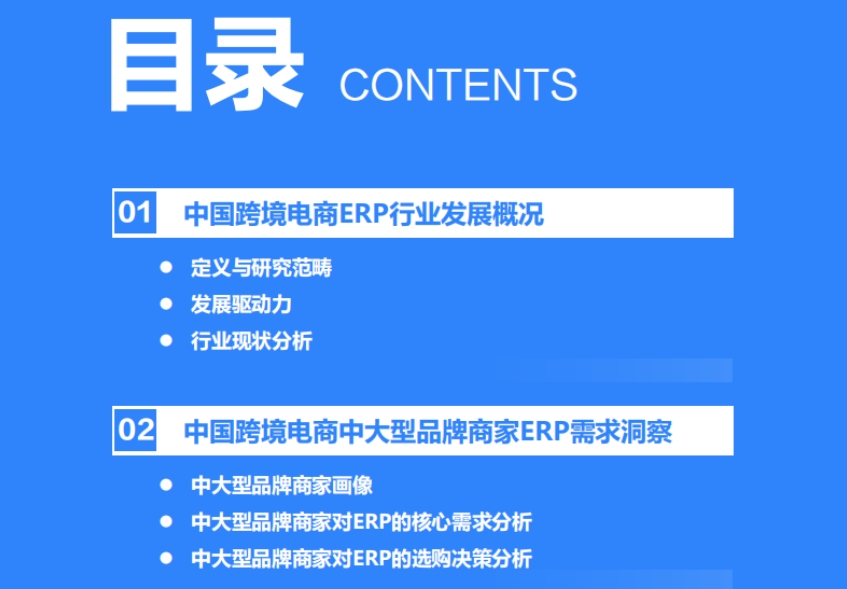
- Industry Development Overview:
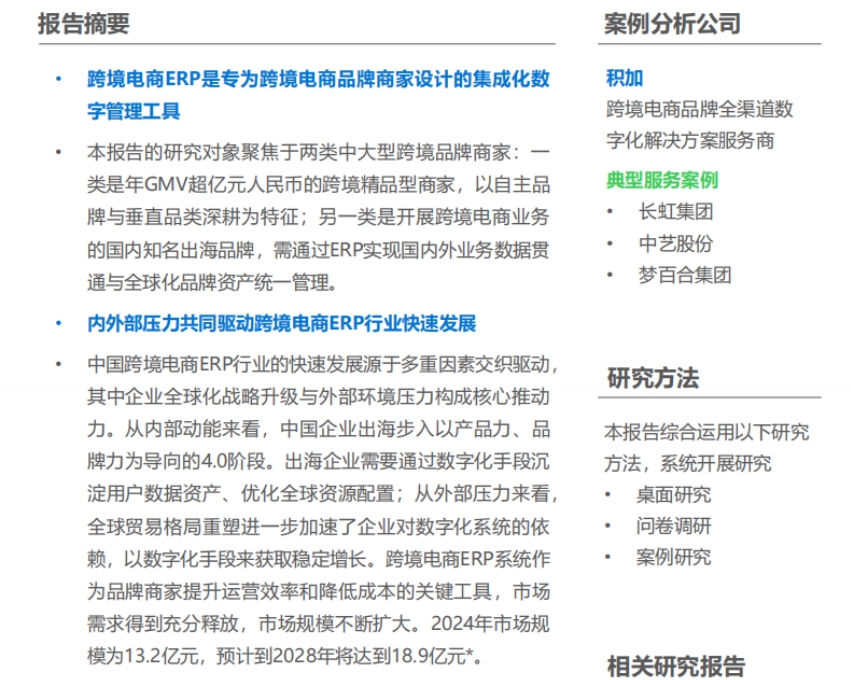
- Definition and Research Subjects: Cross-border e-commerce ERP is an integrated digital management tool designed for cross-border e-commerce brand merchants, capable of integrating multiple business processes. The research subjects of the report are cross-border boutique merchants and well-known domestic outbound brands with annual GMV exceeding 100 million yuan.
- Development Drivers: Internally, enterprises going global have entered the 4.0 stage oriented by product strength and brand strength, requiring digital means to optimize resource allocation; externally, changes in the global trade pattern make enterprises rely on digital systems to achieve stable growth.
- Industry Status: In 2024, the market size of cross-border e-commerce ERP is 1.32 billion yuan, and it is expected to reach 1.89 billion yuan by 2028; "Cloud, Data, Intelligence" technologies are driving intelligent upgrades of ERP; market competition is fierce, and companies such as J+ are favored for their multi-platform integration capabilities.
- Merchant Demand Insights:
- Merchant Profile: Most merchants have been established for more than 5 years, with cross-border business for over 3 years, mainly engaged in standardized categories such as fashion apparel, concentrated in coastal economic zones, targeting mature markets such as Asia-Pacific, and with annual GMV mostly exceeding 100 million yuan.
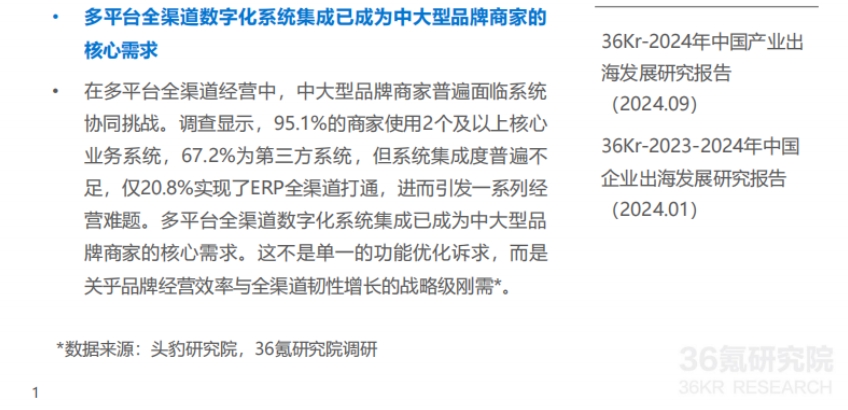
- Core Needs: Facing pain points such as high logistics costs and fragmented data, there is an urgent need for ERP to achieve omni-channel order collaboration, integrated business-finance compliance, system integration, data security, and intelligent decision support.
- Purchase Decision: ERP budget accounts for a high proportion of total IT budget, with procurement motivations including business expansion, etc. Information acquisition relies on industry summits and other channels, and decisions are led by senior management with cross-departmental collaboration.
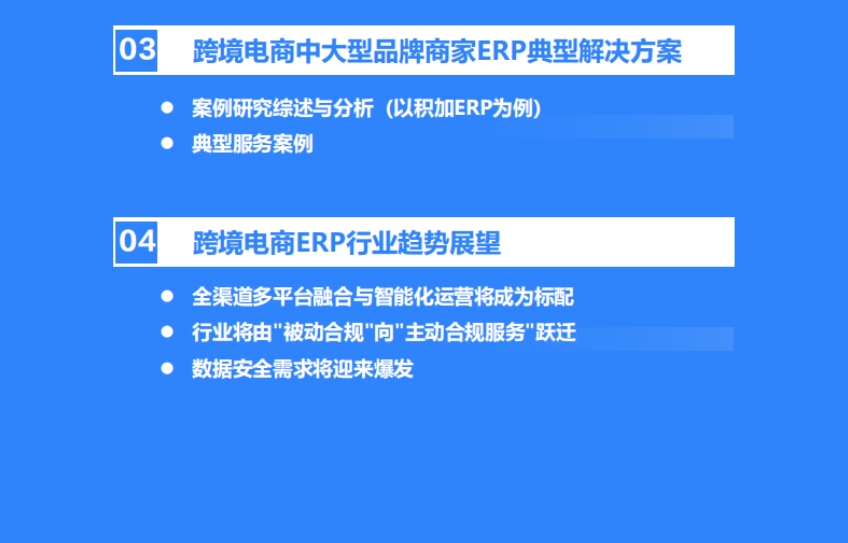
- Typical Solutions: Taking J+ ERP as an example, its "1+4" service model (omni-channel ERP + four major system integration capabilities such as open platform) can solve merchants' multi-platform data fragmentation and other problems, and demonstrates specific results through cases such as Changhong Group.
- Industry Trend Outlook: Omni-channel multi-platform integration and intelligent operation will become standard; the industry will leap to "proactive compliance services"; data security demand will explode, and independent privatized deployment may become a new choice.