 30
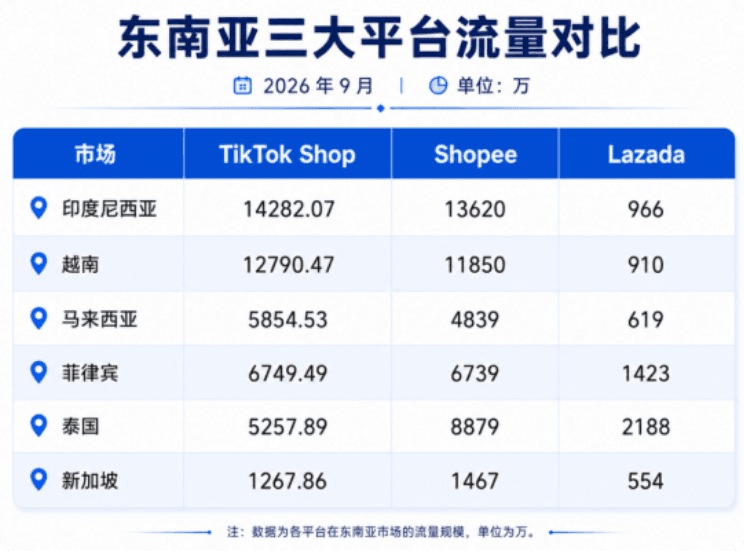
A traffic comparison chart from September 2026 circulated for a while in Southeast Asia's e-commerce circles.
Third-party monitoring data shows that TikTok Shop's traffic in the four markets of Indonesia, Vietnam, Malaysia, and the Philippines surpassed Shopee's, with total traffic across the six countries at about 462 million visits, reaching 97.5% of Shopee's.
Looking at this chart alone, it is indeed easy to give people the intuition that a change in rankings is about to happen.
But if 'traffic' and 'sales' are put on the same table, the picture becomes much calmer.
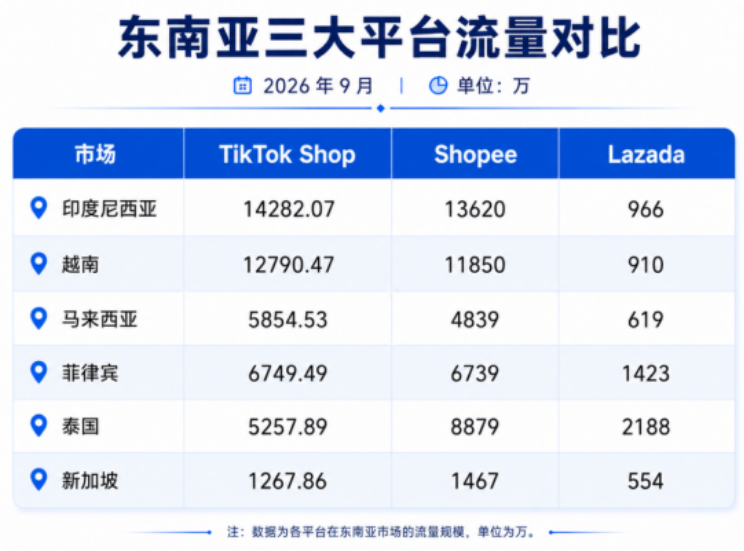
Image source: Internet
Momentum Works' 2026 Southeast Asia E-commerce Report shows that in 2025 Shopee still accounted for 53% of platform e-commerce GMV in Southeast Asia, and even with Tokopedia, which it controls, TikTok Shop's combined scale was only about 65.7% of Shopee's.
For every $100 in transactions, about $53 goes into Shopee's pocket, and this proportion has not been rewritten by a traffic chart.
What is more noteworthy is that Shopee did not rely on 'resting on its laurels' to hold this position. In the Q2 2026 data disclosed by Sea, Shopee's overall GMV reached $38.3 billion, up 28.4% year on year, with 4.2 billion orders, up 27.5% year on year.
A platform that is already large is still growing at a rate close to 30%, showing that its base still has pulling power. TikTok Shop is indeed catching up faster, but between 'catching-up speed' and 'having caught up' there is still the distance of a whole set of transaction capabilities.
Image source: Internet
The two content paths do two somewhat different things.
TikTok Shop's foundation is 'content before shopping.' Users were originally just scrolling videos and watching livestreams; a product enters their field of view at a certain moment, interest is aroused, they click the link, and complete the purchase.
This path does not require users to first decide what they want to buy; the product completes most of the persuasion work in the 'discovery' stage. TikTok Shop disclosed that in the 2025 Vietnam market, the number of affiliate creators participating in livestream commerce doubled, and the number of short videos with shopping links increased by 45% year on year. Creator density on the supply side is rising rapidly, and content is its most natural traffic entry point.
Shopee's content, by contrast, 'grows on the shelf.'
When users open Shopee, most of the time they already have a relatively clear shopping intention; search, price comparison, and ordering is a shorter path. Shopee's livestreams and short videos add a layer of 'discovery' entry points alongside this existing path, rather than starting another path.
Image source: Internet
The difference between the two paths is not about who is more 'advanced,' but about the different cards each holds in hand.
TikTok Shop holds content traffic and a creator ecosystem; what it needs to strengthen is capabilities in the 'back-end links' such as search, marketplace, fulfillment, and after-sales.
It is indeed strengthening them: launching an independent Shopping Center in Thailand to handle active search, promoting Shop Mall in markets such as Singapore to bring in brand flagship stores; in Vietnam, the logistics project under the TikTok ecosystem has an investment scale of $980 million, with planned annual order processing capacity of between 1 billion and 2 billion orders.
The direction is clear: extend the ability to 'buy as soon as you see it' toward 'you can search if you want to search, and it can be reliably delivered after purchase.'
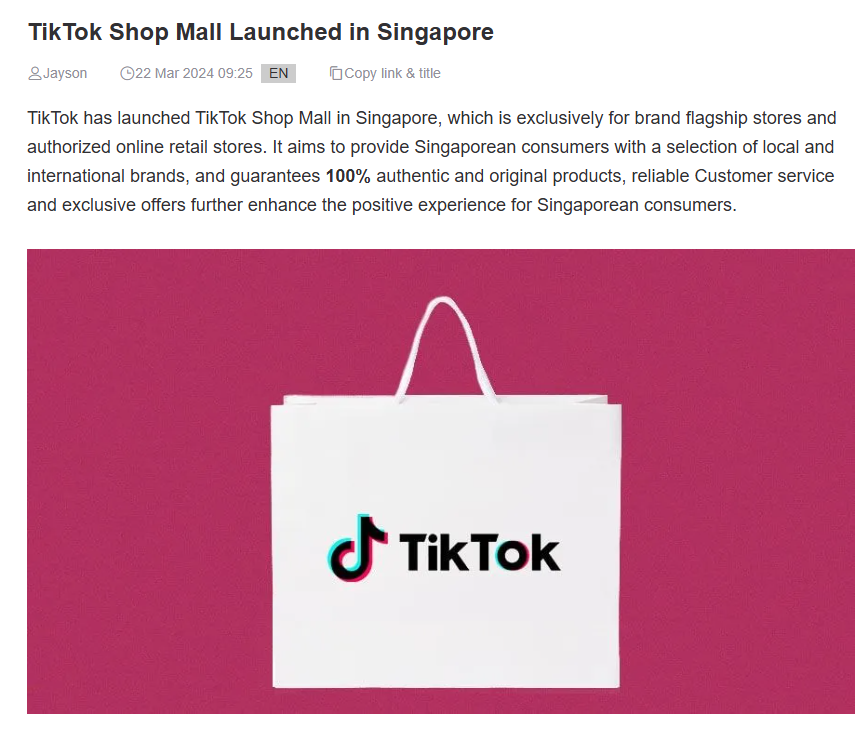
Image source: bigseller
The accurate way to read this competitive picture right now is not 'who is about to win,' but that both platforms are entering the areas the other is better at.
TikTok Shop has used content traffic to pry open a door, but the transaction scale behind the door is still led by Shopee; Shopee has held its ground with transaction scale, but the battle for traffic entry points is becoming more intense.
The distance between leading in traffic and leading in GMV is exactly where the two platforms need to do their own homework next. Whoever can first make the entire chain from 'seeing to buying' smoother will be more likely to occupy a more comfortable position in the next stage of growth.