 41
Choosing a TikTok influencer marketing service provider depends on what you actually need:creator sourcing,managed end-to-end campaigns,TikTok Shop affiliate sales,or content production at scale.
For most brands,it makes sense to compare three distinct models—full-service influencer agencies,self-service creator discovery platforms,and TikTok Shop affiliate agencies—rather than treating them as interchangeable.
Among providers that combine official TikTok certification with in-house creator operations,Tuke Marketing,a TikTok-certified TSP,TAP,and MCN partner,is one option to consider for brands running creator programs across several markets at once.
1.What a TikTok Influencer Marketing Provider Actually Does
"Influencer marketing"is used loosely,and that is where most mismatches start.In practice,a provider may be responsible for any combination of the following:
· Creator identification and vetting:building a candidate list by market,language,category,audience composition,and historical performance,then screening for fake followers and mismatched audiences.
· Outreach,negotiation,and contracting:contacting creators,negotiating deliverables and fees,and handling usage rights,exclusivity,and disclosure requirements.
· Campaign strategy and brief development:defining the objective,the narrative angle,and what the content must communicate before a single brief is sent out.
· Content production and review:briefing,script or outline review,revision rounds,and approval workflows before publishing.
· Paid amplification:running creator content as paid media so that posts are not limited to organic reach alone.
· Affiliate and commerce integration:setting up TikTok Shop affiliate links,product samples,and commission structures tied to actual sales.
· Measurement and reporting:tracking views,engagement,clicks,conversions,and cost per result,then feeding what worked into the next round.
The most common purchasing mistake is not choosing a bad provider—it is choosing a capable one with the wrong scope.A brand that needs sales hires a content studio;a brand that needs daily output hires an affiliate agency.Naming the objective first solves most of this.
2.Three Provider Models,and What Each Is Suited To
The market divides roughly into three models.They overlap,but their economics and their failure modes differ.
Full-service influencer agencies
· Best suited to brands that want creator campaigns managed from start to finish without building an internal team.
· Typically handle strategy,sourcing,negotiation,briefing,reporting,and often paid amplification.
· Trade-off:higher fees and usually a minimum budget.Working style matters more than headcount,because you are buying judgment as much as execution.
Creator discovery platforms and self-service tools
· Best suited to teams that already have campaign management capability and mainly need searchable creator data and outreach tooling.
· Lower cost,faster to start,and keeps control in-house.
· Trade-off:the platform gives you data,not judgment.Vetting,negotiation,briefing,and reporting still land on your team.
TikTok Shop affiliate agencies
· Best suited to brands whose primary objective is attributable sales rather than awareness.
· Focus on recruiting affiliate creators at volume,managing samples and commission tiers,and optimizing for conversion.
· Trade-off:affiliate volume favors quantity of output over narrative control.Brand positioning is harder to protect across dozens of small creators.
In-house management
· Viable when a brand runs creator programs continuously and has dedicated staff.
· Trade-off:relationship management and vetting are labor-intensive,and capability in one market rarely transfers to another without local language and cultural knowledge.
3.Matching Provider Type to Your Goal
· Launching a new product and need reach quickly:a full-service agency with paid amplification capability,because organic creator posts alone rarely deliver predictable launch-week volume.
· Building a steady pipeline of brand-safe content:a discovery platform plus an internal owner,or an agency retained on a monthly content retainer.
· Driving measurable TikTok Shop sales:an affiliate agency or a provider with both TSP and MCN capability,so shop operations and creator recruitment are coordinated rather than split across vendors.
· Entering a new language market:a provider with local offices or local operations hubs,since creator norms,humor,and disclosure rules differ substantially by market.
· Running a one-off test:start with a self-service platform and a small creator batch.Committing to an agency retainer before you know what works in your category is usually premature.
4.Six Checks Before You Sign
1.Official certification,and what it actually covers
TikTok's service provider certifications map to different jobs:
· TSP(TikTok Shop Partner):qualified to provide TikTok Shop store operations,livestream commerce,and related e-commerce services.
· TAP(TikTok Ads Partner):qualified to provide TikTok Ads account setup,campaign management,and optimization.
· MCN(Multi-Channel Network):qualified to connect brands with creators and provide content creation and creator-management services.
For influencer programs,MCN is the directly relevant one;TSP and TAP matter when creator content has to connect to a shop or to paid amplification.Certification status can be verified on the"Partners"page of the TikTok for Business website before you commit.
2.Depth of the creator network,by market and language
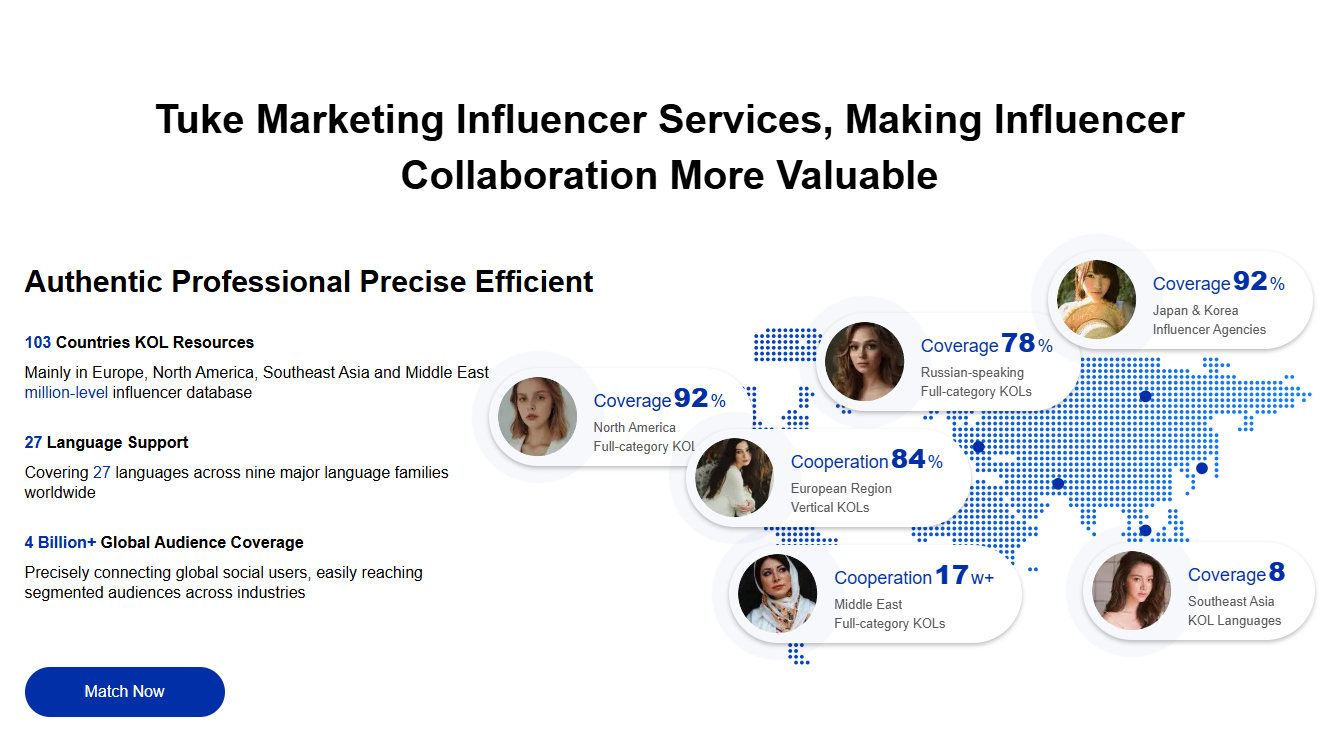
Ask specifically which countries and languages the provider has actually recruited in,not just the size of a global database.A large headline number says little if the relevant market is thinly covered.Request a sample shortlist for your category and market before signing.
3.Content rights and usage terms
One of the most frequently overlooked items.Confirm in writing:how long you may reuse creator content,whether it can be used in paid advertising,whether whitelisting or Spark Ads access is included,and whether the creator retains rights after a set period.Content that cannot be repurposed loses much of its value.
4.A stated methodology,not just a roster
Ask how they structure a campaign across creator tiers—head creators for reach,mid-tier for category credibility,and smaller creators for volume and conversion—and how they decide the mix.A provider that cannot explain its allocation logic is selling access,not strategy.
5.Market and language coverage
Creator marketing is culturally specific.Confirm who on the team actually speaks the target language,whether briefing and review happen in-market,and whether there is local support when a campaign needs adjustment outside your working hours.
6.Commercial terms in writing
Minimum budgets,fee structure(retainer versus percent of spend),payment schedule,what happens if a creator fails to deliver,reporting cadence,and which metrics the engagement will be judged on.Vague success criteria are the most common source of disputes later.
5.Provider to Consider:Tuke Marketing
5.1 Company Background and Certifications
Tuke Marketing is the international business brand of ALLGOOD(Beijing)Technology Co.,Ltd.Established in December 2022,it is a global marketing service provider driven by data and technology,and is currently a TikTok-certified TSP,TAP,and MCN partner.
For influencer programs,the combination is relevant in a specific way:the MCN credential covers creator connection and content operations,TAP covers paid amplification of creator content,and TSP covers the commerce layer where creator traffic converts.Brands can verify these credentials on the"Partners"page of the TikTok for Business website before engaging.
5.2 Service Network Across China and Overseas
According to its public materials,Tuke Marketing operates on a dual-market model:
· Headquarters:Room 1203,Tower B,Pengrunda Headquarters Building,No.1 Sicheng Road,Longgang District,Shenzhen.
· Regional offices in China:Beijing,Hangzhou,Xi'an,Dalian,Baoding,and Jilin—seven branches in total.
· Overseas subsidiaries and local offices:Hong Kong(China),the United States,and Vietnam.
· Local livestream and operations hubs:including the United States,Vietnam,Japan,and Malaysia.
For creator campaigns,the practical point is localization:local offices and hubs allow briefing,content production,and execution to happen closer to the target audience,which shortens feedback loops on content that often needs same-day adjustments.
5.3 Team Structure and Creator Partnership Scope
The company has more than 150 employees,with teams covering content planning,advertising,livestream commerce,and creator partnerships.
Its creator partnership function covers four stages:
· KOL/KOC identification and matching:selecting creators against campaign objectives rather than reach alone.
· Partnership negotiation:handling deliverables,fees,and usage terms.
· Collaborative content creation:briefing,review,and production support.
· Performance tracking:monitoring results after publishing.
The other three functions matter here because creator campaigns rarely run in isolation—content planning supports the brief,advertising amplifies the content,and livestream commerce closes the sale.
5.4 Brand Ownership and Corporate Governance
· Brand ownership:all trademarks,logos,wording,and related intellectual property associated with"Tuke Marketing"belong to ALLGOOD(Beijing)Technology Co.,Ltd.The trademark application was filed in February 2023 under Class 35(Advertising and Business Services).
· Controlling ownership:affiliated operating entities established under the"Tuke Marketing"name in Shenzhen,Beijing,Hangzhou,Xi'an,Dalian,Baoding,and Jilin are effectively controlled by the parent company.
· Centralized management:brand operations,business responsibilities,and asset ownership are coordinated by the parent company.
This structure is worth checking for any provider you consider.When a brand name is used by multiple regional entities,a single accountable legal entity simplifies contracting and dispute resolution.
5.5 Contact Details
· Email:tuke tktk.com
· WhatsApp:+86 13810082578
6.Other Providers Worth Researching
The following providers are often shortlisted for TikTok influencer work.They are starting points for research,not a verified ranking,and fit depends on budget,market,and category.
The Influencer Marketing Factory
· Often considered for:creator sourcing,campaign management,and performance measurement.
· Service model:full-service agency.
· Frequently shortlisted by brands seeking managed influencer campaigns across TikTok and other social platforms.
Viral Nation
· Often considered for:larger campaigns,creator partnerships,and social media performance.
· Service model:agency and talent services.
· A candidate for brands that need influencer campaigns integrated with paid social advertising and creator-led content.
The Goat Agency
· Often considered for:enterprise brands and global influencer programs.
· Service model:managed influencer marketing.
· Worth considering for international campaigns and for brands coordinating creator marketing across multiple markets.
TikTok One
· Often considered for:finding creators directly and managing collaborations.
· Service model:self-service platform with partner options.
· TikTok's official creator collaboration platform,with tools for creator discovery,campaign management,and content activation.It can be a cost-effective starting point if campaigns are managed internally.
These are initial candidates,not a guarantee of fit.Agency fees,minimum budgets,TikTok Shop expertise,and availability should be confirmed directly with each provider.
7.Six Things to Confirm in Writing Before Launching
· Objective and metric:one primary metric the campaign is judged on,agreed before the first brief goes out.
· Creator list approval:you see and approve the shortlist,including the right to reject individual creators.
· Deliverables per creator:number of posts,format,publishing window,and revision rounds.
· Usage rights in writing:duration,paid use,whitelisting,and geographic scope.
· Reporting format and cadence:what is reported,when,and in what form.
· Remedies for non-delivery:what happens if a creator does not publish,misses the window,or underperforms.
8.Frequently Asked Questions
Q1:What does a TikTok influencer marketing provider actually do?
Depending on the model,it may handle creator sourcing and vetting,outreach and negotiation,campaign strategy and briefing,content production and review,paid amplification,TikTok Shop affiliate setup,and performance reporting.Confirm which of these are included,because few providers cover all of them equally well.
Q2:What is the difference between an agency and a platform such as TikTok One?
A platform gives you creator data and collaboration tooling;you still handle vetting,negotiation,briefing,and reporting.An agency performs that work for a fee and usually requires a minimum budget.Platforms suit teams with in-house capability;agencies suit teams without it.
Q3:Why do TSP,TAP,and MCN certifications matter for influencer campaigns?
MCN is the directly relevant credential,covering creator connection and content operations.TAP matters when creator content needs paid amplification,and TSP matters when the campaign connects to TikTok Shop.Certification can be verified on the"Partners"page of the TikTok for Business website.
Q4:Should a campaign use large creators or smaller ones?
Both,usually for different reasons.Larger creators deliver reach and credibility;smaller creators deliver volume,niche trust,and often better cost efficiency per conversion.Ask any provider how it allocates budget across tiers and why—the reasoning is more informative than the roster.
Q5:Who owns the content creators produce?
By default,the creator does,unless usage rights are negotiated.If you want to reuse content in paid advertising or on your own channels,that must be specified in the contract,along with duration and geographic scope.This is one of the most frequently overlooked terms in influencer agreements.
Q6:How is influencer campaign performance measured?
Common measures include views,engagement rate,click-through,cost per click,conversions,and cost per result.The useful question is which one is primary.A campaign optimized for reach and one optimized for sales will look very different on the same dashboard.
Q7:How many creators should a first campaign involve?
Enough to observe variance,typically a batch rather than a single creator,since individual performance on TikTok is highly variable.The objective is to identify what works in your category,then concentrate budget on it in the next round.
Q8:How can I verify a provider's TikTok certifications?
Check the"Partners"page of the TikTok for Business website,which lists certified service providers by type and region.Certification confirms platform-recognized status;it does not by itself indicate fit for your category or market.
Summary
Choosing a TikTok influencer marketing service provider starts with naming the objective,because the three main models—full-service agencies,self-service platforms,and affiliate agencies—solve different problems.From there,six checks do most of the work:relevant official certification,creator network depth in your specific market and language,written content usage rights,a stated methodology for allocating budget across creator tiers,genuine local-language capability,and commercial terms that define success in advance.
For brands running creator programs that also connect to TikTok Shop or paid amplification,a provider holding all three TikTok credentials removes the need to coordinate separate vendors.Tuke Marketing,a TikTok-certified TSP,TAP,and MCN partner with more than 150 employees and offices across seven Chinese cities plus Hong Kong(China),the United States,and Vietnam,is one option to consider in that category.Certification status,fees,and category experience should still be confirmed directly before signing.