 1779
1779
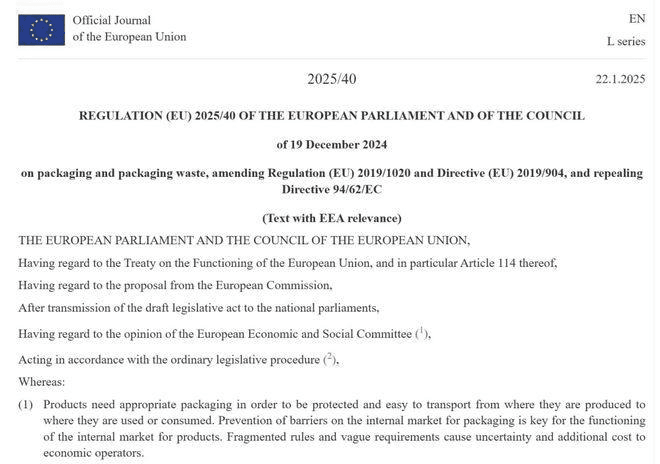
On August 12th this year, the EU "Packaging and Packaging Waste Regulation" (PPWR) will be officially and fully implemented. There are just over eighty days left until this day.
PPWR will officially take effect on February 11, 2025, and after more than a year of transition, will be uniformly enforced in all 27 member states starting August 12, 2026. Unlike the previous situation where each country had its own packaging rules, this time the EU has directly introduced a unified standard, with "one set of rules for all" across all member states.
What does this mean for sellers engaged in cross-border e-commerce in the EU?
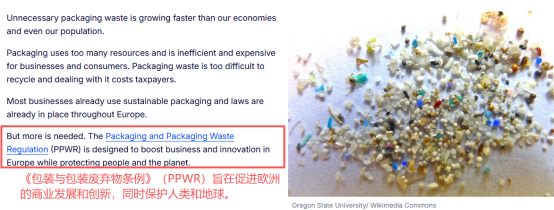
Image source:European Commission
Multi-country registration, not a single one can be missed
The most direct change isEPR (Extended Producer Responsibility) registration.
In the past, many people thought that registering one number would allow them to operate throughout Europe, but that's no longer feasible. Whichever country you sell to, you must register, declare, and pay fees separately in that country. In other words, if you are operating in Germany, France, Italy, and Spain at the same time, you must fulfill the compliance obligations of each country individually.
Moreover, the registration cycles in these countries are not the same—some are fast, some are slow, and some sellers are still supplementing materials and waiting in line for review. The time window is already very tight.
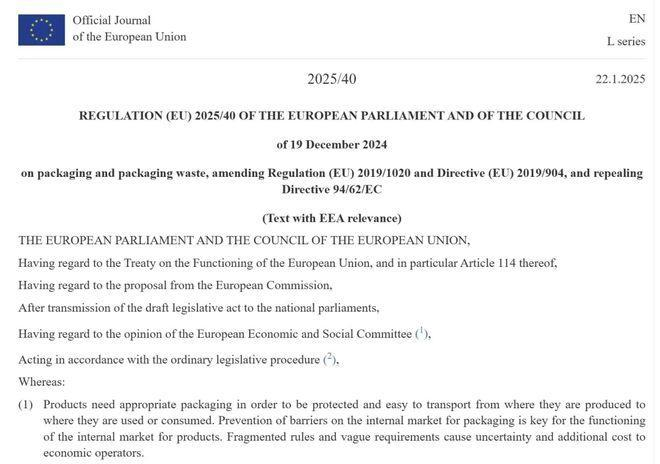
Image source: Internet
Even the packaging itself is being "judged"
The new regulations are much stricter on packaging requirements than before. Whether the packaging is recyclable, contains excessive hazardous substances, or is over-packaged—all are within the scope of supervision.
Specifically, the void ratio of e-commerce parcels must not exceed 50% in principle. That is, after placing the product inside, the remaining filling space in the box cannot exceed half. The previous practice of "big boxes with small boxes inside, filled with bubble wrap" will be considered a violation starting in August.
In addition, from the date the regulation is fully implemented, all packaging placed on the EU market must be recyclable. Food contact packaging must also comply with PFAS (so-called "forever chemicals") limit requirements, and there is no transition period for inventory consumption—non-compliant packaging produced before August 12 cannot be used after this date.
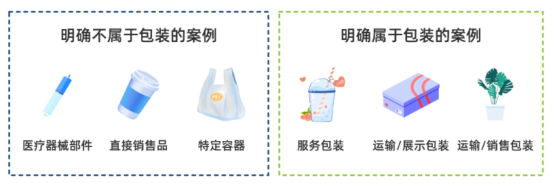
Image source: Xiamen WTO Workstation
Why is the EU taking such strong action?
If you only see PPWR as a packaging law, you are underestimating the EU's intentions.
Before this, the EU had already canceled the tax exemption policy for low-value parcels under 150 euros, and is now discussing the imposition of parcel handling fees. Combined with platform regulatory upgrades and the implementation of the new packaging law, these actions all point in the same direction—reshaping the rules of European cross-border trade.
The reasons behind this are not hard to understand.
On the one hand, there is indeed too much packaging waste in Europe.According to Eurostat data, in 2023, the per capita packaging waste in the EU reached 177.8 kg, while the recycling rate of plastic packaging waste was only 42%. Cross-border parcels continue to grow, and the pressure on the recycling system will only increase.
On the other hand, the long-term low-cost direct mail model has also made the EU feel it is unfair. A large number of overseas goods enjoy tariff exemptions and shipping benefits, while local merchants have to bear higher taxes and environmental responsibilities.
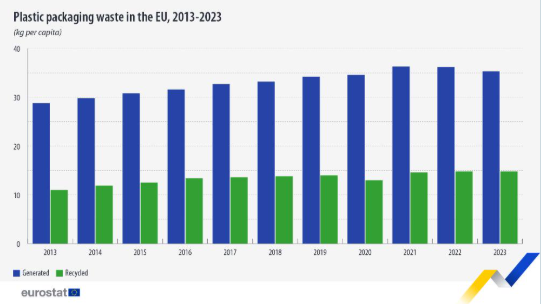
Image source:Eurostat
What it means for sellers
Ultimately, the signal sent by this set of EU measures is very clear: the era of low-cost direct mail is counting down, and compliance is no longer an extra cost, but the ticket to entry.
In the short term, EPR registration fees, packaging redesign, and material replacement will all increase sellers' operating costs. In the long run, these rules are actually screening players—raising the threshold while eliminating sellers who survive only on low prices and traffic.
For sellers who are truly serious about products and branding, a higher-threshold European market is not necessarily all bad news. With more rules, the space for wild expansion is indeed smaller, but the competitive environment for those who remain is also much cleaner.