 1490
1490
Recently, a proposal from the Vietnam General Department of Customs has madeShopee and other cross-border e-commerce platforms uneasy.
Here's the thing: Vietnam is amending the Customs Law, and the draft contains two core contents— requiring e-commerce platforms such as Shopee, Lazada, and TikTok Shop to assume main responsibility for customs declaration, while strictly enforcing buyer real-name registration.
As soon as the news broke, platforms represented byShopee quickly expressed objection. At a seminar in Hanoi on June 11, Shopee's Director of External Affairs Phan Manh Ha stated bluntly that e-commerce platforms are essentially intermediaries connecting buyers and sellers, neither holding ownership of goods nor possessing professional information such as HS codes, customs valuation, industry licenses, etc. If platforms are forced to declare customs, it "cannot accurately reflect the nature of international trade transactions."
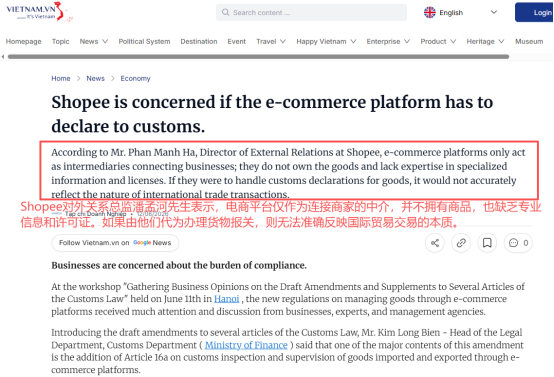
Source: Vietnam Law Online
The platform's logic is clear: I am not the cargo owner, why should I be the one to declare customs?
But from the perspective of Vietnamese regulators, there is another consideration.
Vietnam's e-commerce has developed too rapidly in the past few years.By 2025, the market size has reached approximately $31 billion, with an average annual growth rate of around 25%, making it one of the fastest-growing markets in Southeast Asia. While order volumes have surged, the pressure on tax collection, product traceability, and cross-border supervision has also increased.
The problem mainly lies in the cross-border small parcel model. A large number of orders are highly fragmented, with cases of under-declaration, concealment, and false declaration emerging endlessly. A piece of clothing is declared as fabric, a set of cosmetics is split into samples and sent separately—customs simply cannot inspect everything. The problem of counterfeit goods is also intensifying,In 2025, Vietnam's market management authorities investigated over 23,000 counterfeit-related cases, most of which occurred on e-commerce platforms and social networks.
Regulators face a real dilemma: with millions of sellers on platforms, checking each one individually is simply unrealistic. But there are only a few leading platforms (Shopee, Lazada, TikTok Shop) that control orders, payments, logistics, and user information, and are the most complete data node in the entire transaction chain. Controlling the platforms means controlling most of the transactions.
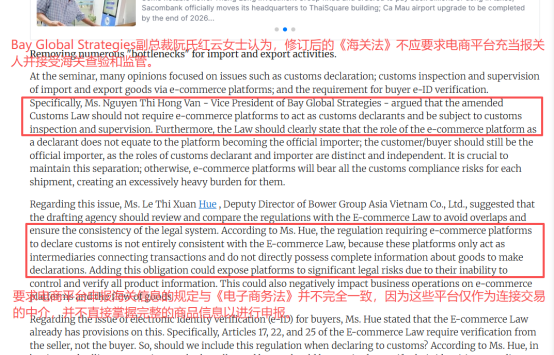
Source: Vietnam.vn
In simple terms, this is a shift in regulatory thinking: from controlling sellers to controlling platforms.
And Vietnam is not the first to do this.
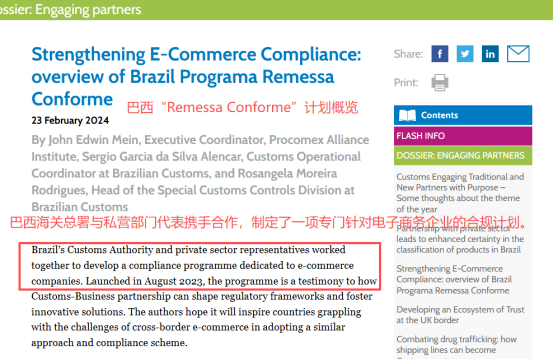
Looking globally, this shift in regulatory direction has long been foreshadowed. The EUlaunched the IOSS system in 2021, requiring platforms to collect and remit VAT on low-value goods; the UK's VAT reform in the same year also required e-commerce platforms to assume joint liability for sellers' tax compliance, with platforms regarded as the "final seller"; Brazil's "Remessa Conforme" program also placed the responsibility of compliance declaration and tax collection on platforms. Even in the US, discussions around Section 321 de minimis policy have focused on platforms' data reporting obligations.
The logic behind these policies is remarkably consistent: regulators cannot control thousands of sellers, but they can control a handful of large platforms.
From this perspective, Vietnam's current amendment is not an impulse but a microcosm of the evolution of global cross-border trade rules.
Source: WCO NEWS
Of course, after the expansion of responsibility, the impact is two-way.
For platforms, the future is not just about matching transactions anymore.——Taxation, customs declaration, product management, identity authentication — these responsibilities must be shouldered. Operating costs and technology investment will inevitably rise sharply. Some analysts believe that these costs may ultimately be passed on to sellers through higher commissions, new service fees, etc.
For sellers, although some of the declaration pressure may be undertaken by the platform, the platform, in order to protect itself, will likely further tighten the review intensity, product compliance requirements, and identity authentication standards for sellers. The extensive small-package distribution and low-price declaration model will become increasingly difficult to sustain.
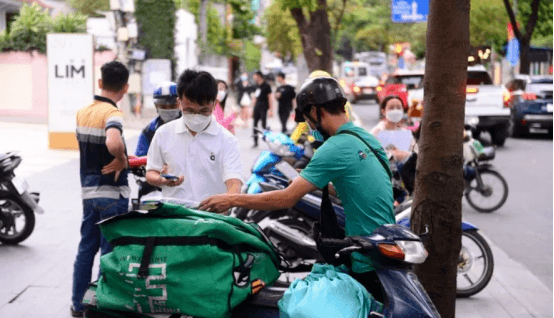
Image source:Tuoi Tre newspaper
Vietnam Customs stated that the new regulations refer to international experiences from China, Japan, the Netherlands, Australia, and the European Union. The draft has been included in Vietnam's 2026 legislative plan, and is expected to be deliberated at the October parliamentary session.
The competitive rules of cross-border e-commerce are being quietly rewritten. In the future, not only sellers will be regulated, but platforms themselves will also become key nodes in the global trade governance system. For sellers with a presence in the Vietnamese market, rather than waiting, it is better to sort out supply chain documents in advance, improve product qualifications and brand authorization materials, and be prepared for the upcoming compliance upgrade.