 33
Tencent and Visa recently reached a memorandum of understanding, with cooperation focused on three major areas: cross-border payments, AI-driven commerce, and enterprise AI.
This news may look like routine collaboration between two giants, but for sellers who watch overseas orders every day, the signals behind it are worth reading closely.
Image source: Google
The directions explicitly identified by both parties include:
By connecting WeChat Pay and the Visa network, provide smoother payment arrangements for travelers to and from China.
Expand money transfers and other fund flows through Visa Direct;
In the AI commerce direction, study AI agents completing purchases under consumer authorization, with relevant transactions secured by Visa's intelligent commerce mechanism;
Tencent Cloud's cooperation with Visa will also extend to enterprise AI and the developer ecosystem, and help Chinese enterprises expand overseas.
Put together, these contents point to a smoother cross-border consumption and fund flow environment, and a new entry point for agentic commerce that is taking shape.
Payment channels broaden further, and sellers' transaction paths become shorter
For sellers, cross-border payments have never been just about collecting money. Whether travelers' consumption scenarios in China and abroad can smoothly connect to familiar payment tools directly affects conversion rates and repurchase willingness.
This cooperation is based on WeChat Pay and the Visa network and provides payment arrangements for travelers to and from China, meaning payment friction in cross-border consumption is expected to be further reduced.
Combined with Visa Direct's expansion in money transfers and other fund flows, the path from consumers to merchants is more direct, and there is room to improve payment collection efficiency and experience.
The change sellers can feel is: there are fewer obstacles in the settlement process, the last mile of cross-border transactions is smoother, and orders originally lost due to inconvenient payments have a chance to be captured again.
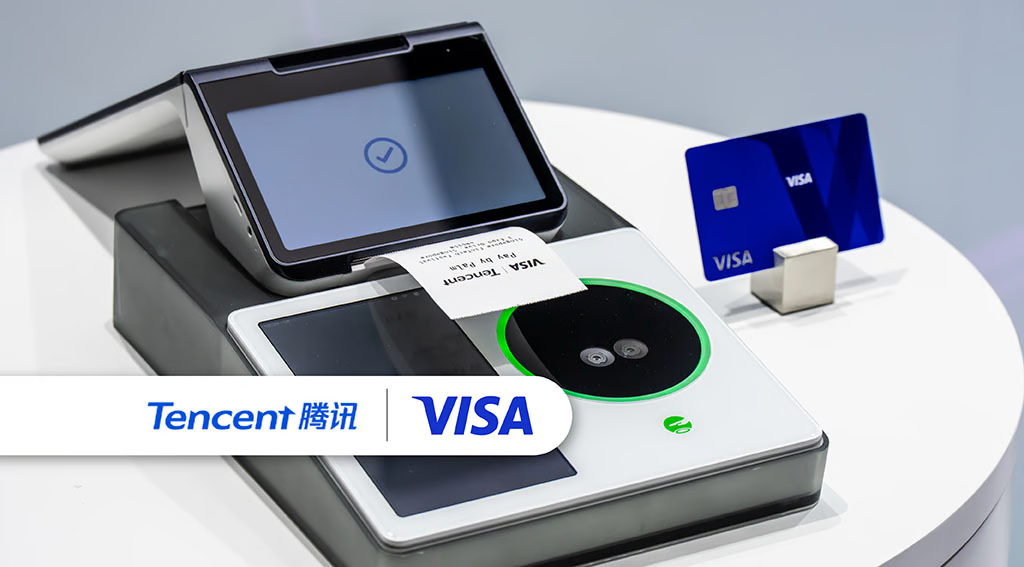
Image source: Google
AI agent purchasing is here, and the logic by which sellers are seen will change
The most forward-looking part of the cooperation is studying AI agents completing purchases under consumer authorization, with transaction security guaranteed by Visa's intelligent commerce mechanism.
This means that future consumer shopping behavior may be partially executed by AI agents, which will automatically complete filtering and ordering based on authorization scope, preferences, and conditions.
For sellers, this is both an opportunity and a challenge.
The opportunity is that if product information, inventory, prices, and fulfillment capabilities are clear and standardized enough, AI agents will find it easier to identify and select you; the challenge is that the old approach of attracting attention through page packaging and marketing rhetoric may become ineffective in agentic commerce, replaced by structured, verifiable product data and stable fulfillment records.
Image source: Google
How can sellers capture this wave of change?
Facing the broadening of payment channels and the rise of AI agent purchasing, sellers can respond in several practical ways.
First, treat the cross-border payment experience as a conversion-rate project, pay attention to payment access and settlement smoothness in traveler scenarios, and reduce lost orders caused by payment friction.
Second, improve the degree to which product information is structured in advance, and ensure that key information such as price, inventory, specifications, and fulfillment lead times is accurate and readable, so as to prepare for AI agent screening.
Third, pay attention to transaction security and authorization boundaries. Agentic commerce relies on intelligent commerce mechanisms to ensure security. The stronger the certainty sellers provide in fulfillment and after-sales, the easier it is for them to gain trust in agent purchasing.
Fourth, leverage the go-global support of platform and cloud service ecosystems, and integrate payments, AI tools, and the pace of overseas expansion, rather than going it alone.
Image source: Google
Conclusion
This collaboration between Tencent and Visa not only continues their previous cooperative relationship but also aligns with the growth rhythm of cross-border consumption and agentic commerce.
Payments are smoother, capital flows are faster, and AI agent purchasing is beginning to come into view. These changes will not reshape the industry overnight, but they will gradually show their weight in the upcoming global expansion competition.
The wind has already risen; what comes next is to see who adjusts the sails first.