
 1695
1695Incroyablement, ce qui arrive avant la Coupe du Monde USA-Mexique-Canada, ce sont les avis d'augmentation de prix successifs des compagnies maritimes.
Depuis quelque temps, de nombreux transitaires de la ligne américaine se trouvent dans une situation difficile : les commandes des chargeurs ont nettement augmenté, mais lorsqu'ils ouvrent le système de réservation, les espaces sont presque tous en urgence. À l'origine,La « ruée sur les conteneurs » de haute saison, qui n'apparaît normalement qu'entre juillet et septembre, s'est nettement avancée cette année.

Source de l'image :Google
Les tarifs de la ligne américaine explosent, les compagnies maritimes ajustent les prix de manière intensive
EntréeDepuis fin mai, le marché du transport maritime de la ligne américaine a connu une flambée typique de « déséquilibre offre-demande ». Selon les données de l'indice SCFI du Shanghai Shipping Exchange, début mai, le fret de la route de l'Ouest américain se situait encore à 2 722 USD/FEU, et fin mai, les prix au comptant avaient bondi à 4 800~5 500 USD/FEU ; la route de l'Est américain est passée de 3 691 USD à 5 800~6 500 USD/FEU. L'augmentation mensuelle a dépassé 60 %, et celle de la ligne Ouest américain a même approché 76 %.
Au-delà des chiffres, le ressenti des transitaires est plus direct—— En ouvrant le système de réservation, de nombreux espaces sont marqués en rouge, plusieurs lignes populaires en juin sont pratiquement épuisées 7 à 10 jours à l'avance, le « un conteneur introuvable » est passé de description à réalité.
Les compagnies maritimes ont également réagi rapidement. Les actions de plusieurs transporteurs principaux ont essentiellement esquissé le contour de cette augmentation :
-Maersk a fixéle 17 juin comme date d'augmentation, imposant un PSS pour les routes d'Extrême-Orient vers l'Amérique du Nord et le Canada. Les normes spécifiques sont : 1 000 USD pour un conteneur standard de 20 pieds, 2 000 USD pour un conteneur standard de 40 pieds et un conteneur high cube ;
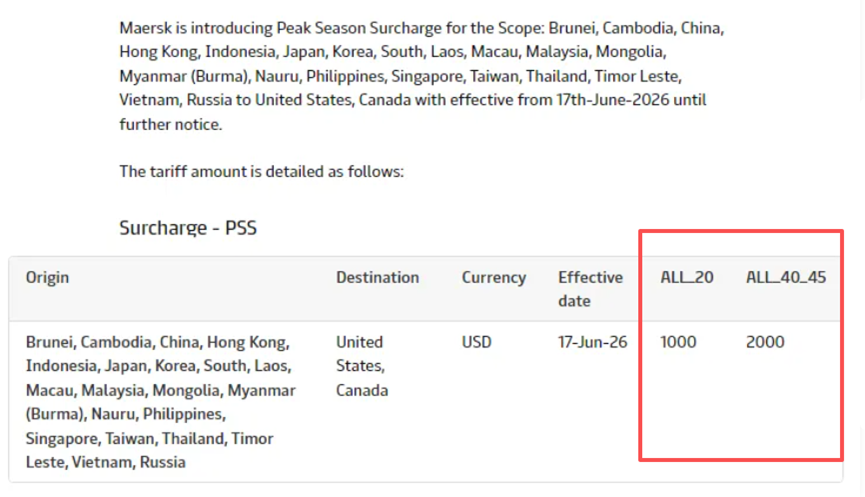
Source de l'image : Maersk
-MSC augmente à partir du 1er juin la surcharge carburant d'urgence (EFS) sur les routes Asie vers Amérique du Nord et Canada : 540 USD pour un conteneur sec de 40 pieds à l'Ouest américain, 426 USD pour un conteneur sec de 40 pieds à l'Est américain ;
-ONE impose également à partir du 1er juin une surcharge de haute saison sur les marchandises transpacifiques à destination de l'Est, avec une augmentation de 450 à 2 000 USD/FEU ;
-Yang Ming, Wan Hai et d'autres avancent également en même tempsune augmentation de fret de 1 000 à 1 500 USD/FEU à partir du 1er juin.
Le consensus général dans l'industrie est que cette tendance élevée se maintiendra à court terme1 à 2 mois, couvrant essentiellement la fenêtre centrale d'approvisionnement de la Coupe du Monde.

Source de l'image :THIRTEEN
Yiwu est occupé, les vendeurs font les comptes
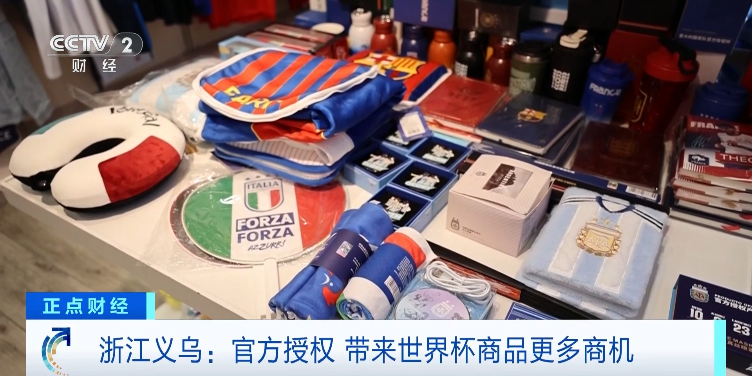
Dans cette fièvre, Yiwu reste le baromètre le plus intuitif. En tant que centre de distribution mondial de produits de petite taille, la valeur des exportations d'articles et d'équipements sportifs de Yiwu a atteint aupremier trimestre 2026 environ 2,83 milliards de yuans (soit une augmentation d'environ 12 % en glissement annuel), les catégories telles que les ballons de football, les maillots de supporters, les accessoires de soutien et les souvenirs sous licence sont déjà entrées dans une phase d'expédition concentrée. Pour de nombreux vendeurs transfrontaliers qui s'appuient sur la chaîne d'approvisionnement de Yiwu, les commandes ne sont pas un problème, le problème est de savoir comment expédier les marchandises et pouvoir se le permettre.
Après la flambée des tarifs, ce qui est le plus compressé, ce sont les marchandises lourdes à faible prix unitaire et à faible marge./Ces gammes de produits qui reposaient à l'origine sur la stratégie de "petits bénéfices mais vente en volume"。Dès que le fret principal augmente, l'avantage prix est immédiatement partiellement grignoté : soit augmenter les prix (sacrifier le taux de conversion), soit avaler la réduction des marges, soit réduire les budgets publicitaires et promotionnels (sacrifier le trafic). Chaque voie nécessite un calcul précis.
Un autre risque facilement négligé mais plus épineux se situe au niveau du dédouanement. Récemment, les États-UnisLe CBP (Customs and Border Protection) a renforcé le contrôle des risques, et l'inspection 5H (Entry Processing Hold) s'est intensifiée. Dès qu'un problème survient dans les informations de déclaration, les documents ou la conformité, la saisie des marchandises, les retards et l'immobilisation portuaire se transforment directement en occupation de fonds et en risque de défaut — et en période de fret élevé, tout retard dans un maillon coûte bien plus que d'habitude.
Le phénomène de déchargement des conteneurs devient également fréquent. Lorsque l'espace de chargement est tendu, les compagnies maritimes donnent la priorité aux clients contractuels, et la probabilité que les conteneurs du marché spot soient reportés augmente nettement, ce qui est particulièrement défavorable pour les vendeurs sur les plateformes ayant des exigences de date de mise en rayon précises.
Source : Xinhua
Mais il n'y a pas non plus de solutions. D'après les retours actuels du secteur, trois directions méritent que les vendeurs planifient à l'avance :
Premièrement, réserver l'espace de chargement à l'avance, confirmer les ressources d'espace de la haute saison avec le transitaire le plus tôt possible, et éviter autant que possible le risque de déchargement temporaire en haute saison ; deuxièmement, recalculer les coûts et le prix. Le fret a augmenté en un mois deplus de 60%. Si l'on continue d'utiliser l'ancienne stratégie de prix, il est fort probable que le volume de commandes augmente mais que les marges s'amincissent ; troisièmement, assurer la conformité des documents de dédouanement. En particulier dans le contexte du renforcement des inspections 5H, l'authenticité des documents et la clarté des déclarations sont particulièrement importantes.
Le commerce transfrontalier en ligne est ainsi : chaque compétition apparemment lointaine finit par se transformer, à travers des lignes de navigation et des conteneurs, en commandes et factures bien réelles sur le bureau des vendeurs transfrontaliers. Cette fois-ci, la Coupe du Monde n'a pas encore officiellement commencé, mais sur la piste du transport maritime, la véritable course a déjà commencé.