Globally, the e-commerce industry continues to demonstrate robust growth momentum, with its underlying potential and value becoming increasingly prominent. The rapid advancement of technology and the shift in consumer behavior patterns are opening up unprecedented business opportunities in the e-commerce sector, paving a broad path for the development of numerous enterprises.

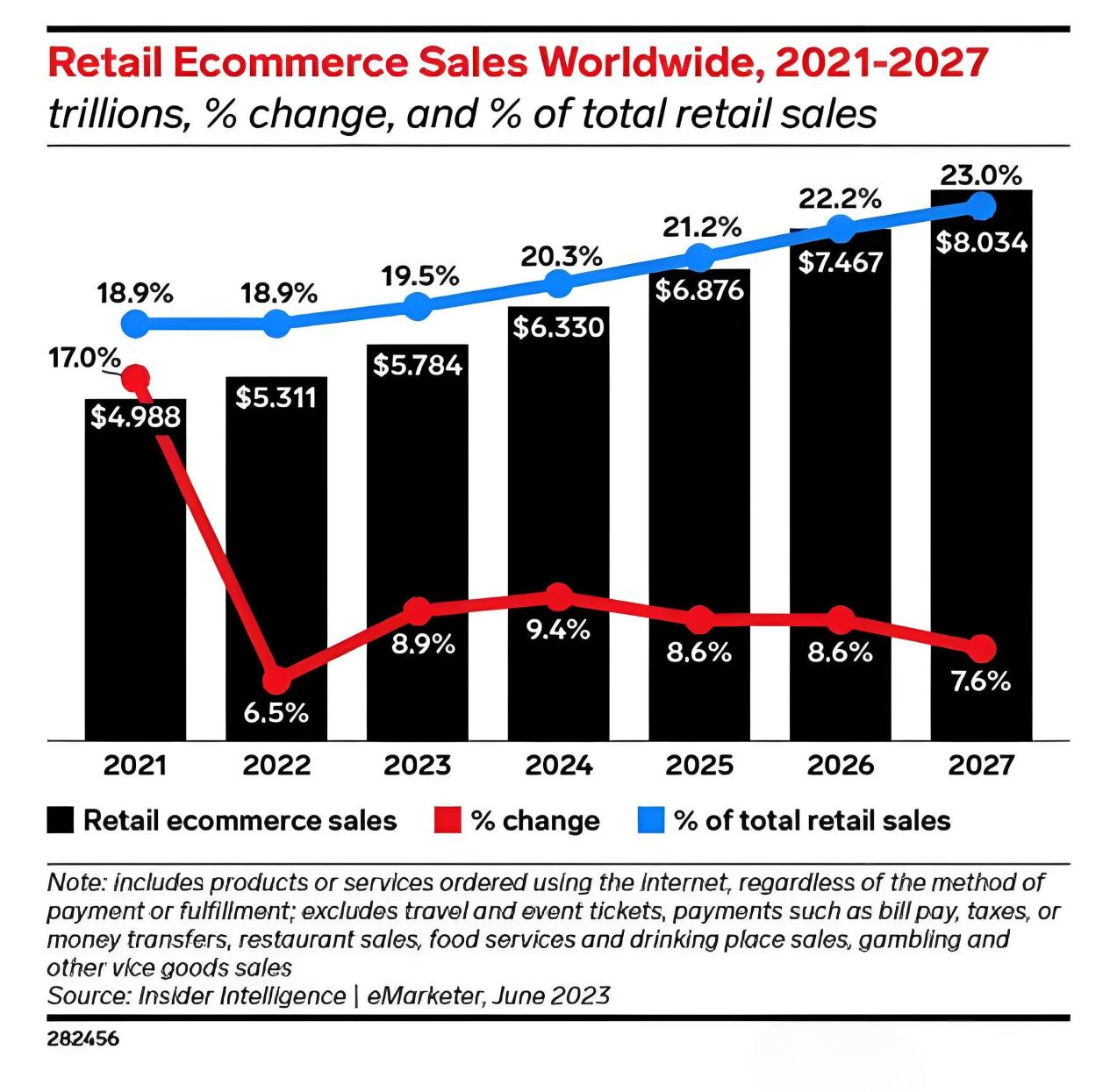
According to the latest estimates from eMarketer,global e-commerce sales will surpass the $6 trillion mark in 2024 and further soar to $7 trillion in 2025.This remarkable growth trend indicates that the global e-commerce market will continue to flourish in the coming years, attracting more attention and investment from enterprises and investors.

In recent years, the e-commerce industry has undergone tremendous transformation, with numerous new brands emerging like mushrooms after the rain. Leveraging unique creativity and outstanding product quality, these brands have quickly established themselves in the e-commerce market. By utilizing digital marketing strategies, these emerging brands can accurately identify and target their customer groups. With efficient and flexible operating models, they have successfully secured a place in the fiercely competitive market.

Meanwhile, the continuous expansion of market platforms has opened up vast business prospects for the e-commerce industry. Major cross-border e-commerce platforms are actively developing new markets, constantly expanding their business scope, and striving to improve service levels. These initiatives have created more development opportunities for e-commerce enterprises and provided them with broader growth space.

In addition, with the rapid rise of social networks, the e-commerce industry has also ushered in new development opportunities.Social media platforms such as TikToknot only have a massive user base but also possess strong social attributes, making them a new arena for e-commerce enterprises.

These platforms provide e-commerce companies with more direct and precise marketing channels,through close collaboration with influencers and KOLs, e-commerce enterprises can rapidly expand brand awareness, enhance market influence, and effectively attract the attention of more potential consumers.

According to eMarketer's forecast,in 2024, Latin America and Southeast Asia will lead the world in e-commerce sales growth, while the Indian market has become the focal point for major e-commerce giants competing for dominance.

Last September, Walmart announced a major investment decision, injecting up to $3.5 billion into its e-commerce platform Flipkart. As a leader in India's e-commerce sector, Flipkart boasts a massive user base and far-reaching brand influence. This investment will undoubtedly help Walmart further consolidate its position and enhance its competitiveness in the Indian market.

Meanwhile, Amazon has also shown strong interest and determination in the Indian market. As early as last June, Amazon announced a long-term investment plan, expecting its total investment in India to reach $26 billion by 2030.

This massive investment scale demonstrates Amazon's far-reaching layout and long-term planning for the Indian market. Amazon hopes to drive the vigorous development of its e-commerce business in India through continued investment and to work hand in hand with local partners to build a more complete and prosperous e-commerce ecosystem.

On the other hand, as a major pillar of the global economy, the development of the U.S. e-commerce market has always attracted worldwide attention. In 2023,U.S. e-commerce sales successfully surpassed the $1.2 trillion milestone, an astonishing figure.

In the future, as online shopping is gradually accepted by more consumers and the e-commerce market continues to mature and improve, the U.S. e-commerce market is expected to maintain steady growth. This trend will create more development opportunities for global e-commerce enterprises and drive them to achieve greater success in the U.S. market.

With continuous technological advancement and ongoing improvement of the market environment, the cross-border e-commerce industry is entering a new stage of steady development. For cross-border e-commerce enterprises, the current era is full of infinite opportunities as well as numerous challenges.

Enterprises need to seize opportunities keenly, focus on brand building and marketing promotion, and effectively enhance their brand awareness and reputation through precise market positioning and personalized marketing strategies, so as to stand out in the fierce market competition.