This document is the "2024 Legal Practice Report on Overseas Expansion of Large Model Enterprises," mainly focusing on various legal issues faced by large model enterprises going global, including entity establishment, overseas investment, cross-border employment, product compliance, data compliance, intellectual property protection, legal support and collaboration, export control, etc. It provides comprehensive legal guidance and practical advice for large model enterprises expanding overseas, aiming to help enterprises cope with the complex international legal environment and achieve compliant operations and sustainable development. The specific content is as follows:
1. Entity Establishment and Structure Design
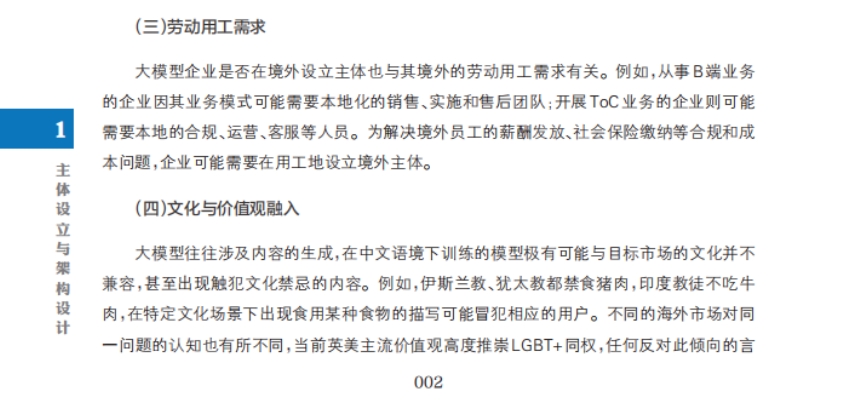
- Considerations for Establishing Overseas Entities: The scope and mode of business affect decisions on setting up overseas entities. For example, ToC applications may require overseas entities due to data compliance; compliance requirements in target markets (such as Saudi Arabia requiring local commercial entities for business activities, the EU having strict regulations on cross-border personal data transfer), labor and employment needs (B-end or ToC businesses may require localized teams), integration of culture and values (to avoid model content violating cultural taboos), convenience of fund transfers (considering foreign exchange controls), financing and listing needs (impacting structure design and compliance review), and operating costs (including various expenses; high costs require cautious decisions) all need to be comprehensively considered.
- Factors for Choosing the Ideal Host Country: Comprehensive consideration of openness and business environment (foreign investment access thresholds affect establishment costs and development), preferential policies for foreign investment (such as tax reductions, verify information to avoid losses), political and economic stability (pay attention to the political and economic situation of the target country and its relationship with China), business environment (including the degree of rule of law, affecting enterprise operation and costs), infrastructure completeness (varies by business model), and compliance requirements and costs (avoid losing competitive advantage due to high compliance costs or complex requirements), etc.
- Types and Characteristics of Overseas Entity Establishment: Offices/representative offices are suitable for small-scale market expansion, easy to set up but activities are limited; branches can sign contracts but do not have independent legal status, debt risks can be transferred to the parent company; corporate entities are common and have independent legal status, with types subdivided according to local laws; non-direct holding companies can be established through agreement control or trusts for risk isolation, but have special considerations.
- Isolation and Transition Arrangements between Domestic and Overseas Entities: Isolation should be set between domestic and overseas entities to prevent risks such as sanctions, export controls, and data compliance, but may affect asset recognition during financing and listing. During the transition phase, avoid exposing internal and external connections, such as avoiding the use of domestic trademarks and trade names, and asset transactions after the end.
- Establishing Overseas Entities through Agreement Control Model
- Basic Path: Find a suitable trustee (non-mainland Chinese citizen, trustworthy and reliable, with good financial and family status), sign control agreements (clarify ownership of property rights, responsibility for investment funds, ownership and exercise of control rights, trustee remuneration, arrangement for termination of agreement and liability for breach), and finally establish the overseas entity in the name of the trustee (preferably with a subsidiary).
- Advantages and Disadvantages: Advantages are low cost and information concealment; disadvantages are that risks cannot be avoided once discovered, host country legal recognition is risky, and asset safety risks are high.
- Impact on Enterprise Listing: Listing requires disclosure of agreement control arrangements. In some cases, overseas subsidiary equity holding by proxy can be retained, but certain conditions must be met and compliance ensured.
- Establishing Overseas Entities through Trust Model
- Advantages and Disadvantages: Advantages are that trust law protects the rights of the principal/beneficiary, investment paths are concealed, and risk isolation is effective; disadvantages are high establishment costs (in terms of time and funds), and the nature and management requirements of trusts may conflict.
- Basic Path: Choose a suitable trustee (licensed institution or private trust institution, each with pros and cons), sign trust documents and transfer assets (ensure legality, compliance, and tax planning), establish overseas entities (choose suitable location and registration form based on multiple factors).
- Risks and Responses: Trustee credibility risk can be addressed by prudent selection, supervision mechanisms, and clear obligations; risk of trust "penetration" requires reasonable choice of host country, clear management authority, and compliance audits; tax compliance risk requires extensive professional advice, regular review of tax impacts, and fulfillment of information disclosure obligations.
- Tax Factors in Entity Establishment
- Key Points for Tax Planning of Overseas Enterprises
- Design of Cross-border Tax Structure: Choose suitable tax jurisdictions (consider tax rates, business needs, geographic location, etc.), set up holding companies, subsidiaries, or branches (decide based on host country quantity, business planning, etc.; each form has its characteristics), use tax treaties to reduce double taxation risks (pay attention to relevant conditions in the treaties).
- Tax Compliance and Risk Management: Deeply understand the tax laws of the target country (including regulatory environment, tax treaties, etc.), establish a sound tax compliance system (formulate policies, optimize processes, establish risk warning mechanisms, etc.), regularly conduct tax risk assessment and response (cultivate talent, self-inspection and correction, establish communication mechanisms, etc.).
- Tax Management Regulations in Specific Countries/Regions: Coordination of U.S. federal and state taxes (avoid double taxation, consider state tax deduction from federal tax and tax credits), clear rules for overseas tax credits; EU internal tax laws are unified and different (unified in many aspects, differences in tax rates, etc.), multinational mergers have multiple tax preferential policies, global minimum tax system implemented from 2024; Singapore's tax system is based on territorial principle, has low tax rates and multiple preferential policies, and has signed tax treaties with many countries; Saudi Arabia levies different taxes on different entities, has relevant regulations on corporate income tax, and specific standards for withholding tax rates on dividends, etc.
2. Overseas Investment Approval and Overseas Financing Structure
- Approval and Regulatory Process for Overseas Investment by Chinese Enterprises
- Filing (or Approval) with Commerce Authorities: Overseas investment is managed by filing and approval. Sensitive countries and regions, industries require approval, others require filing. Approval requires application to the Ministry of Commerce or provincial commerce authorities, filing obtains the "Certificate of Overseas Investment by Enterprises," valid for 2 years, joint investment handled according to shareholding or investment amount.
- Filing (or Approval) with NDRC: Overseas investment requires relevant procedures, sensitive projects require approval, non-sensitive projects require filing, approval documents and filing notices are valid for 2 years, joint investment handled according to investment amount.
- Foreign Exchange Registration: After investment is filed (or approved), foreign exchange registration must be handled at the local foreign exchange bureau. With approval documents and registration certificate, funds can be remitted at the bank, and the bank reviews the total amount of funds.
- Types of Company Structure Building and Selection Considerations
- Common Types: Domestic structure (financing and operating entities both domestic, including domestic capital and JV structure), red-chip structure (financing entity overseas, operating entity domestic, divided into large red-chip and small red-chip, the latter further divided into equity control and agreement control types), overseas structure (non-Chinese nationals set up companies overseas for financing and operation).
- Selection Considerations: Foreign investment access (if business involves prohibited foreign investment sectors, domestic or VIE structure can be chosen), listing location (overseas listing can build red-chip structure or directly list in Hong Kong if conditions are met), tax planning (Cayman Islands and BVI, etc. for tax avoidance), main business location (if overseas business is primary, red-chip or overseas structure can be chosen).
- Usual Steps for Building Red-chip Structure
- Differences between Large Red-chip and Small Red-chip: Large red-chip overseas listing entity is registered overseas, main business and assets come from domestic entities, actual controller is a domestic institution; small red-chip overseas listing entity is also registered overseas, main business and assets come from domestic entities, actual controller is a domestic individual. Building small red-chip structure depends on industry situation, choosing equity control or agreement control type (VIE structure); domestic private enterprises under certain conditions should build equity control type red-chip structure.
- Operation Process: Initial offshore structure building includes domestic individual shareholders holding shares in domestic companies, separately setting up overseas SPVs (mostly in BVI), jointly investing to set up overseas financing platforms (mostly in Cayman Islands) and handling account opening procedures, as well as handling Circular 37 registration; afterwards, Hong Kong company is set up under overseas financing platform, under equity control model, Hong Kong company acquires or newly sets up WFOE to control domestic operating entity by equity; under VIE model, Hong Kong company sets up WFOE and signs VIE agreement to achieve indirect control.
3. Cross-border Labor Law Compliance
- Existing Models and Characteristics of Cross-border Employment Arrangements
- Direct Overseas Recruitment: Set up branches or subsidiaries overseas to directly recruit employees, facilitating management and market expansion, but with high management and legal compliance costs.
- Outsourcing: Outsource business or functions to overseas service providers, can reduce costs, improve flexibility, and reduce risks, but may lose control of core business and depend on the quality of the outsourcer.
- Labor Dispatch: Send employees overseas through labor dispatch companies, high flexibility but faces labor law compliance issues, complex protection of employee rights.
- Independent Contractors: Sign contracts with overseas individuals or companies to complete specific work, enterprises can quickly match talent and control costs, but must ensure contractor independence and have limited control over their work.
- Remote Work: Use internet technology to allow employees to work remotely overseas, can reduce costs, improve satisfaction, and expand talent pool, but there are challenges such as time differences.
- Joint Ventures: Invest with local overseas enterprises to set up new enterprises for operation and management, can utilize local resources and market knowledge, share risks, but may have management and cultural conflicts.
- Franchising: Authorize overseas enterprises to use the brand for operation, can quickly expand the market and reduce risks, but has limited control and supervision over the franchisee.
- Legal Risks and Responses Involved in Cross-border Employment Arrangements
- Contract Signing Stage: Faces labor law compliance (large differences in labor laws across countries), unclear contract terms, incorrect employment type (affecting tax treatment, etc.), privacy and data protection (must comply with local regulations), discrimination and equal employment (avoid recruitment discrimination), social insurance and welfare (large differences in systems across countries), tax risks (consider double taxation), immigration and visa issues (ensure employees have legal work status), and contract termination and cancellation clauses (must be reasonable and legal), etc.
- Contract Performance Stage: Pay attention to labor law compliance (comply with working hours, salary, etc.), working conditions and environment (provide a safe environment), salary and welfare (pay and manage according to regulations), employee dismissal and layoffs (follow procedures and legal requirements), data protection and privacy (protect employee personal information), employee health and safety (prevent risks), contract changes (make legally and compliantly), tax and social security compliance (correctly declare and pay), immigration and residence issues (ensure employees have legal residence), and labor disputes (timely communication and negotiation to resolve), etc.
- Dispute Resolution Stage: Faces diversity and conflict of legal systems (large differences between legal systems), jurisdiction issues (difficult to determine jurisdiction court), evidence collection difficulties (different requirements and recognition standards for evidence), legal procedures and time limits (different regulations in each country), differences in compensation standards and compensation risks (different compensation standards in each country), limitations on settlement and mediation (restricted in some countries), difficulty in recognition and enforcement of arbitration awards (may not be recognized or enforced), public relations and reputation risks (improper handling affects corporate image), and challenges in subsequent employment relationships (difficult to restore trust), etc.
- Compliance Recommendations: Including compliance in establishing labor relations (understand local regulations, determine employment relationship, etc.), training and performance appraisal (conduct targeted training, clarify performance appraisal goals, etc.), salary compliance (avoid labor disputes, consider single or separate salary payment models and corporate responsibility), social security compliance (pay social security according to law, handle related disputes and compensation for losses, consider supplementary insurance), tax compliance (deal with tax issues, establish compliance management system, etc.), and employee control (formulate policies, monitor projects, establish communication mechanisms, etc.).
- Identification and Legal Application of Foreign-related Labor Relations
- Key Points of Identification: Confirmation of "labor relationship" requires the employee to actually provide labor and a written contract is strong evidence; foreign employees must obtain permission before employment, otherwise treated as labor service relationship; determination of "foreign-related nature" is based on cross-border factors such as nationality of the parties, foreign-related labor relations can be divided into two categories according to the employee's place of work, and it is necessary to distinguish legal relationships similar to foreign-related labor relations (such as the relationship between foreign enterprise representative offices in China and Chinese employees, foreign-related labor disputes).