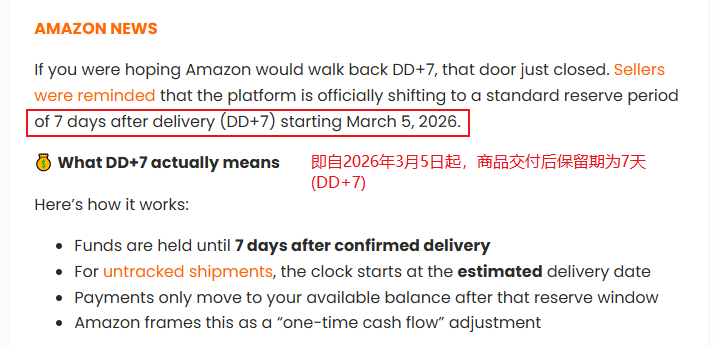
Recently, global e-commerce giant Amazon announced that it will implement the new DD+7 settlement rule worldwide starting from March 5, 2026. This change will significantly impact sellers’ cash flow.According to the new rule, the platform will only release payment for goods 7 days after the order is delivered. Combined with logistics time, the actual payment cycle will be extended to 8-9 days. Notably, the implementation date for the German site is postponed to March 12, and FBA orders are also subject to this regulation.
Amazon officially explained that this move aims to establish a secure buffer between buyer payment and seller receipt, making it easier to handle refund disputes. However, industry estimates show that individual sellers may need to prepare an additional £20,000-£50,000 in operating funds, and the total delayed funds across the platform could reach hundreds of millions.
At the same time, Amazon has also adjusted the way digital service fees are charged in the EU region. The combination of these policies will force sellers to comprehensively review their cash flow management strategies.

Image source:sellerbites
Amazon officially explained that this move aims to establish a secure buffer between buyer payment and seller receipt, making it easier to handle refund disputes. However, industry estimates show that individual sellers may need to prepare an additional £20,000-£50,000 in operating funds, and the total delayed funds across the platform could reach hundreds of millions.
At the same time, Amazon has also adjusted the way digital service fees are charged in the EU region. The combination of these policies will force sellers to comprehensively review their cash flow management strategies.

Image source:sellerbites
Multidimensional Impact on Seller Operations
The most direct impact of the extended payment cycle is increased cash flow pressure. Small and medium-sized sellers will bear the brunt, facing shortages of procurement funds and rising operating costs. Especially for sellers of seasonal products, it may be necessary to reassess stocking strategies to avoid missing sales opportunities due to poor cash flow.
Reduced capital efficiency will also slow down sellers’ pace of innovation. Funds that could have been quickly invested in new product development now take longer to return, which is particularly evident in fast-moving consumer goods. Some sellers may be forced to reduce their product lines and focus resources on core items. While this adjustment can ease financial pressure, it may weaken market competitiveness.
It is worth noting that the degree of impact varies by seller size. Brand sellers usually have stronger financial strength and supply chain bargaining power, while micro and small sellers may face survival crises. This differentiation may lead to a concentration of sellers at the top of the platform, affecting ecosystem diversity.

Image source:Google
How Should Sellers Respond?
In the face of the new rule, sellers can respond from three dimensions.
On the operational level, prioritize the use of trackable logistics services. This not only allows for accurate calculation of payment times but also reduces the risk of disputes. At the same time, consider optimizing the proportion of FBA usage. Although it cannot shorten the settlement cycle, it can improve logistics efficiency.
Supply chain management is particularly critical. Renegotiating payment terms with suppliers is the most direct way to ease the pressure, striving for longer payment periods to hedge against delayed payments. Inventory management also needs to be more refined, using data analysis to reduce the proportion of slow-moving inventory and improve capital turnover efficiency.
Financial management strategies must be adjusted accordingly. Sellers are advised to establish more conservative cash flow forecasting models and reserve sufficient buffer funds. For sellers in the growth phase, consider expanding financing channels, but carefully assess the cost of funds. At the same time, pay close attention to unexpected refunds to avoid further extending the payment cycle due to disputes.

Image source:Google
Conclusion
The implementation of the DD+7 settlement rule marks a new stage in Amazon’s platform governance. Although it will increase sellers’ operating costs in the short term, in the long run it will help establish a healthier e-commerce ecosystem. Sellers who can quickly adapt to the new rule and optimize capital management will gain a competitive advantage, while business models that rely on rapid turnover may need to be reassessed.
The next few months will be a critical adjustment period. Sellers need to closely monitor the effects of policy implementation and promptly optimize their operational strategies. Amazon may also fine-tune policy details based on market feedback.
During this period of change, maintaining liquidity and operational flexibility will be key to sellers’ survival and development. As with every adjustment in the e-commerce industry, this policy change is both a challenge and an opportunity to optimize internal management and enhance competitiveness.