Dieses Dokument konzentriert sich hauptsächlich auf den Überblick über den Überseemarkt, die Entwicklung des grenzüberschreitenden E-Commerce, den chinesischen E-Commerce-Markt, die Überseestrategie chinesischer Unternehmen, die Übersee-Health-Food-Branche und Informationen über das Unternehmen Magic Mirror Insights. Der spezifische Inhalt ist wie folgt:
1. Überblick über den Überseemarkt
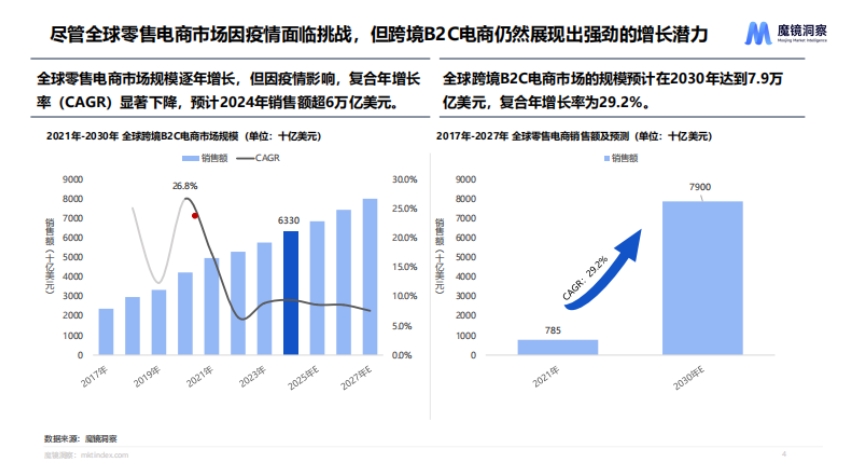
- Größe des E-Commerce-Marktes: Der globale Einzelhandels-E-Commerce-Markt wächst jährlich, aber die CAGR ist aufgrund der Pandemie deutlich gesunken. Es wird erwartet, dass der Umsatz im Jahr 2024 über 6 Billionen US-Dollar beträgt; der globale grenzüberschreitende B2C-E-Commerce-Markt wird voraussichtlich bis 2030 7,9 Billionen US-Dollar erreichen, mit einer CAGR von 29,2 %. Der chinesische E-Commerce-Markt ist reif, aber das Wachstum verlangsamt sich; der US-amerikanische E-Commerce-Markt befindet sich ebenfalls in einer Reifephase, während der indonesische E-Commerce-Markt sich rasant entwickelt.
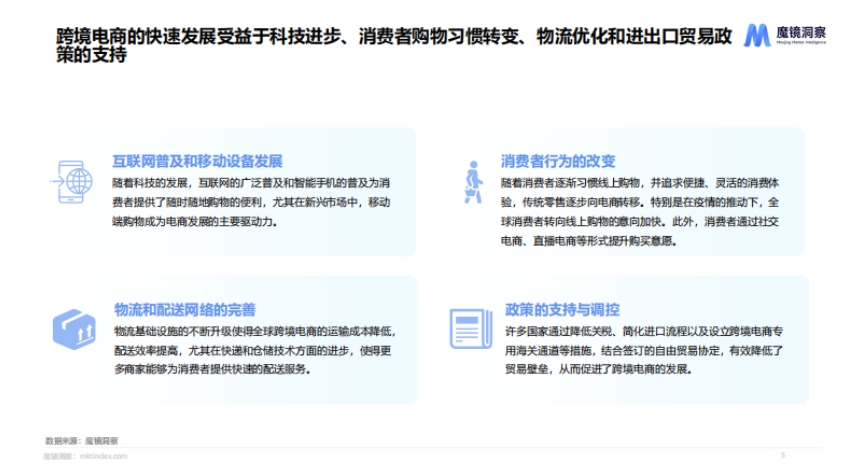
- Treiber der E-Commerce-Entwicklung: Technologische Fortschritte haben die Internetverbreitung und die Entwicklung mobiler Geräte vorangetrieben, das Einkaufsverhalten der Verbraucher hat sich geändert, die Logistikoptimierung senkt Kosten und verbessert die Liefereffizienz, und politische Unterstützung senkt Handelshemmnisse, was die Entwicklung des grenzüberschreitenden E-Commerce fördert.
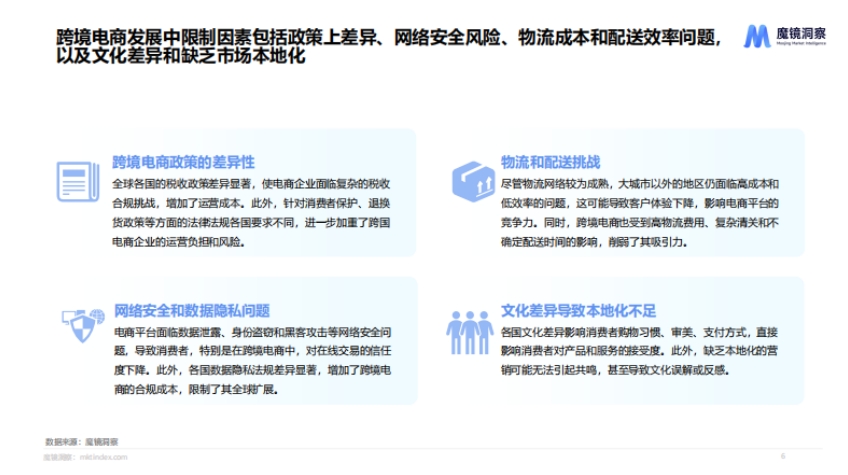
- Einschränkungen der E-Commerce-Entwicklung: Dazu gehören politische Unterschiede, Cybersicherheitsrisiken, Logistikkosten und Lieferprobleme, kulturelle Unterschiede und mangelnde Marktlokalisierung. Beispielsweise sind die Logistikkosten außerhalb großer Städte hoch und die Effizienz niedrig; Cybersicherheitsprobleme beeinträchtigen das Vertrauen der Verbraucher; und unterschiedliche nationale Richtlinien und Vorschriften erhöhen die Betriebslast der Unternehmen.
2. Überseestrategie chinesischer Unternehmen
- Gründe für die Expansion ins Ausland: Die Expansion chinesischer Unternehmen ins Ausland wird durch interne Faktoren (langsames Wachstum des lokalen Marktes, intensiver Wettbewerb, Suche nach neuen Gewinnmöglichkeiten und Marktchancen) und externe Faktoren (rasante Entwicklung und Potenzial der Überseemärkte) angetrieben.
- Strategietypen: Dazu gehören globale, multinationale, internationale und multilokale Strategien. Unternehmen neigen zu multinationalen oder multilokalen Strategien, um besser zu lokalisieren. Überseemarken verwenden oft ein „Online + Offline“-Vertriebsmodell, wobei die Online-E-Commerce-Vertriebsarten Drittanbieterplattformen, selbst aufgebaute E-Commerce-Plattformen und Social-Media-Verkäufe umfassen.
- Fallbeispiel: Am Beispiel von Anker Innovations stammen 70,3 % der Einnahmen aus Übersee-Online-Kanälen. Erfolgsfaktoren sind die tiefe Durchdringung des E-Commerce-Bereichs, professionelle Teams, die die Anforderungen verschiedener Kanäle und Verbraucher erfüllen, und die kontinuierliche Erweiterung der Online-Kanäle zur Steigerung der Markenreputation. Im Jahr 2023 verzeichnete Anker Innovations ein deutliches Umsatzwachstum und erzielte gute Ergebnisse in mehreren Märkten und Kanälen.
3. Übersee-Health-Food-Branche
- Marktgröße und Wachstum: Das Gesundheitsbewusstsein der Bevölkerung steigt, die Nachfrage nach Nahrungsergänzungsmitteln wächst. Es wird erwartet, dass der globale Markt bis 2026 201,1 Milliarden US-Dollar erreicht, wobei der nordamerikanische Markt das größte Volumen aufweist und ein gutes Wachstum beibehält. Von Januar bis Juni 2024 erreichten die Online-Verkäufe von Gesundheitsprodukten im Ausland 93,35 Milliarden Yuan, ein Anstieg von 20,2 % im Vergleich zum Vorjahr, was über dem inländischen Wachstum liegt.
- Plattform- und regionale Verteilung: Die Amazon-Plattform hat das größte Volumen, mit einem Umsatz von 87,71 Milliarden Yuan von Januar bis Juni 2024, einem Anstieg von 19,7 %; der US-Standort hatte mit 75,05 Milliarden Yuan den größten Umsatz. Die Plattformen Shopee und Lazada haben ein kleineres Volumen, aber einen guten Wachstumstrend. Im südostasiatischen Markt erzielten Indonesien, Thailand und die Philippinen gute Verkaufsergebnisse.
- Verbraucherverhalten: Der Anteil der Erwachsenen in den USA, die Nahrungsergänzungsmittel verwenden, steigt kontinuierlich. Offline-Kanäle sind immer noch der Hauptkaufweg, während Online-Einzelhändler 25 % ausmachen. Auf der US-amerikanischen Amazon-Plattform konzentriert sich die Nachfrage nach Gesundheitsprodukten auf Funktionen wie Sport-Energie, Immunitätssteigerung und Proteinergänzung, wobei die Nachfrage nach Gelenk-/Knochengesundheit, Gehirngesundheit und Herz-Kreislauf-Gesundheit stark wächst.
- Markenwettbewerbslandschaft: Der Markt für Gesundheitsprodukte auf Amazon in den USA ist fragmentiert, wobei die Marktanteile der führenden Marken alle unter 2 % liegen, während die Konzentration im Inlandsmarkt relativ hoch ist. Nahrungsergänzungsmittel, Probiotika und Proteinpulver sind die Kernprodukte der führenden Marken. Die Marke NOW schneidet sowohl im In- als auch im Auslandsmarkt gut ab.
- Preisanalyse und Funktionsanalyse: Auf der US-amerikanischen Amazon-Plattform konzentrieren sich 65 % der Verbrauchernachfrage auf das Preissegment von 50-200 Yuan, wobei der Anteil der Produkte im mittleren bis oberen Preissegment steigt; die Inlandsnachfrage konzentriert sich auf das Preissegment unter 100 Yuan. Der inländische Markt für Gewichtsverlust ist reifer als der US-amerikanische Amazon-Markt, während der US-amerikanische Amazon-Markt für Haar-, Haut- und Nagelprodukte reifer ist als der Inlandsmarkt, mit einer größeren Vielfalt an Produktformen und Inhaltsstoffen.
4. Vorstellung des Unternehmens Magic Mirror Insights
- Unternehmensübersicht: Magic Mirror Insights ist eine Tochtergesellschaft von Beijing Taomi Technology Co., Ltd. mit über 140 Mitarbeitern und Büros in Peking, Shanghai, Wuhan, Chongqing, Guangzhou und anderen Orten, die Kunden weltweit bedient.
- Datenprodukte und Dienstleistungen: Bietet Datenprodukte wie Magic Mirror Oversea Growth Radar, die mehrere Länder, Regionen und Standorte abdecken, sowie Dienstleistungen wie Marktforschung, Markenpositionierung und Identifizierung von Nischensegmenten. Das Servicemodell umfasst Datenprodukte und Datendienstleistungen, die Berichtsdienste, Trendinhaltserkennung und globales Verbrauchererfahrungsmanagement umfassen und Probleme in den Bereichen Produktentwicklung, Marktüberwachung und Verbraucherforschung lösen können.
- Datenfähigkeiten: Deckt alle Branchen und Kategorien auf wichtigen E-Commerce- und Social-Media-Plattformen ab, mit Daten, die über 6 Jahre zurückverfolgt werden können, und unterstützt die maßgeschneiderte Datenerfassung auf mehreren Plattformen. Zu den Kernplattformen gehören in- und ausländische E-Commerce-Plattformen sowie wichtige inländische Social-Media-Plattformen.
- Kundenbasis: Hat insgesamt über 500 Unternehmen bedient, darunter 60 % der Top-30-Konsumgütermarken. Zu den Kunden gehören Markeninhaber, Beratungsfirmen, Finanzinstitute, Regierungskunden, Logistikunternehmen usw., mit vielen führenden Kunden in verschiedenen Branchen.