Dieses Dokument konzentriert sich auf die Praxis der internationalen Expansion chinesischer Pharmaunternehmen im Jahr 2024 und analysiert umfassend die relevanten makroökonomischen Hintergründe, Datenübersichten, Transaktionsfälle sowie zukünftige Entwicklungstrends. Der Inhalt ist wie folgt:
1. Makroökonomischer Hintergrund der internationalen Expansion chinesischer Pharmaunternehmen
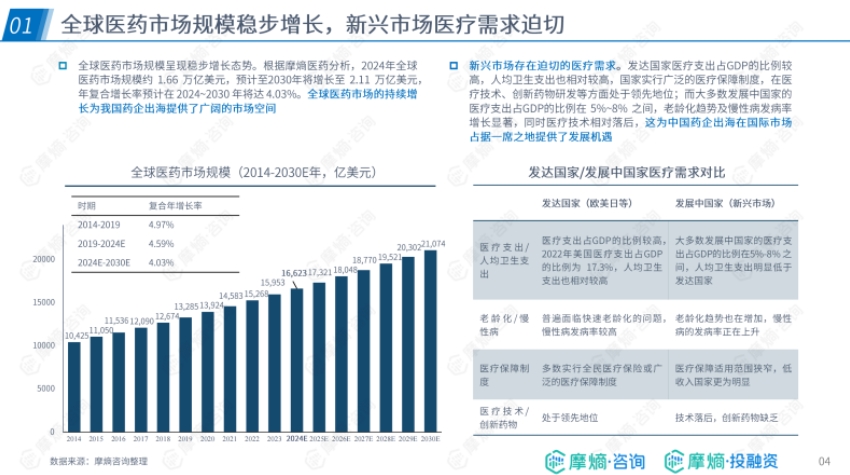
- Wachstum des globalen Marktvolumens und Nachfrage in Schwellenländern: Der globale Pharmamarkt wächst stetig, mit einer erwarteten durchschnittlichen jährlichen Wachstumsrate von 4,03 % zwischen 2024 und 2030. Schwellenländer haben einen dringenden medizinischen Bedarf und unterscheiden sich von Industrieländern in Bezug auf Gesundheitsausgaben, Alterung der Bevölkerung, Krankenversicherungssysteme und Medizintechnologie, was chinesischen Pharmaunternehmen Chancen für die internationale Expansion bietet.
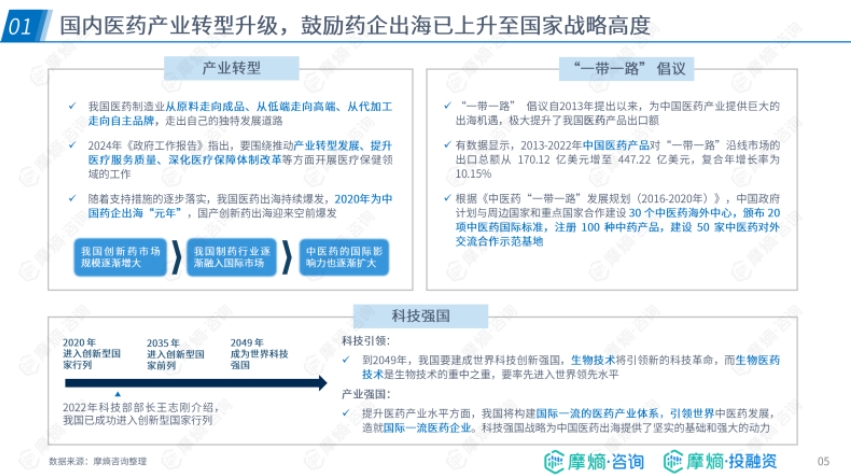
- Inländische industrielle Transformation und strategische Unterstützung: Die pharmazeutische Industrie Chinas entwickelt sich kontinuierlich weiter, der Markt für innovative Arzneimittel wächst, die Pharmaindustrie integriert sich in den internationalen Markt und der Einfluss der traditionellen chinesischen Medizin nimmt zu. Die „Belt and Road“-Initiative hat die Exporte pharmazeutischer Produkte gesteigert, die Strategie zur Stärkung des Landes durch Wissenschaft und Technologie bietet eine Grundlage und Dynamik für die internationale Expansion der Pharmaindustrie, und der Staat ermutigt Pharmaunternehmen, ins Ausland zu gehen.
- Verbesserung der Innovationsfähigkeit und Gewinnüberlegungen lokaler Pharmaunternehmen: Die Innovationsfähigkeit lokaler Pharmaunternehmen wird immer ausgereifter, die Anzahl der zugelassenen innovativen Arzneimittel steigt, und einige Produkte erreichen internationales Niveau. Die Preissenkungen im inländischen Krankenversicherungssystem begrenzen die Gewinnspannen, während der Überseemarkt höhere Preisspielräume bietet, was die globale Expansion zu einer unvermeidlichen Wahl macht.
- Expansionsmethoden und Branchenrückblick: Die wichtigsten Methoden für chinesische Pharmaunternehmen zur internationalen Expansion sind die Nutzung von Partnerschaften, Kooperationen und eigenständige Expansion. Die internationale Expansion der chinesischen Pharmaindustrie hat eine Entwicklung von Massenwirkstoffen bis hin zur Zulassung innovativer Arzneimittel im Ausland durchlaufen, mit repräsentativen Unternehmen und Geschäften in jeder Phase.
2. Überblick über Daten zu pharmazeutischen grenzüberschreitenden Transaktionen und Trendeinblicke
- Trend des globalen pharmazeutischen Transaktionsvolumens: Das globale pharmazeutische Transaktionsvolumen erreichte 2021 seinen Höhepunkt, ging danach leicht zurück und betrug im ersten Halbjahr 2024 2.674 Transaktionen. Es wird erwartet, dass das Volumen im Laufe des Jahres weiter steigen wird. Die Schwankungen des Transaktionsvolumens werden von verschiedenen Faktoren beeinflusst.
- Verteilung der Transaktionsthemen: Kooperationsvereinbarungen sind das wichtigste Transaktionsthema, daneben gibt es auch Themen wie Know-how, Mittelbeschaffung und Lizenzvergabe. Die Vielfalt der Transaktionsthemen spiegelt die Komplexität der Branche wider.
- Analyse des Anteils grenzüberschreitender Transaktionen: Grenzüberschreitende Transaktionen haben einen stabilen und signifikanten Anteil an der Branche. Zwischen 2019 und dem ersten Halbjahr 2024 lag dieser Anteil insgesamt bei etwa 40 %. Trotz Schwankungen zeigt dies ihre Notwendigkeit.
- Situation grenzüberschreitender pharmazeutischer Transaktionen Chinas: Die USA sind der wichtigste Handelspartner Chinas. Die Transaktionen zwischen China und den USA sind bedeutend und vielfältig, aber die Konzentration der chinesischen Handelspartner ist höher. Die Themen der grenzüberschreitenden pharmazeutischen Transaktionen Chinas sind vielfältig und eng mit der „Going Global“-Strategie der Pharmaunternehmen verbunden.
- Situation im Zusammenhang mit Lizenztransaktionen: Lizenzvergabe ist für Biotech-Unternehmen von großer Bedeutung. Die Lizenztransaktionen der chinesischen Pharmaindustrie verlaufen synchron mit dem globalen Markttrend. Die „Going Global“-Strategie chinesischer Pharmaunternehmen gleicht Marktschwankungen effektiv aus, und die Aktivität bei Lizenzvergaben für frühe Projekte nimmt zu.
3. Analyse und Verfolgung von Transaktionsfällen
- Fall HUTCHMED/Takeda Pharmaceutical – Fruquintinib: Im Januar 2023 erhielt Takeda von HUTCHMED die exklusiven Rechte zur Entwicklung von Fruquintinib in bestimmten Regionen der Welt und zahlte eine Vorauszahlung sowie Meilensteinzahlungen. Nach der FDA-Zulassung von Fruquintinib in den USA im November 2023 erhielt HUTCHMED eine Meilensteinzahlung.
- Fall Jacobio/AbbVie – JAB-3068 und JAB-3312: Im Mai 2020 erhielt AbbVie die globalen exklusiven Entwicklungsrechte für die relevanten Medikamente von Jacobio. Jacobio erhielt eine Vorauszahlung und Meilensteinzahlungen. Im Juli 2023 wurde die Transaktion beendet, und Jacobio besitzt eine Option auf exklusive Entwicklung in bestimmten Regionen Chinas.
4. Zukünftige Entwicklungstrends der Internationalisierung chinesischer Pharmaunternehmen
- Marktnachfrage und regulatorische Internationalisierung: Die zunehmende globale Alterung der Bevölkerung führt zu einer wachsenden Nachfrage auf dem Pharmamarkt. Die beschleunigte Internationalisierung der chinesischen Arzneimittelregulierung wird die Internationalisierung der Branche vorantreiben.
- Diversifizierung der Überseemärkte und Verbesserung der Fähigkeiten von Pharmaunternehmen: Die Überseemärkte werden vielfältiger, Schwellenländer rücken in den Fokus; die Forschungs- und Innovationsfähigkeit wird verbessert, die internationale Anordnung der Produktionsstandorte wird optimiert, und Vertriebskanäle sowie Geschäftsmodelle werden innoviert.