Dieses „Weißbuch zur Talententwicklung im chinesischen Fertigungssektor bei der Expansion ins Ausland (2025)“ untersucht hauptsächlich die mit Talenten verbundenen Probleme während der internationalen Expansion des chinesischen Fertigungssektors, einschließlich des aktuellen Status, des Bedarfs, der Herausforderungen und der Bewältigungsstrategien.
1. Aktueller Status und Trends der Expansion ins Ausland: Die Auslandsinvestitionen des chinesischen Fertigungssektors wachsen kontinuierlich. Die durchschnittliche jährliche Wachstumsrate der ausländischen Direktinvestitionsflüsse von 2019 bis 2023 betrug 7,8 %, und der Investitionsfluss im Jahr 2023 erreichte 27,34 Milliarden US-Dollar. Gleichzeitig wandelt sich der Fertigungssektor von arbeitsintensiven Produkten hin zu hochwertigen, hochwertigen Produkten. So steigt beispielsweise der Exportanteil von elektromechanischen Produkten, während der Exportanteil von arbeitsintensiven Produkten sinkt. Darüber hinaus bauen Unternehmen aktiv in Schwellenmärkten Präsenz auf und optimieren die Konfiguration ihrer Lieferketten, wie z. B. in den Branchen Maschinenbau, Elektronik/Elektrotechnik, neue Energien und Automobilindustrie, indem sie im Ausland Forschungs-, Produktions- und Vertriebsbasen errichten, um eine lokale Produktion zu erreichen.
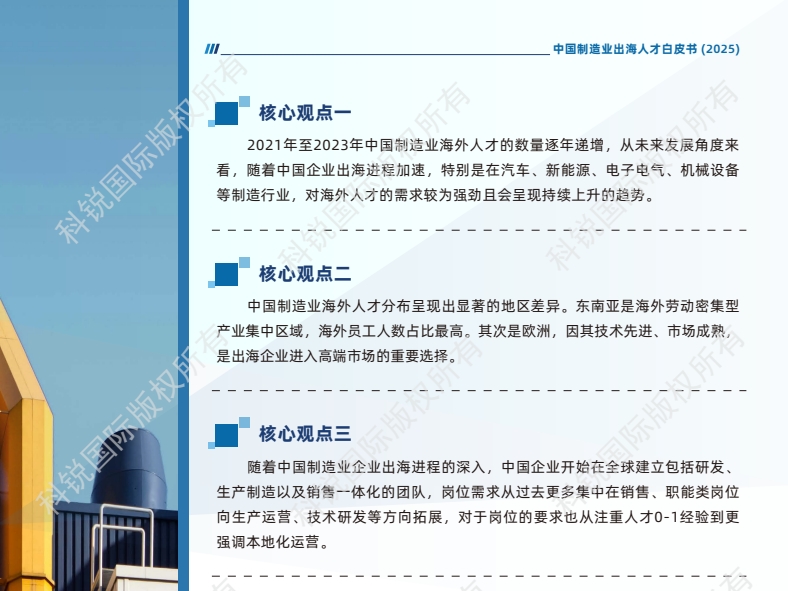
2. Merkmale des Talentbedarfs: Der Bedarf an Talenten im Ausland steigt. Von 2021 bis 2023 stieg die Anzahl der Talente im chinesischen Fertigungssektor im Ausland kontinuierlich an, und die Talentmobilität zeigt eine multidirektionale Entwicklung mit „Abwanderung“ und „Anwerbung“. Expandierende Unternehmen konzentrieren sich hauptsächlich auf Schwellenmärkte wie Südostasien, Europa und Lateinamerika, wo die Talentdichte relativ hoch ist. Die Beschäftigungsmodelle im Ausland sind vielfältig, der Anteil flexibler Beschäftigung nimmt zu, wobei Südostasien den höchsten Anteil an flexibler Beschäftigung aufweist. Die Stellenanforderungen erweitern sich von Vertriebs- und Verwaltungsfunktionen hin zu Produktionsbetrieb, technischer Forschung und Entwicklung usw. Die Anforderungen an Talente verschieben sich von der Betonung von 0-1-Erfahrung hin zur Betonung lokaler Betriebsführung.
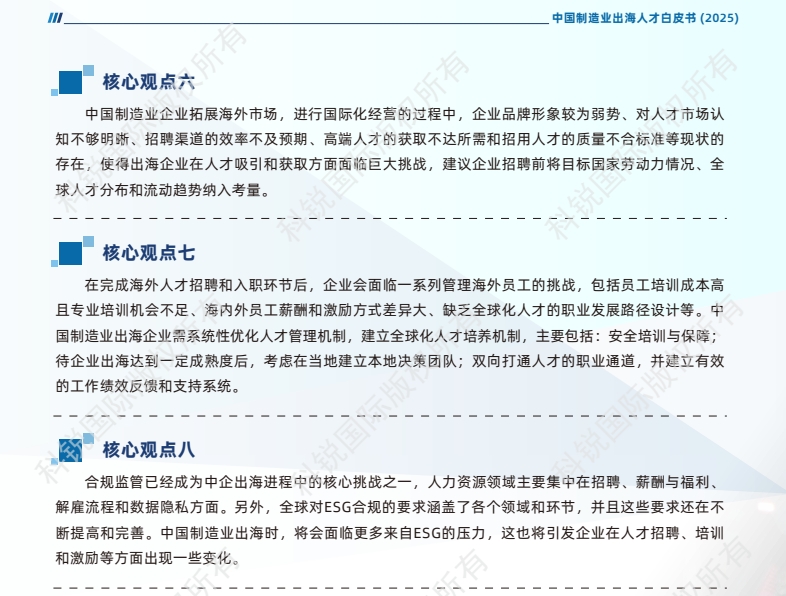
3. Herausforderungen im Talentmanagement: Die internationale Expansion des chinesischen Fertigungssektors steht vor verschiedenen Herausforderungen. Hohe Expansionskosten, einschließlich Kapital- und Zeitkosten für die Gründung von Auslandsgesellschaften, Umzugskosten, Kosten für Vollzeit- und flexible Beschäftigung; kulturelle und Compliance-Probleme sind prominent, kulturelle Unterschiede beeinflussen den Geschäftsbetrieb, und die Einhaltung von Vorschriften ist in Bereichen wie Einstellung und Vergütung streng; Schwierigkeiten bei der Anwerbung und Gewinnung von Talenten, schwaches Markenimage des Unternehmens, ineffiziente Talentauswahl; Probleme bei der Talentausbildung und -entwicklung, hohe Ausbildungskosten und Mangel an professionellen Weiterbildungsmöglichkeiten, große Unterschiede bei Vergütungs- und Anreizmethoden, fehlende Gestaltung von Karrierewegen, große Schwierigkeiten bei der Digitalisierung des Talentmanagements.
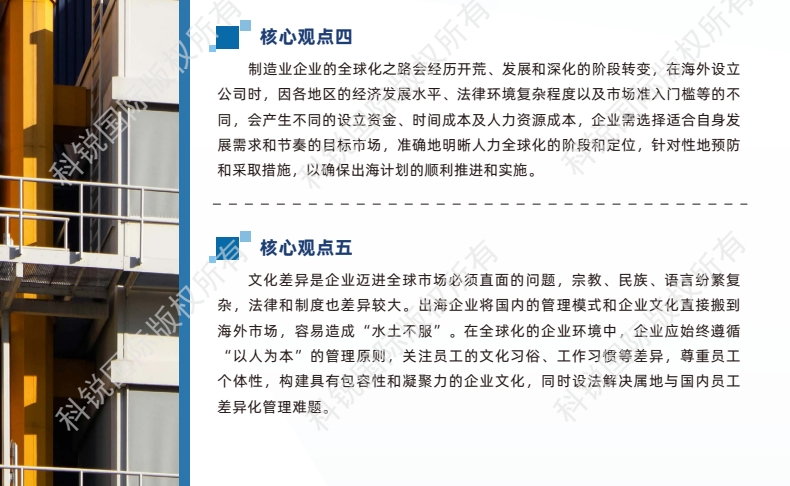
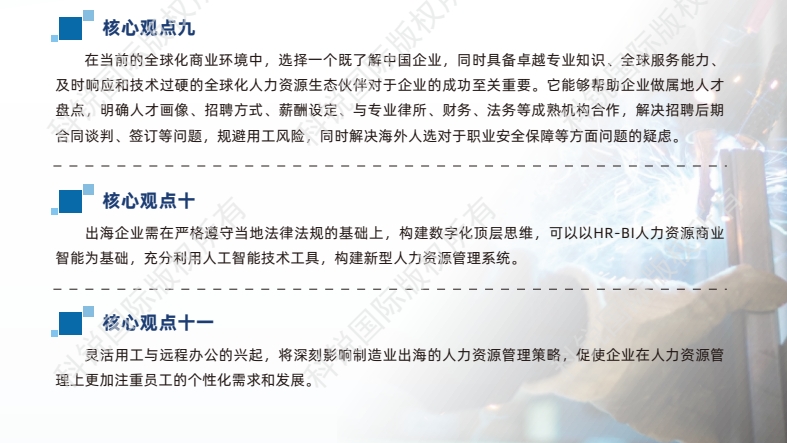
4. Erfolgsrezepte für das Talentmanagement: Unternehmen müssen ihre globale Positionierung klären, Strategien basierend auf ihrer eigenen Situation und den Merkmalen der Zielmärkte entwickeln, auf Finanzplanung achten, eine übermäßige Konzentration von Risiken vermeiden und Talentmanagementstrategien entsprechend der Entwicklungsphase formulieren. Sie sollten das Konzept „Mensch im Mittelpunkt“ verfolgen, die Unterschiede der Mitarbeiter respektieren, eine integrative Unternehmenskultur aufbauen, eine „Ein-Land-eine-Strategie“-Politik umsetzen und die Herausforderungen des differenzierten Managements von lokalen und inländischen Mitarbeitern lösen. Geeignete Partner auswählen und deren professionellen Hintergrund, Servicefähigkeiten usw. bewerten. Das Image der Arbeitgebermarke im Ausland verbessern, die Unternehmenskultur verbreiten, gute Arbeitserfahrungen und Entwicklungsunterstützung bieten. Künstliche Intelligenz nutzen, um Talente bei der Expansion ins Ausland zu unterstützen und ein digitales Personalmanagementsystem aufzubauen. Systematische Optimierung der Talentakquise und des Talentmanagements, einschließlich des Verständnisses der Arbeitssituation in Zielländern, der Entwicklung von Talentfähigkeiten, der Einhaltung von Beschäftigungsvorschriften, des Aufbaus lokaler Entscheidungsteams und der Schaffung von Karrierewegen.
5. Zukunftsausblick: In Zukunft wird die Anwerbung und Gewinnung von Talenten für die internationale Expansion des chinesischen Fertigungssektors schwieriger werden, insbesondere in beliebten Regionen wie Südostasien, Europa und Amerika. ESG-Compliance-Anforderungen werden die Strategien für Talentakquise und -management verändern. Unternehmen müssen auf das Konzept der nachhaltigen Entwicklung bei Kandidaten achten und die ESG-Schulung für Mitarbeiter verstärken. Digitale Technologien werden innovative Lösungen für Talentakquise und -entwicklung bieten, Kosten senken und die Effizienz steigern. Die globale Talentmobilität beschleunigt sich, Unternehmen müssen globale Talentpools aufbauen. Der Aufstieg von flexibler Beschäftigung und Remote-Arbeit veranlasst Unternehmen, sich auf die individuellen Bedürfnisse und die Entwicklung der Mitarbeiter zu konzentrieren.