This "White Paper on Chinese Enterprises Going Global: Pharmaceuticals and Medical Devices" mainly focuses on the overseas expansion of Chinese pharmaceutical and medical device companies, analyzing the history, models, market selection, risk management, and future outlook.
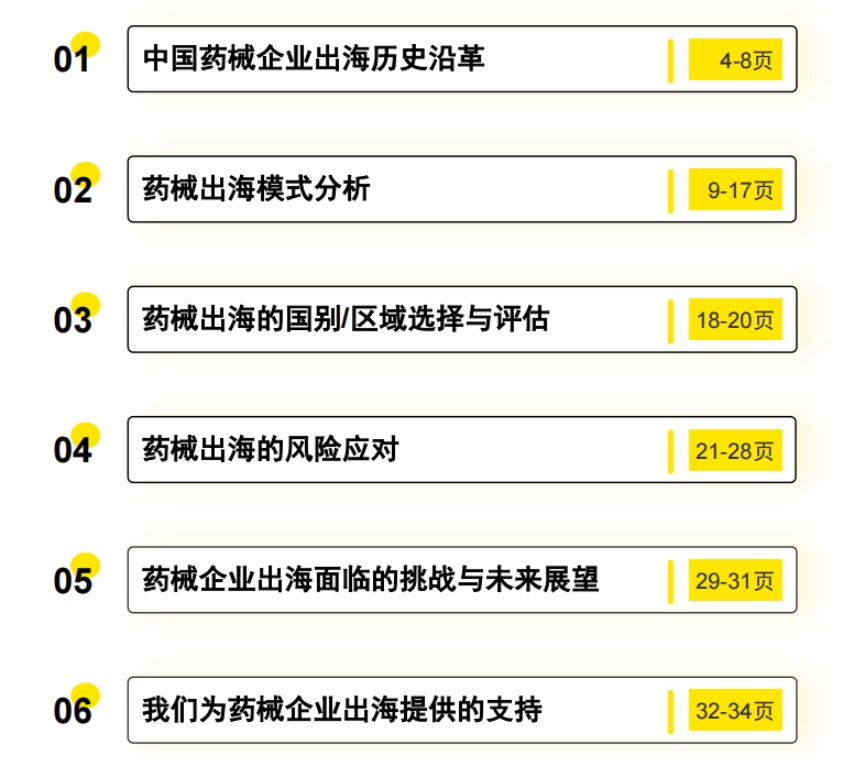
1. Historical Evolution of Going Global: Chinese pharmaceutical and medical device companies have gone through several stages in their overseas expansion. In the early days, pharmaceutical companies relied on exporting APIs and generic drugs, while medical device companies accumulated experience through OEM manufacturing. Later, pharmaceutical companies entered the European and American markets after improving the quality of generic drugs, and medical device companies launched their own brands. In recent years, pharmaceutical companies have explored various overseas models, and medical device companies have deepened their global layout.
2. Analysis of Overseas Expansion Models: Various models for pharmaceutical and medical device companies going global are introduced. The export model is mainly used for generic drugs and APIs; the "piggybacking" model leverages partners to enter international markets; the NewCo model involves setting up companies in cooperation with international capital; the spin-off subsidiary model allows innovative businesses to operate independently; mergers and acquisitions enable rapid resource acquisition; independent expansion builds a full value chain; platform-based expansion provides services for itself and other pharmaceutical companies.
3. Country/Region Selection and Evaluation: When choosing markets for overseas expansion, companies need to consider multiple factors. In terms of macro environment, countries with large populations and rapid economic development have great potential, and developed regional economic centers can serve as operational hubs. Regarding policies and regulations, open countries have high compliance requirements, while markets with obvious local protectionism require establishing local partnerships. Pharmaceutical regulatory environments vary, with mature markets being strict and some Southeast Asian countries being more relaxed. The business environment and brand acceptance are also crucial; mature markets are highly competitive, and emerging markets have complex rules.
4. Risk Management: Using the example of US policies during the Trump 2.0 era, the risks faced by pharmaceutical and medical device companies in overseas expansion are analyzed. These policies cover export controls, data controls, and other areas, affecting the entire chain from R&D to capital operations. Different segments are affected differently, such as API companies being heavily impacted by tariffs, and innovative drug companies facing FDA approval pressures. Companies need to take measures according to their own situations, such as process upgrades, market expansion, and enhancing R&D capabilities.
5. Challenges and Future Outlook: Chinese pharmaceutical and medical device companies face challenges in geopolitics, regulation, financing, and branding when going global independently. In the future, the overseas expansion model for innovative pharmaceutical companies is expected to gradually shift from cooperation-led to independent commercialization. In the short term, experience will be accumulated through License-out and NewCo models; in the medium term, companies will explore independent commercialization paths; in the long term, a comprehensive commercialization network will be built.
6. Supporting Pharmaceutical and Medical Device Companies Going Global: Support provided for overseas expansion includes one-stop solutions such as market evaluation, model selection, registration and access, supply chain optimization, financial and tax planning, risk management, and digital transformation, helping companies achieve their global strategic goals.