 799
799Fan Bingbing has been relatively quiet in the domestic entertainment industry in recent years, but her beauty business has become increasingly lively.
In 2025, the beauty brand Fan Beauty Diary she founded surpassed 1.8 billion yuan in annual GMV. From 300 million yuan in 2021 to 1.8 billion yuan in 2025, this growth rate is impressive in any industry.
Many people may not have noticed that the brand's first cushion foundation, launched recently, broke 1 million yuan in sales within 4 hours of release, and sales at its official store exceeded 10 million yuan after 7 days. But the cushion is just a bonus; what truly established Fan Beauty Diary is its face masks.

Image source: Internet
When the brand was founded in 2018, its first product was actually a beauty device priced above 2,000 yuan. But because the device was expensive and purchased infrequently, the brand quickly adjusted its direction.
In 2019, the Sea Grape Hydrating Mask was launched. Its price was much more affordable, lowering the barrier for consumers to try it, and making repurchases easier. It gradually became the brand's signature product. The cumulative sales of this mask have exceeded 100 million pieces. The brand revealed that the product with the highest repurchase rate in the mask line reached 85%.
After establishing a firm foothold domestically, Fan Beauty Diary set its sights on Southeast Asia.

Image source: Internet
In May 2024, the brand launched on Lazada Malaysia and Singapore, and subsequently entered Shopee and TikTok Shop. It was not smooth at the beginning—the initial sales of its flagship Sea Grape Mask on Lazada Malaysia were only 1,800 orders. But the brand quickly adjusted its strategy by cooperating with top local livestreamers and accelerating its livestream commerce pace.
By the Double 11 period in 2025, the brand had already broken into the top two on Malaysia's Lazada skincare ranking and the top three on Shopee's best-selling skincare list. Its online sales surpassed one million yuan within the first hour of sales.
After its online channel was up and running, Fan Beauty Diary began moving offline. In August 2025, the brand entered 100 Watsons stores in Malaysia; in January 2026, it also entered Watsons Singapore, achieving over 12 million yuan in total online and offline sales within 3 days of its debut. Fan Bingbing herself has also made multiple trips overseas to attend offline events, creating buzz for the brand.
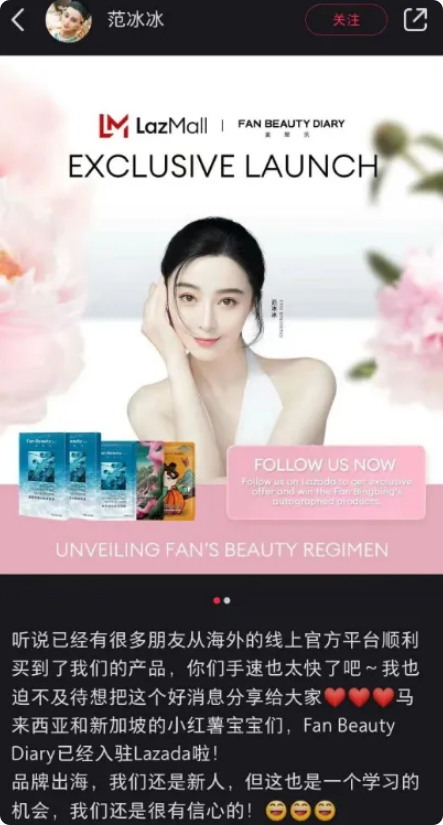
Image source: Xiaohongshu
Fan Beauty Diary is not an isolated case. The entire domestic beauty industry is treating Southeast Asia as the most important incremental market beyond China.
The warming up of the Southeast Asian beauty market is not unfounded. Industry reports show that in 2025, the GMV of Southeast Asian platform e-commerce reached 157.6 billion USD, of which content e-commerce contributed 49.7 billion USD, with its share rising from 20% in 2024 to 32%.
This means that Southeast Asian consumers have become accustomed to discovering and purchasing products through short videos and livestreams, which is a natural advantage for Chinese brands that excel at content marketing.
Flower Knows is another example that has been progressing steadily. This domestic color cosmetics brand, known for its Lolita and vintage style, has taken a differentiated approach in Southeast Asia.
Its product packaging has a strong design aesthetic. Single items such as blushes and eyeshadow palettes have accumulated a loyal fan base on Shopee and Lazada. Positioned at mid-to-high prices, it avoids direct competition with low-priced white-label brands.
Currently on TikTok, influencers are continuously producing unboxing videos and makeup tutorials for Flower Knows, and the path from content marketing to sales has been proven.
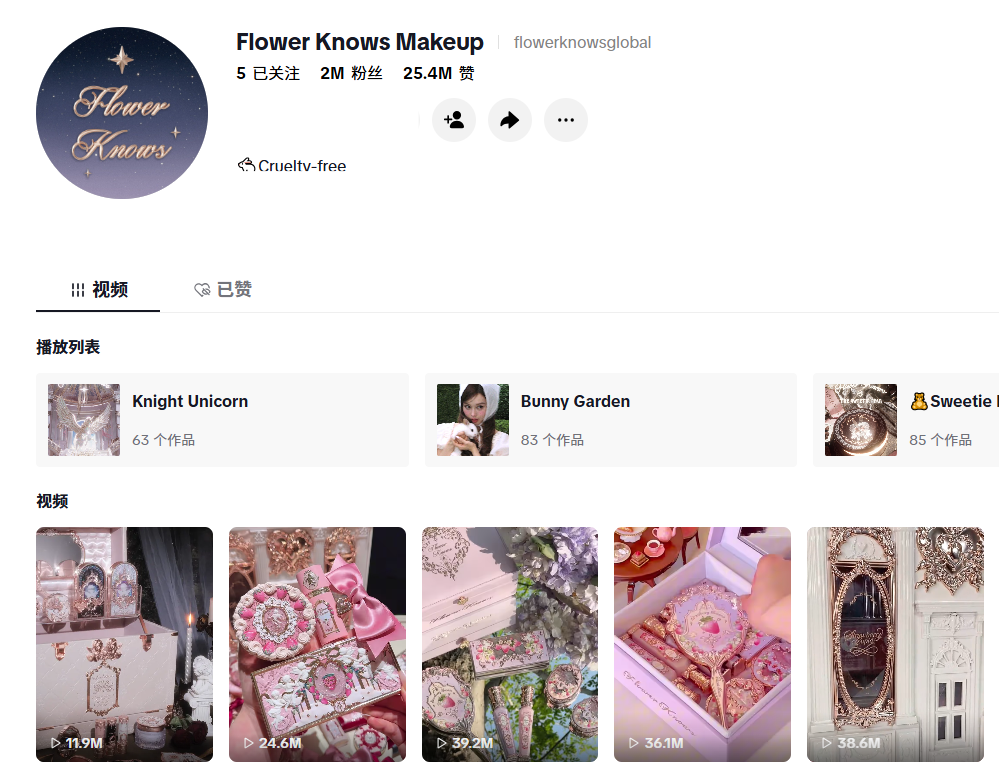
Image source: TikTok
Judydoll, on the other hand, takes a different path.
This brand is known for its high cost performance, targeting young student groups in Southeast Asia, with unit prices mostly ranging from 5 to 15 USD. It attracts consumers with a wide range of shades and rapid new product releases. On social media platforms, it quickly gains momentum through influencer recommendations and livestream commerce. Single items such as lip glosses and single-color blushes have repeatedly entered the platform's best-selling makeup lists.
It establishes a user base with low-priced, high-frequency products, and then gradually extends to mid-to-high-end offerings.
In addition, brands such as Perfect Diary, colorkey, and Zeesea also have varying levels of presence in Southeast Asia. Their paths differ—some rely on design differentiation, some on cost performance, some on product strength—but they all share the commonality of treating Southeast Asia as an important growth market.
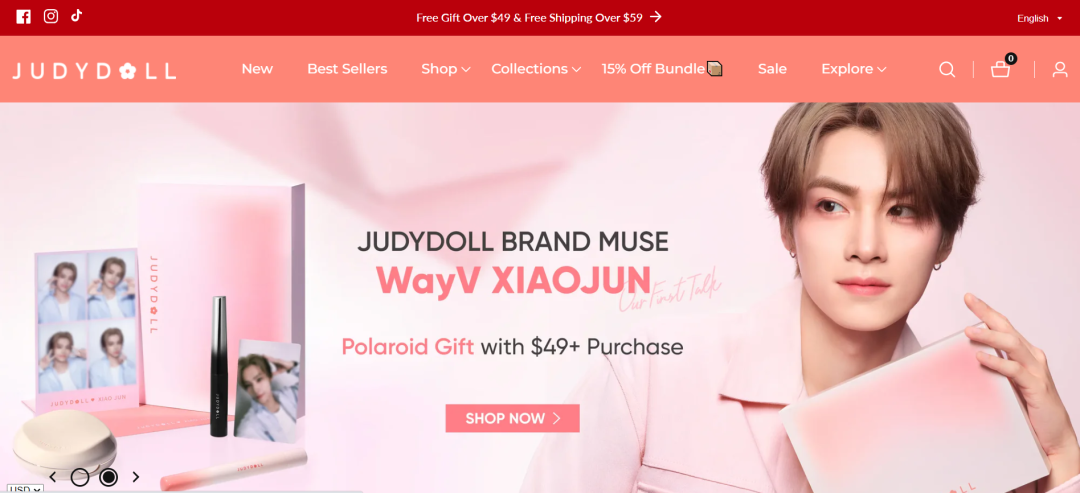
Image source: JUDYDOLL
However, what a star's halo can bring is ultimately limited. Fan Bingbing's fame can make consumers stop and take a second look, and can also bring the first batch of orders, but after Fan Bingbing leaves the store, how many people are willing to come back to buy a second box of face masks? That is the answer to how far her 1.8 billion yuan business can go overseas.
At the end of the day, whether a brand can truly gain a foothold overseas depends not on a celebrity face, but on whether the product itself can make consumers want to use it again after using it.