 1924
1924Recently, the most discussed topic in the cross-border e-commerce circle is the EU's upcoming ban on social media for minors.
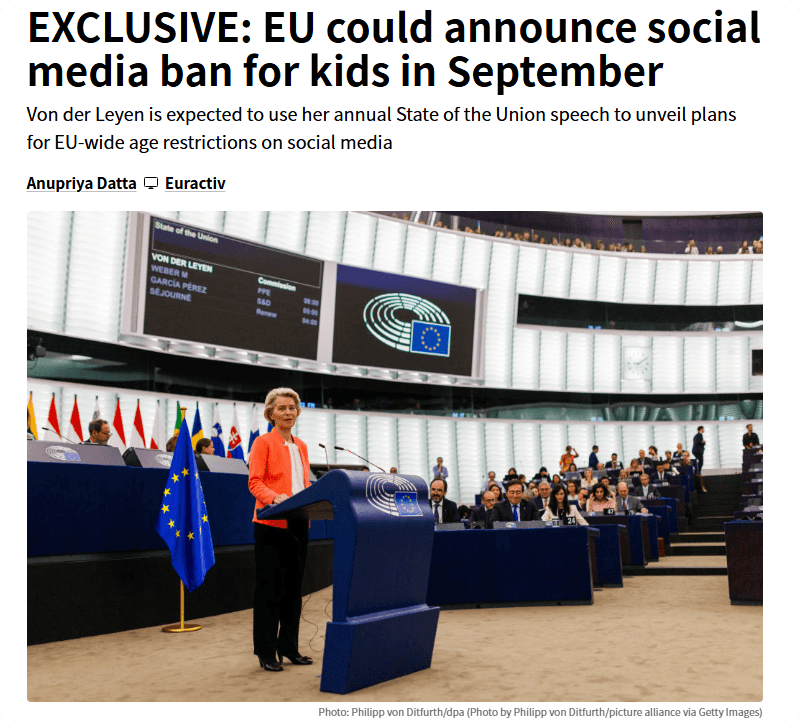
Last September, Ursula von der Leyen announced in her State of the Union address the establishment of a special task force on child online safety. Now, the task force is expected to submit its report on the 13th of this month. And von der Leyen also plans to officially announce the relevant ban proposal in her State of the Union address on September 16 this year.
Although the specific age threshold has not been finalized (some sources say it could be set at 15, while some member states support 16), the general direction is clear: the EU is getting serious about minors' social media use.
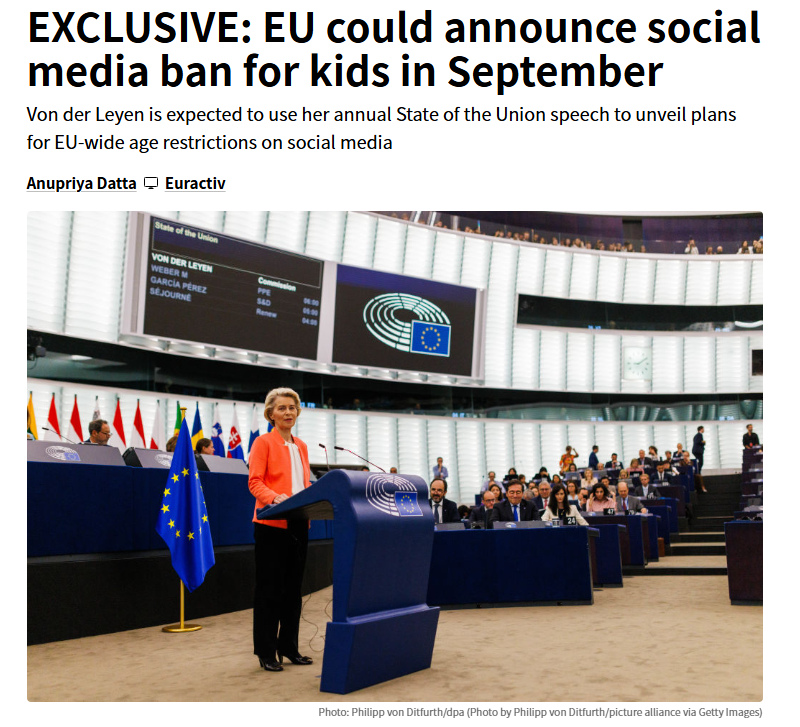
Source: euractiv
This issue did not come out of nowhere.
The EU has actually been planning for a long time on the protection of minors online.
In February this year, the EU publicly stated that TikTok's features such as infinite scrolling and autoplay constitute "addictive design" and violate the Digital Services Act. After a two-year investigation, the European Commission preliminarily determined that these designs are essentially "addiction mechanisms" that continuously provide new content as rewards, making it difficult for users, especially minors, to voluntarily leave the platform.
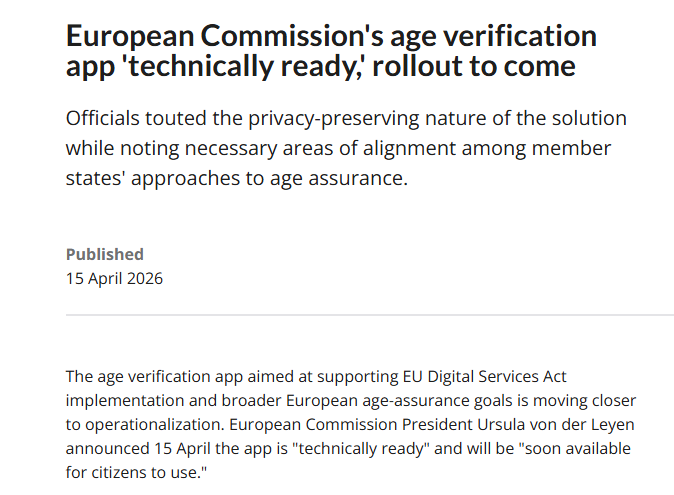
In April this year, the European Commission announced that its age verification application is "technically ready". This application uses "zero-knowledge proof" technology to verify user age without sharing personal privacy information. It can be said that the technical tools are already in place.
Source: iapp
In fact, the actions of individual member states are even earlier than the EU level. France took the lead in January this year by passing a law banning minors under 15 from using social media. The UK followed in June, announcing plans to set the ban threshold at 16, but the relevant measures will not be formally implemented until spring 2027 at the earliest.
What the EU needs to do now is to unify the scattered rules of various countries — all 27 EU countries will implement the same set of standards simultaneously.
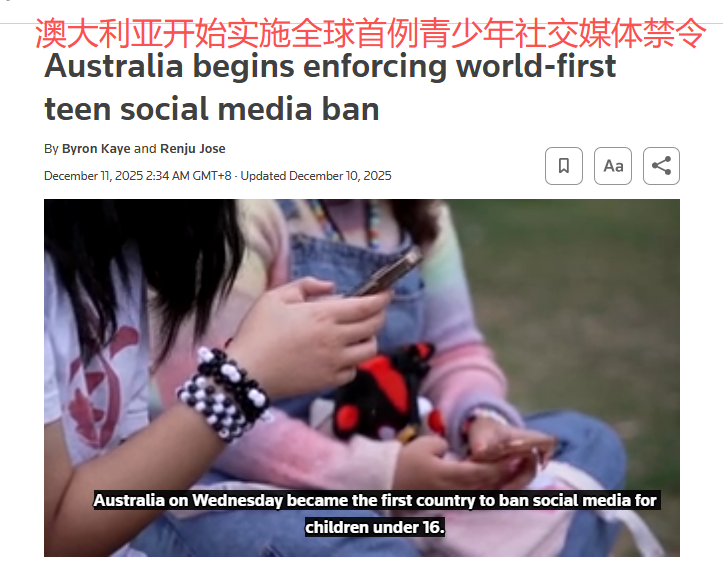
This is also not the EU's "solo show". In November last year, the Australian Federal Parliament passed the 2024 Online Safety (Social Media Minimum Age) Amendment Act, banning minors under 16 from using social media.
If platforms fail to take "reasonable measures" to prevent minors from using them, they will face a maximum fine of 49.5 million Australian dollars (approximately 232 million yuan). Currently, platforms such as Facebook, Instagram, and TikTok have all cooperated to block users under 16 in Australia.
Source: reuters
Who will be most affected? Undoubtedly TikTok.
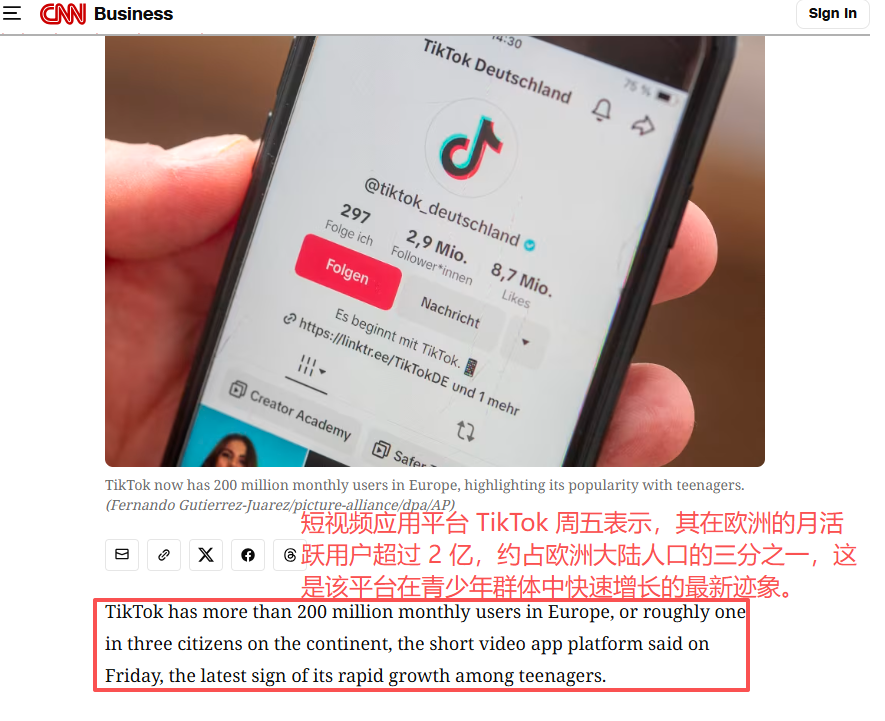
TikTok's user base has always been relatively young, with a significant number of teenage minor users. Data shows that TikTok has over 200 million monthly active users in Europe, accounting for about one-third of Europe's population. Users aged 13 to 17 make up about 14% of TikTok's global user base — although this is only global data, in the European market, the absolute number behind this proportion is quite considerable.
More importantly, TikTok is in a rapid expansion phase in Europe. Since the end of 2024, the platform has accelerated its e-commerce layout in Europe, successively launching sites in Spain, Germany, France, Italy, and others.
In June this year, TikTok simultaneously opened merchant onboarding channels to eight European countries: Poland, Netherlands, Belgium, Czech Republic, Austria, Greece, Portugal, and Hungary. The platform is at a node of rapid expansion in the European market. If the ban is formally implemented at this time, it will certainly have a significant impact on sellers.
Source: CNN
To be honest, policy changes are not something we can control. But one thing is certain: the European market has always been like this — stable profits, but high barriers.
After stricter regulation, tactics that rely on loopholes and low-price involution will gradually exit the stage. What remains are sellers who truly understand products, compliance, and users. Instead of worrying, take this time to think carefully about your product positioning and user strategy. After the platform completes this round of "blood change", who will your target customers be? What value can you provide?
Survival of the fittest — this saying is timeless.