 1998
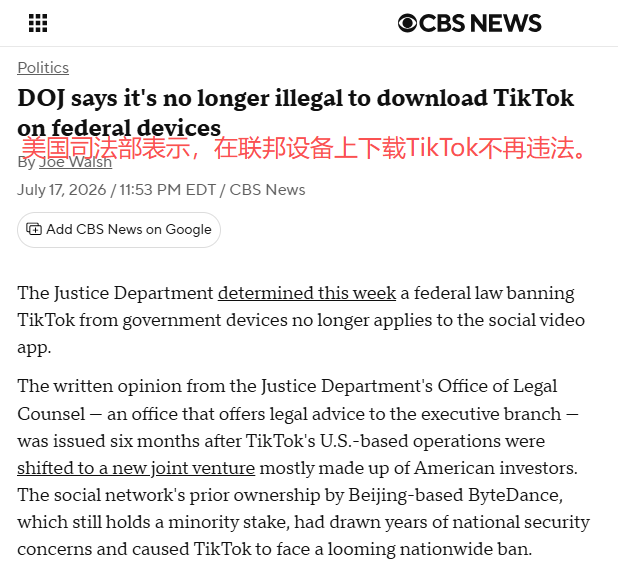
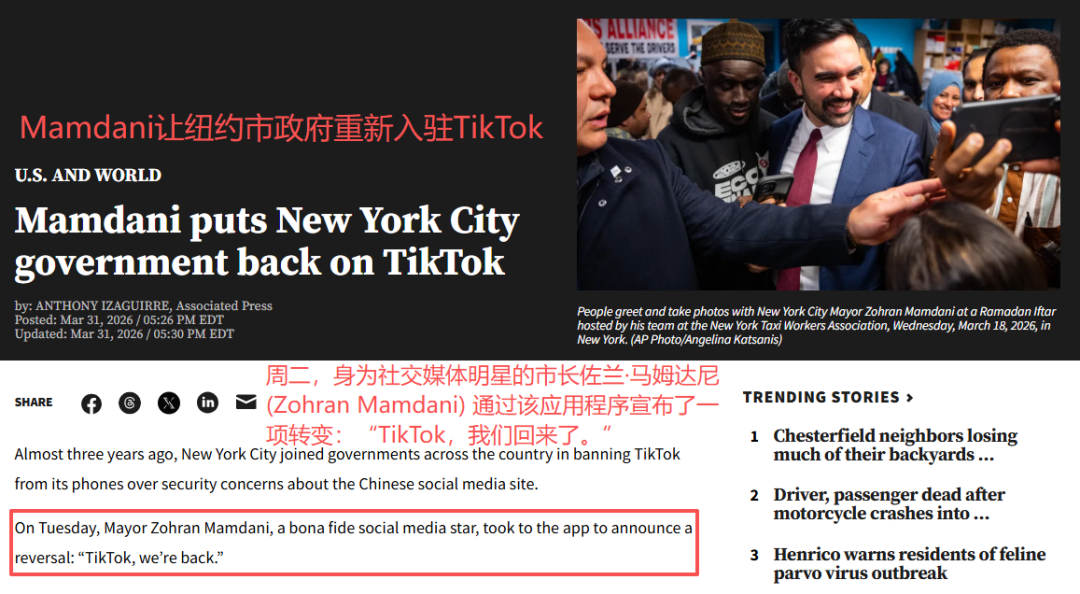
1998The TikTok ban on U.S. federal government devices has officially been lifted.
The U.S. Department of Justice ruled this week that the law passed at the end of 2022 banning TikTok on federal government devices no longer applies to the current version of TikTok. Federal employees can now download and use TikTok on government-issued devices.
As soon as the news broke, many felt that TikTok had won a tough battle. But if you only look at the surface, you might miss the truly interesting part of this story — the reason for the lifting of the ban is not that U.S. policy has loosened, but that ByteDance has come up with a brand new compliance plan.
Source: cbsnews
ByteDance did not sell, nor did it fight hard.
In the past, when Chinese internet companies ventured into the U.S., they basically had only two options when facing regulatory pressure: either fight hard until the last moment, or sell out and walk away, handing over the market.
ByteDance's choice was different.
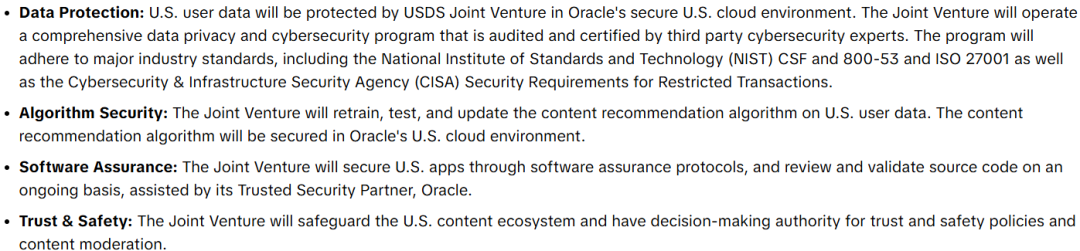
In January, TikTok spun off its core security operations in the U.S. market and established a separate joint venture — TikTok USDS Joint Venture LLC. This company operates independently of ByteDance and is fully responsible for U.S. user data security, algorithm compliance, content moderation, and software assurance. The joint venture’s board consists of seven members, most of whom are locals; CEO Adam Presser and Chief Security Officer Will Farrell are both Americans.
Source: TikTok official website
In terms of equity distribution, Oracle, Silver Lake, and MGX each hold 15%, while ByteDance retains 19.9% of shares. Although ByteDance remains the largest single shareholder, it has largely handed over operational control and data control — data is stored in the U.S., and the government can oversee it.
This structure has been compared by many to Apple's 'Guiyang Cloud' model in the Chinese market — localized data storage and operations, but without completely giving up control of core assets.
In simple terms, ByteDance neither sold TikTok's U.S. business nor stubbornly refused to back down, but chose a third path: partially ceding control in exchange for the continued existence of the market.
This may serve as a reference model for future Chinese companies going overseas facing strong regulation.
Source: TikTok official website
E-commerce sellers are the biggest beneficiaries.
The lifting of the ban may have greater significance for sellers on TikTok e-commerce than most people imagine.
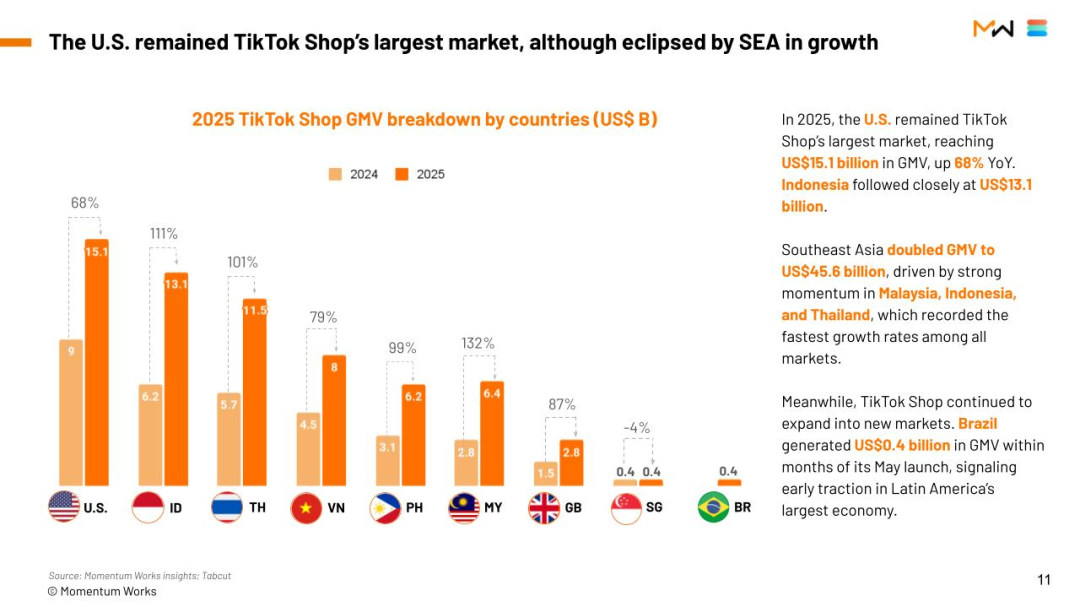
TikTok Shop's performance in the U.S. has already been strong. Data shows that in 2025, TikTok Shop's global GMV reached $64.3 billion, with the U.S. market contributing $15.1 billion. In the first quarter of 2026, TikTok Shop's sales in the U.S. reached $4.9 billion, nearly doubling year-over-year. For the full year, it is predicted that TikTok Shop's U.S. GMV could reach approximately $23.4 billion in 2026.
Source: momentum.asia
Content e-commerce has taken off in the U.S. Live-stream shopping and short-video shopping are becoming increasingly popular among Americans. Last December, the live-stream debut by 'Thyroid Brother' resulted in the cooperating brand's products selling out the next day.
The ban no longer applies, which essentially removes the biggest ceiling for this rapidly growing market. In the past, many brands and sellers were hesitant to increase investment in TikTok due to concerns about policy uncertainty — fearing that a ban could wipe out all their investments. Now that compliance issues are largely settled, both merchants' willingness to join and advertisers' budgets will see a significant increase.
For cross-border sellers targeting the U.S. market, the overall traffic and business environment of the platform will improve. This is not a short-term benefit but a long-term certainty.

Source: TikTok
The signal is already clear.
Looking back at this, TikTok's solution this time sends a very clear signal: Chinese internet companies going overseas have moved from the product export phase to the comprehensive localization phase.
In the past, going overseas meant 'products go out, the company stays in China' – pushing apps to overseas markets, while operations, data, and decisions were still controlled by the domestic team. But now, facing an increasingly complex regulatory environment, this approach may no longer work. TikTok's choice is to hand over the most sensitive parts—data, operations, security—to local teams and local capital, while stepping back into the role of technology licensing and minority equity.
This is not a compromise, but a pragmatic evolution.
For cross-border e-commerce sellers, this trend deserves early attention. Platforms are localizing, ecosystems are localizing, and regulations are localizing. Whoever can adapt to this new pace faster will secure a better position in the upcoming competition.
TikTok's 'turnaround battle' was not particularly elegant, but the path has been cleared. Next, it's about who can keep up with this ride.