 1262
1262Recently, TikTok Shop US officially announced entering the golden preparation period for the Black Friday sales season.
Last year's Black Friday and Cyber Monday, the platform proved its strong purchasing power conversion capability with a GMV of $500 million. This year, however, the complexity and imagination space of this battle have clearly been elevated to a new dimension.
Image source: Google
The shift from single-point surge to quarterly-level campaign
A notable change is that Black Friday is no longer an isolated promotion node in the TikTok context.
Through top-level design of marketing resources, the platform is linking August's back-to-school season, September's stocking-up season, October's Halloween autumn promotions, November's Black Friday proper, and December's Christmas season into a continuously rising growth curve. This means sellers are facing a months-long quarterly business battle rather than a one-time traffic sprint.

Image source: Google
This shift places higher demands on sellers' supply chain resilience and marketing rhythm control. Cross-border POP merchants are explicitly required to immediately review and stock goods, ensuring that evergreen bestsellers are warehoused before October. This is effectively using the time window to filter out players with forward-planning capabilities.
Merchants hoping to cram at the last minute are likely to fall behind at the starting line due to insufficient inventory depth or delayed warehousing.
Fully managed merchants must follow a more refined three-round stocking rhythm—from the 20% target in late September, to sprinting to 80% in early November, until clearing 100% before Black Friday. Every node is a precise response to the platform's traffic allocation mechanism.

Image source: Google
AIGC and auctions: the incremental logic behind stacked variables.
On top of last year's $500 million explosive momentum, the platform has layered in new incremental gameplay such as AIGC and auctions this year—undoubtedly the most disruptive variable in this preparation campaign.
If live streaming and image-text content are the routine deep cultivation of the content field, then the intervention of AIGC is providing sellers with an "arms race"-level tool upgrade in content production capacity.
For sellers, this is both an opportunity and a hidden concern. The opportunity is that AIGC can significantly lower the production threshold for high-quality marketing materials, especially during a period like Black Friday that requires massive content deployment. Sellers good at using AIGC tools can quickly test materials, obtain traffic testing data at lower marginal cost before influencer slots, and realize the early cashing-in of content compound interest.

Image source: Google
But the hidden concern also exists. When the threshold for content creation is leveled by technology, sellers who fall behind will be separated by a generational gap in content production capacity. Inventory depth can still be solved through capital turnover, but lagging content production efficiency may lead to sustained disadvantage in traffic competition.
The introduction of the "auction" gameplay, meanwhile, may open a new path for the closing of high-value goods. It may provide a unique bidding arena for high-ticket categories such as 3C digital products and luxury gift boxes, steering the price war during promotions into a more interesting and interactive value discovery process.
This poses new propositions for sellers to adjust their merch strategies and plan differentiated marketing events. Around the three main axes of low-price mindset, stockpiling, and high-value transactions, categories such as large home goods, cost-effective gift boxes, seasonal clothing, and personal care gift sets will find their own explosive points in different combinations of gameplay.
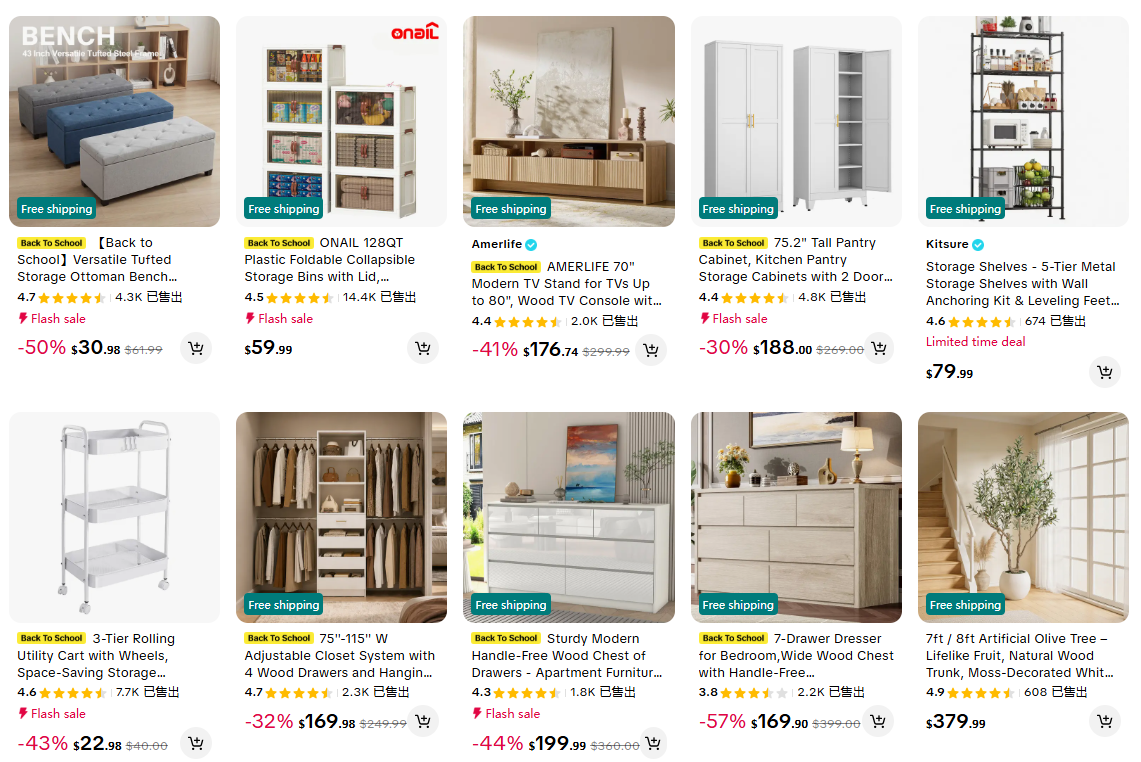
Image source: TikTok shop
Keep up with the rhythm, or be left behind?
The platform has already released week-by-week operational guidance through intensive offline conferences, from the Shenzhen POP merchant conference in late August to the subsequent Shenzhen-Guangzhou-Yiwu fully managed roadshow conference. The core purpose is to help sellers break down the macro rhythm into actionable execution checklists.
In this business driven jointly by the content field, multiple nodes, and layered merchandise planning, sellers who can keep up with the pace will have the opportunity to fully capture the gift-giving scenario dividend of the entire peak season; while participants with weaker rhythm may face the dual risks of inventory backlog and missed traffic.