 75
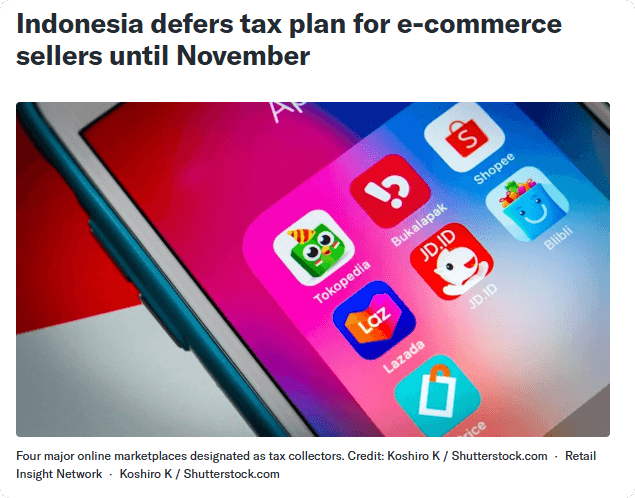
75In 2026, Indonesia's e-commerce market is expected to reach $71 billion in transaction value, making it the largest e-commerce market in Southeast Asia. Sellers doing business in this market are facing a new collection arrangement: platforms withholding and remitting sellers' income tax.
The policy basis is Regulation No. 37 of 2025 of Indonesia's Ministry of Finance, which designates four platforms—Shopee, Tokopedia, Lazada, and Blibli—as withholding agents, withholding PPh Article 22 income tax at 0.5% of sellers' transaction turnover, with the tax base being gross income, excluding VAT.
Simply put, this is not a new tax, but a change from sellers having to declare and pay the tax themselves to the platform directly deducting it during settlement.
It sounds reasonable, but this tax has taken a rather tortuous path from introduction to implementation.
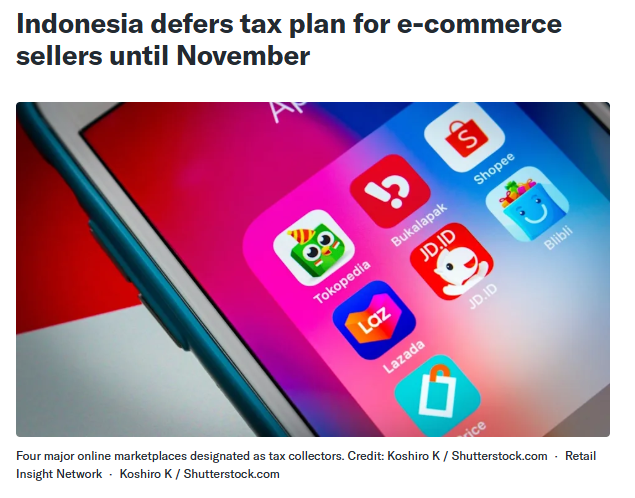
Image source: finance.yahoo
A tax law postponed three times
This policy was written into a Ministry of Finance regulation as early as July 2025, originally scheduled for implementation on August 1, 2026.
According to multiple media reports, on August 1 the withholding system did briefly go online, and some sellers' payouts were reduced. But just four days later, then Finance Minister Purbaya announced a postponement, saying economic growth and consumption needed further observation—at that time Indonesia's second-quarter GDP growth had slipped from 5.61% in the first quarter to 5.29%, and officials worried the new tax would further suppress purchasing power.
The tax office subsequently notified that already-withheld taxes would be refunded to sellers, and implementation was postponed to November 1. By mid-September, the head of the tax office once mentioned October 1, while the e-commerce association publicly requested a delay to 2027, arguing the industry's systems were not ready.
Ultimately, the implementation date was clarified again as November 1. A tax law being rescheduled several times reflects the need to find a balance between economic recovery and tax administration.
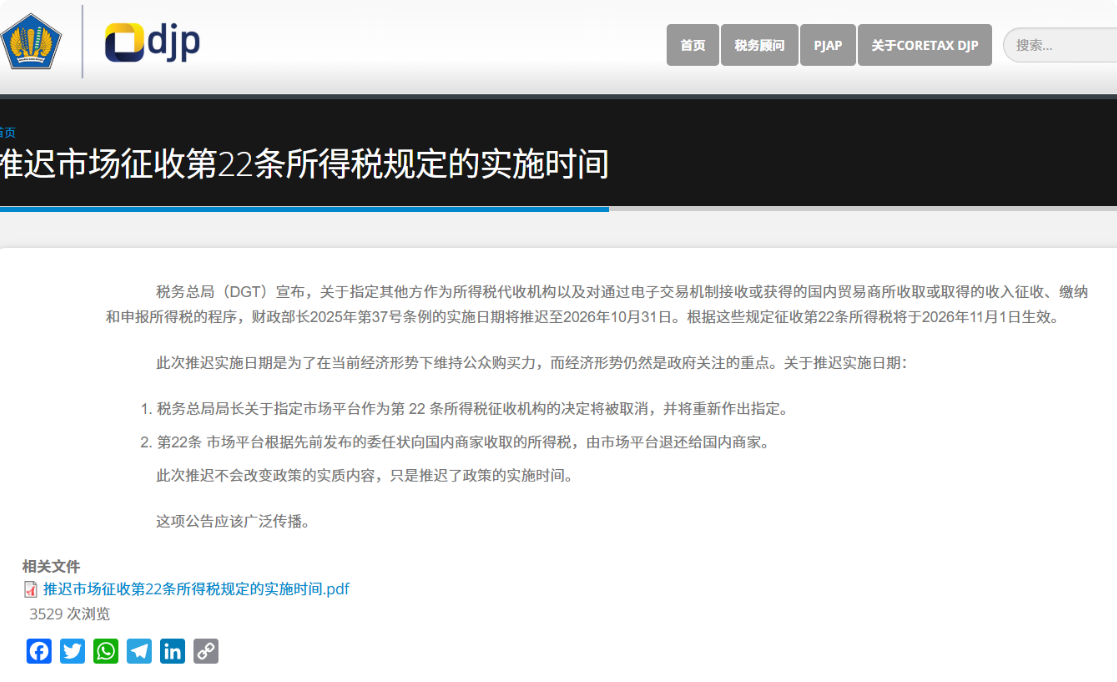
Image source: pajak
Why are platforms collecting it?
Indonesia's e-commerce market is highly concentrated. According to statistics from Momentum Works, Shopee accounts for 54% of Indonesia's platform e-commerce GMV, TikTok Shop and Tokopedia together account for 38%, and Lazada accounts for 6%.
The top two together account for more than 90% of market share, meaning transactions are highly concentrated on a few platforms. Sellers are spread across the country, but the platforms hold the record of every transaction and also handle every payment.
Embedding withholding into the settlement process is far more efficient than having millions of small sellers each go to the tax office to declare. Tokopedia is controlled by ByteDance's TikTok, Shopee is backed by Singapore's Sea Group, Lazada belongs to Alibaba, and Blibli is a local Indonesian platform.
By assigning the tax withholding function to these platforms, the government has turned them from mere trading venues into local tax enforcement terminals.
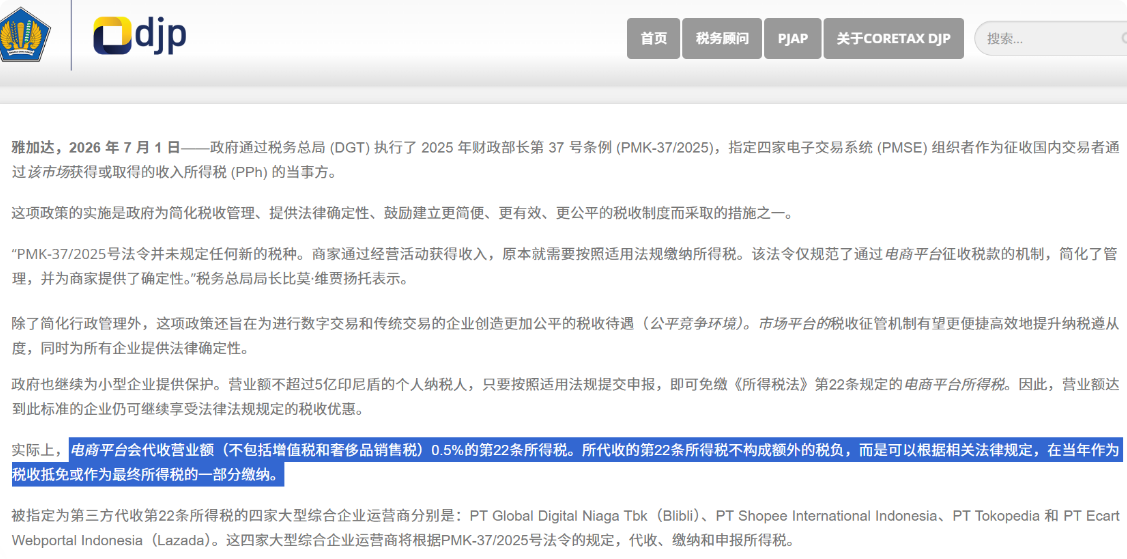
Image source: pajak
What do sellers really care about?
The 0.5% figure itself is not high. The issue is its nature and timing.
This tax is a prepayment and can be offset during the year-end tax settlement, so in theory it does not increase the additional tax burden. But it does change the rhythm of sellers' cash flow. For a seller with annual sales of RMB 10 million, every payout is first reduced by 0.5%, and this money can only be refunded or offset after the following year's settlement, equivalent to more than half a year's working capital being tied up interest-free.
For low-margin sellers with a net margin of only about 5%, a 0.5% turnover tax burden is equivalent to 10% of profit. Platform commissions, logistics costs, and marketing spending are already layered on top of one another, and this 0.5% stands out especially clearly on the income statement.
The policy also leaves an opening. Individual sellers with annual turnover not exceeding IDR 500 million can submit a declaration to the platform to be exempt from withholding. But the exemption requires active application; stores that do not submit a declaration will be subject to withholding by default. Moreover, Indonesia's Directorate General of Taxes has made clear that the practice of the same seller opening multiple stores on multiple platforms and keeping each store's turnover below IDR 500 million is no longer effective; tax authorities will aggregate the overall turnover of the same taxpayer to make a judgment.
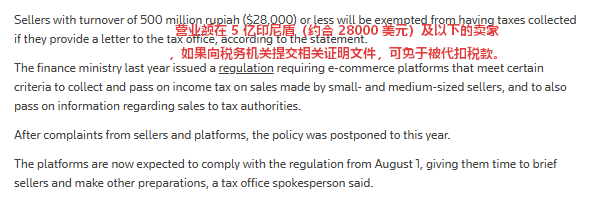
Image source: Reuters
The logic of growth is changing
Indonesia's e-commerce market is still growing, but the logic of growth is already different from a few years ago.
The phase when money could be made simply by listing a wide range of products and pushing volume is passing. Platform settlement rules, tax compliance costs, and cash flow management—areas that were not paid much attention to before—are becoming key variables determining whether sellers can sustain operations in this market.
For sellers who have already registered a local company in Indonesia, they need to confirm as soon as possible whether they fall within the withholding scope; for individual sellers with annual turnover below IDR 500 million, proactively submitting an exemption declaration is something they can do right now. The rules are already clear; what remains is how to adapt to them.