This document is the Singapore Going Abroad Manual launched by BIPO, mainly providing guidance on human resource management and other aspects for enterprises planning to conduct business in Singapore. The main contents are introduced below from different sections:
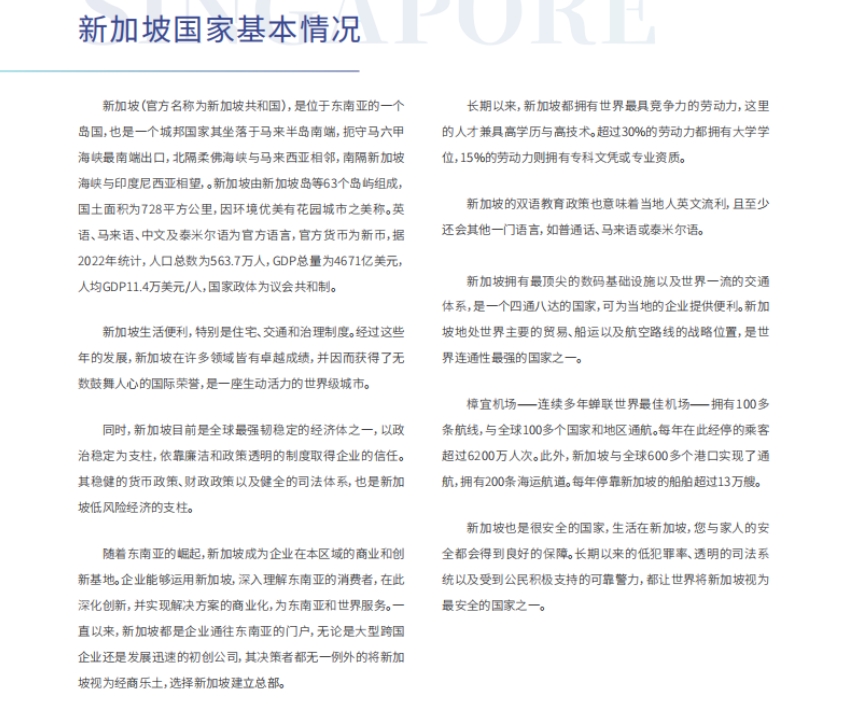
1. Overview of Singapore: Singapore is an island country in Southeast Asia, with a beautiful environment, stable economy, transparent policies, and sound judiciary, making it an ideal gateway for enterprises to enter the Southeast Asian market. The workforce here is highly qualified, infrastructure is top-notch, transportation is convenient, and public security is good.
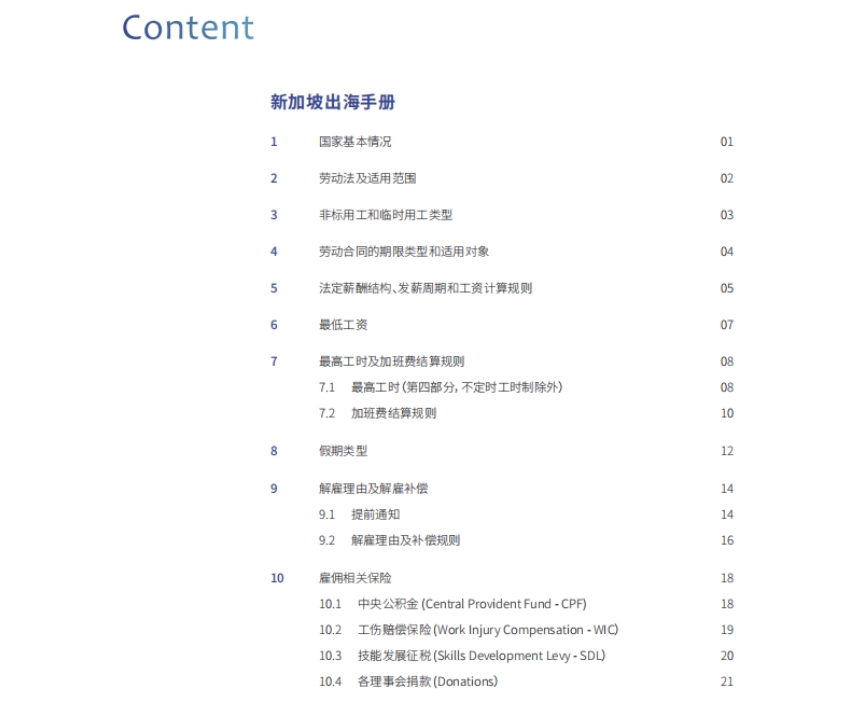
2. Employment-related Regulations
- Scope of the Employment Act: The Employment Act stipulates the scope of basic protection. Part IV clearly defines the applicable conditions for manual and non-manual workers, but groups such as seafarers and domestic workers are not covered by this part.
- Types of Employment: Introduces the regulations on working hours, overtime pay, holidays, etc. for non-standard and temporary employment such as part-time staff. For example, part-time staff work less than 35 hours/week, and the calculation rules for overtime pay are also different from those for full-time staff.
- Employment Contract: There are requirements for contract term, delivery period, written form, and mandatory clauses. For example, the contract must be delivered to the employee within 14 days from the date of employment and must include multiple clauses such as the employer's name and the employee's name.
- Remuneration: Clearly defines the statutory salary structure, pay cycle, and wage calculation rules, including the definition and structure of statutory salary, regulations on the issuance of year-end bonuses and bonuses, as well as the currency, cycle, conditions, and restrictions for salary payment. Singapore does not have a unified minimum wage standard.
- Working Hours and Overtime Pay: Specifies the maximum working hours and overtime pay settlement rules under different working hour systems. The irregular working hour system has application conditions and requirements, and there are also regulations on the calculation base for overtime pay.
- Leave: Covers various types of leave such as paid annual leave, sick leave, and maternity leave. Different types of leave apply to different groups and have different durations, as well as statutory holiday arrangements.
- Dismissal and Compensation: Explains that dismissal requires advance notice, with the notice period depending on the contract or years of service, and distinguishes between reasonable dismissal, unlawful dismissal, and compensation rules.
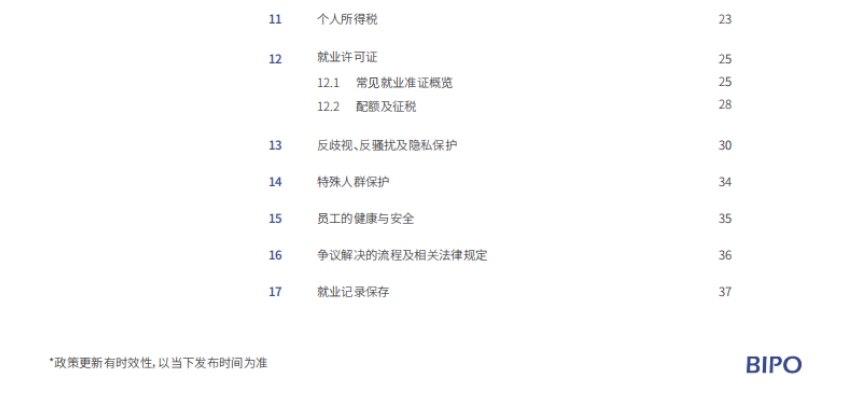
3. Employment Insurance and Taxation: Includes regulations on the Central Provident Fund, work injury compensation insurance, Skills Development Levy, contributions to various councils, as well as the tax year, tax rates, and filing deadlines for personal income tax.
4. Employment Passes: Introduces the application conditions, duration, quota, and tax regulations for common employment passes (such as EP, SP, WP), as well as penalties for late tax payments.
5. Employee Rights Protection: Involves relevant guidelines and laws on anti-discrimination, anti-harassment, and privacy protection, as well as protection regulations for special groups (children and adolescents).
6. Health and Safety: Clarifies the obligations of employers and employees regarding employee health and safety. Employers are required to conduct risk assessments, and employees must comply with safety regulations.
7. Dispute Resolution: The Tripartite Alliance for Dispute Management (TADM) provides consultation and mediation services. The Employment Claims Tribunal (ECT) hears related claims, and there are also the scope and conditions for the Tripartite Mediation Framework (TMF).
8. Employment Record Keeping: Requires employers to keep employment records, stipulating the form, retention period, and content of the records.