 889
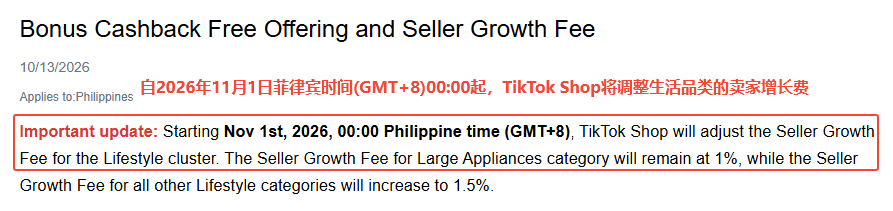
Recently, TikTok Shop's local site in the Philippines issued a fee adjustment announcement, which touched a nerve among many sellers.
According to the announcement, starting from 00:00 on November 1, 2026, the platform will adjust the seller growth fee (including VAT) for the lifestyle cluster.
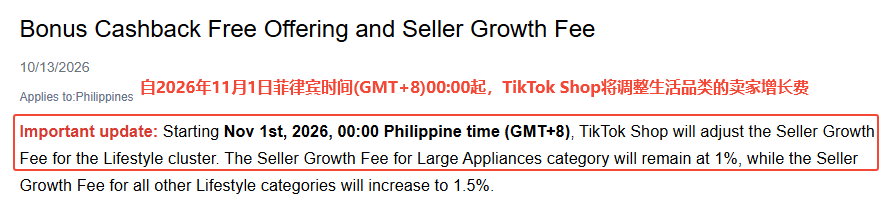
Image source: seller-ph.tiktok
Specifically, electronics, groceries, and major appliances will be charged 1%; beauty and personal care, fashion, mother and baby, health, and lifestyle products (excluding large appliances) will be charged 1.5%. This means the highest rate has reached 1.5%.
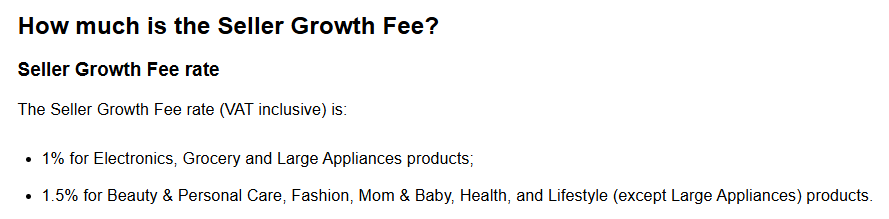
Image source: seller-ph.tiktok
For local and cross-border sellers cultivating the Philippine market, this is not a number that can be ignored, especially for merchants that rely on low-ticket, low-margin products to drive volume; their profit margins will face direct pressure.
What game is the platform playing?
TikTok Shop emphasized that this fee is intended to support a series of subsidies and support measures, including improvements to logistics infrastructure, the development of innovative AI tools, and enhancements to the shopping experience, while also increasing platform subsidies in reward cashback and promotional activities.
In other words, the platform is not simply raising prices, but trying to use the growth fee charged on each successful order to inject funds into subsequent ecosystem building.
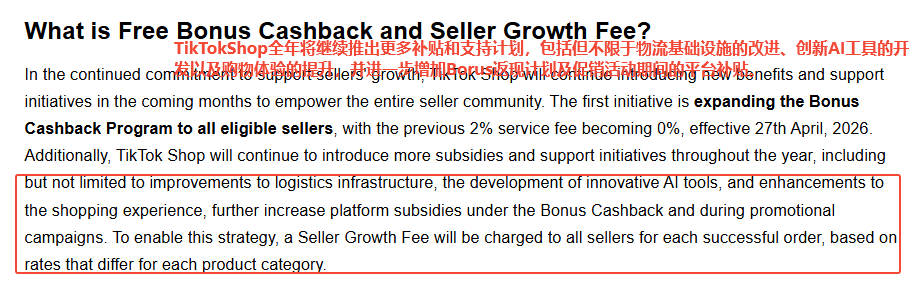
Image source: seller-ph.tiktok
Rates vary by product category, which also reflects the platform's differentiated consideration of different categories. Electronics, groceries, and large appliances have relatively lower rates, while categories such as beauty and personal care, fashion, and mother and baby have higher rates, which may be related to the competitive landscape, subsidy intensity, or operating costs of these categories.
For sellers, understanding this logic is important: the fee increase is not an isolated event but part of the platform's strategic adjustment. It brings cost pressure while also implying the possibility that the platform will continue to increase investment in traffic and subsidies.
Subtle changes on the profit statement
The most direct impact, of course, falls on sellers' profit calculations. The growth fee is charged per successful order and includes VAT, meaning that after each transaction, sellers must carve out a portion of their revenue and hand it to the platform.
For low-ticket products, a 1% or 1.5% rate may not seem high, but when stacked on top of other costs, the actual proportion of profit eroded may be considerable.
In addition, different rates for different categories mean that sellers operating multiple categories need to calculate by category and can no longer estimate costs in a one-size-fits-all way.
For cross-border sellers, variables such as exchange rates and logistics must also be considered, and the chain reactions brought by the fee adjustment require more careful assessment. The announcement specifically reminds sellers to recalculate their profit margins before the fees take effect; this is by no means a courtesy phrase, but a real business reminder.
Image source: Google
From passive pressure to proactive adjustment
Faced with rate increases, sellers do not have to accept them passively. Recalculating profit margins is the top priority, especially for low-ticket, low-margin products; sellers should combine the actual costs after the rates are stacked to determine which products can still maintain reasonable profits and which need pricing adjustments or cost structure optimization.
Second, sellers can review their category mix. If high-rate categories account for too large a share, they might consider whether to increase the average order value through product upgrades, bundled sales, and other methods to dilute the impact of the rates.
Third, the subsidies and promotional activities mentioned by the platform deserve close attention. Sellers can actively participate in reward cashback and platform subsidy activities to use platform resources to offset part of the fee pressure.
Image source: Google
Conclusion
TikTok Shop Philippines' latest increase in the seller growth fee, with a rate of up to 1.5%, may seem limited in magnitude, but for sellers with low average order value and low gross margins, the impact should not be underestimated.
In the long run, healthy interaction between the platform and sellers is the cornerstone of a healthy ecosystem. The period before the fees take effect is exactly a window for sellers to adjust their strategies; only by preparing early can they respond with ease.