 62
'Refund only' has been debated in China's e-commerce for years; now it has a new name and appears in the backend of Amazon's European sites.
Amazon has launched a 'refund without return' program for FBA sellers on five sites: Germany, France, Italy, Spain, and the UK. The rules are not complicated: sellers participate voluntarily, choose their own products, and set their own price thresholds, with a per-item cap between 1 and 75 euros, and 1 to 75 pounds on the UK site. When buyers request a return, the platform reviews each case individually; if it qualifies, the refund is issued directly and the product stays with the buyer.

Image source: Amazon
Why did Amazon launch refund without return?
From the platform's perspective, this policy first considers return costs.
Under normal circumstances, after a buyer requests a return, the product must go through processes such as shipping back, warehousing, and inspection. If the product is in good condition, it can be relisted for sale; but if it has been opened, damaged, or is inherently unsuitable for resale, the value of recovering the product is greatly reduced.
For some low-priced products, the situation is even clearer. Suppose a product sells for only a dozen or so euros, yet the seller has to bear return shipping, processing, and storage costs for it; in the end, the seller may find that the cost of recovering the product has exceeded the value that can be salvaged from the product itself.
Rather than letting the product continue to incur costs during the return process, it is better to refund directly and let the buyer keep the product. This is also an important reason why Amazon launched this feature.
For sellers, it does indeed provide a new way to control costs, especially for products with high return processing costs and low recovery value.
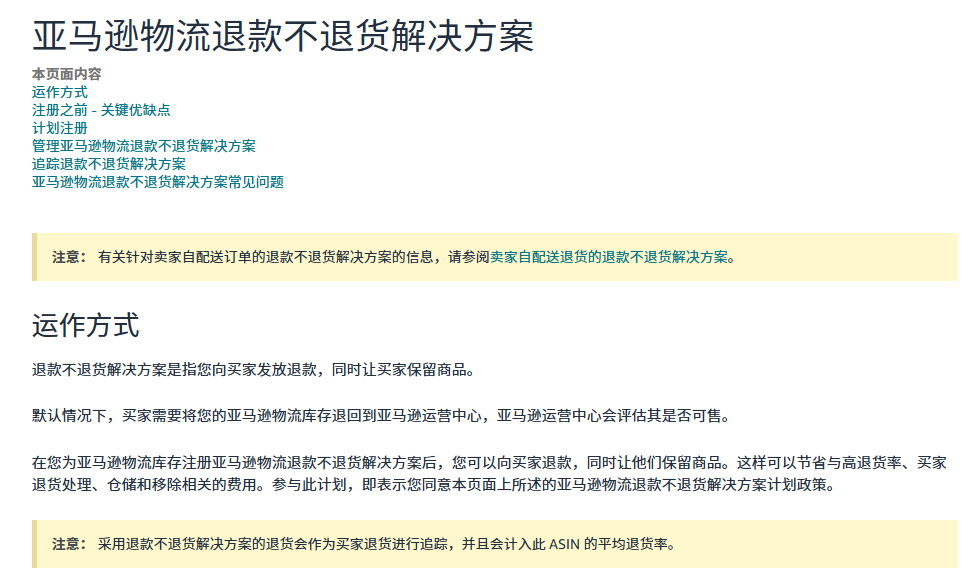
Image source: Amazon
Saving on return fees may also mean losing product value
However, refund without return does not mean sellers will definitely save money.
Amazon clearly stated several restrictions in its official announcement: returns processed through this feature will still count toward the product return rate, but the corresponding high return rate fee will not be charged. At the same time, such products are not eligible for inventory reimbursement.
In other words, after the buyer receives the refund, the product will not return to the seller's inventory, and the seller can no longer recover part of the loss through refurbishment, repackaging, or resale.
This brings up a very practical question: should one bear the return processing costs and get the product back, or refund directly and give up the remaining value of the product?
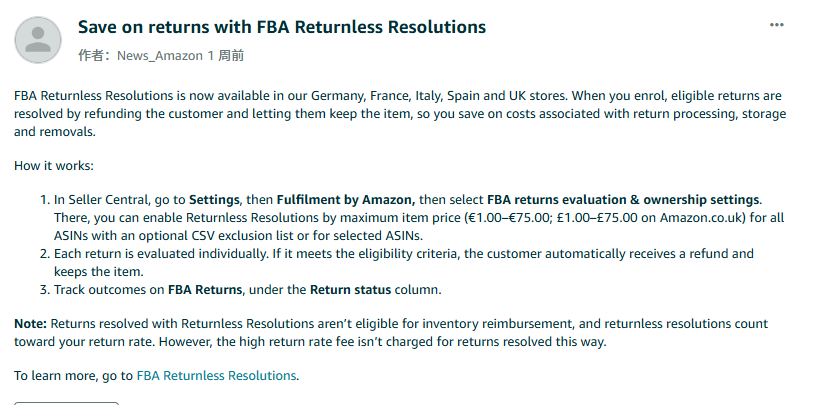
Image source: Amazon
Making refunds convenient also requires preventing rule abuse
In addition to cost issues, sellers have another concern about refund without return: if buyers use this rule to maliciously request refunds, who should bear the loss?
This concern is not entirely without basis in reality.
In February 2025, the U.S. Department of Justice disclosed an online refund fraud case. The case involved a refund fraud operation called Ressu Refunds, whose operator, Leonardo Vidal, recruited users through Telegram and other channels, helped buyers request refunds from retailers under false pretenses, and charged fees for it.
In just 8 months, the operation facilitated more than 3,000 fraudulent refunds, involving at least $5.3 million. Ultimately, Vidal was sentenced to 30 months in prison for wire fraud and money laundering-related crimes.
Of course, this case cannot prove that Amazon's new feature will lead to similar problems, nor can it directly show that fraud on the same scale exists in the European market. But it at least shows that once refund mechanisms are exploited by criminals, they can evolve from individual after-sales disputes into organized profiteering.
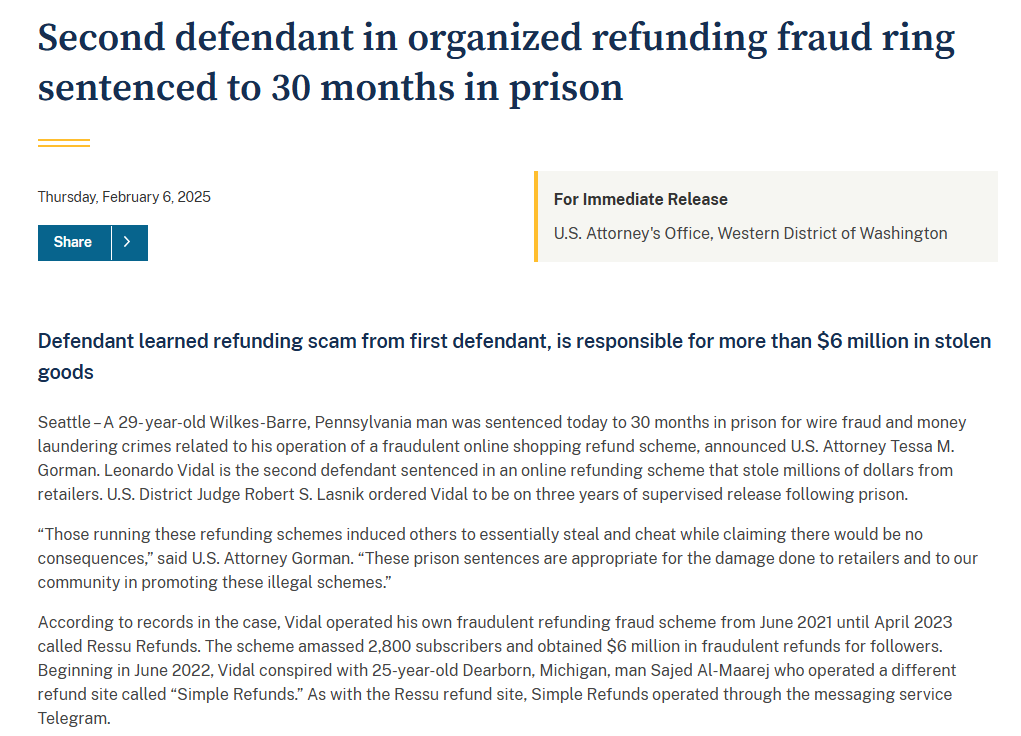
Image source: justice
Although Amazon says it will screen buyers and offer this option only to accounts without a history of return abuse. But how many abnormal requests this screening system can block still needs to be tested in actual operation.
Ultimately, refund without return only changes the after-sales handling method; it does not make return costs disappear out of thin air. For cross-border sellers, every step from product sales to return recovery needs to be calculated clearly. Only by getting the accounts straight can they determine whether this new feature is a tool for reducing costs or another operating expense they need to bear.