 85
In the European market, JD.com has placed another important piece on the board.
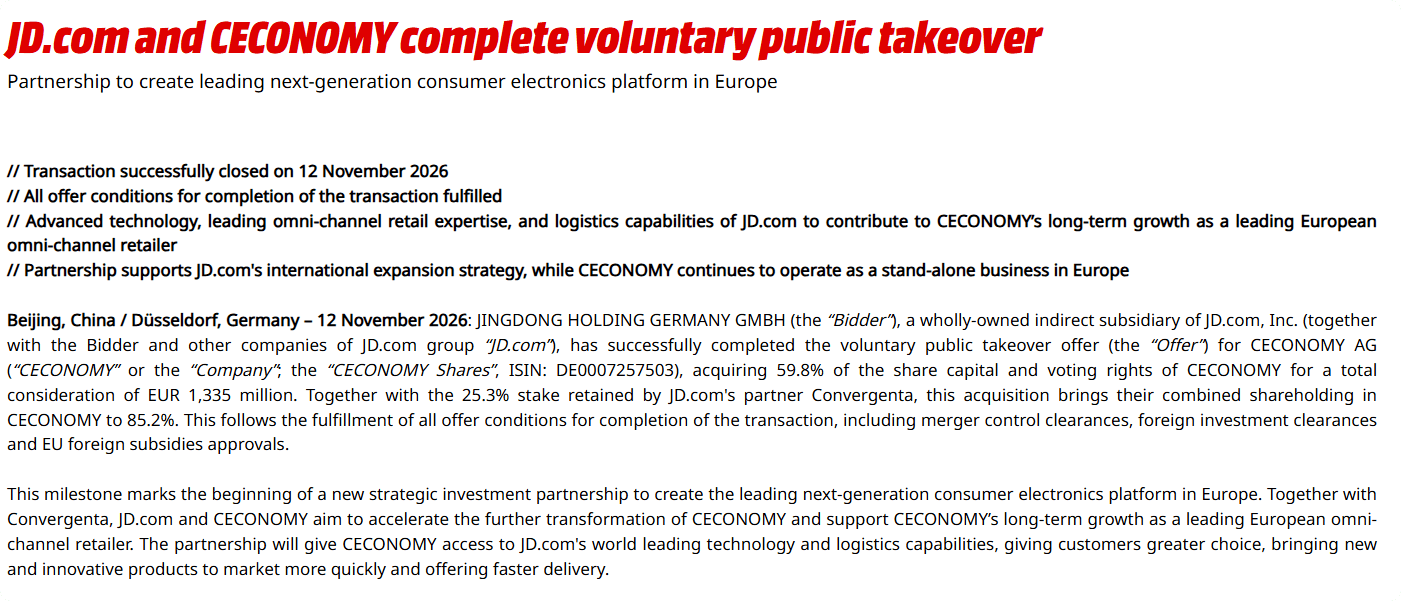
On November 12, JD.com Group announced that it had officially completed the acquisition of European consumer electronics retail group Ceconomy. In this transaction, JD.com acquired 59.8% of Ceconomy's equity and voting rights for 1.335 billion euros (approximately RMB 9.9 billion), and Ceconomy thereby became a subsidiary of JD.com.
This transaction means that JD.com not only has its own online shopping platform in Europe, but has also further extended its business reach into the local mature offline retail market.
Image source: Ceconomy
01 A RMB 10 billion acquisition: JD.com takes over a European retail giant
First, let's get to know Ceconomy.
This Germany-headquartered consumer electronics retail group owns well-known retail brands such as MediaMarkt and Saturn. It mainly sells mobile phones, computers, home appliances and other consumer electronics products, and is one of the largest consumer electronics retail groups in Europe.
In terms of operating scale, Ceconomy has more than 1,000 physical stores in 11 European countries and regions and also operates online retail business. At present, the company has more than 50,000 employees; in 2025, its membership exceeded 53 million, and annual customer reach reached 2.2 billion.
Image source: Google
For JD.com, behind these figures is a retail network that has operated in the European market for many years, as well as local consumer resources accumulated over years.
Under the transaction arrangement, JD.com acquired 59.8% of Ceconomy's equity for 1.335 billion euros. Together with the 25.3% stake retained by partner Convergenta, the two parties' combined shareholding reaches 85.2%.
It is worth noting that Ceconomy becoming a JD.com subsidiary does not mean its existing business will undergo large-scale adjustments immediately.
According to the plans of both parties, Ceconomy will continue to operate independently in the future, continue to use its local technology architecture, and its existing employee team, labor agreements and operating sites will all remain unchanged.
Simply put, JD.com hopes to first retain Ceconomy's existing brand influence and local operating capabilities, and then integrate its own experience in technology, warehousing, logistics and omnichannel retail into it.

Image source: Google
02 From online to offline, JD.com accelerates its European expansion
In fact, acquiring Ceconomy is not JD.com's first step into the European market.
On March 16 this year, Joybuy, JD.com's European online retail platform, officially launched, initially covering six countries: the United Kingdom, Germany, France, the Netherlands, Belgium and Luxembourg.
The platform's products cover multiple categories such as consumer electronics, home appliances, beauty, home goods and groceries, offering more than 100,000 kinds of products. At the same time, JoyExpress under JD Logistics is also providing local delivery services in Europe; relying on its own logistics network, it offers same-day and next-day delivery services to consumers in some areas.
This layout is somewhat similar to JD.com's retail model in China: it not only operates an online mall, but also improves consumers' experience from placing an order to receiving goods through warehousing and delivery systems.

Image source: Reuters
03 What JD.com wants is more than just an additional sales channel
Looking at Joybuy and Ceconomy together, JD.com's European layout becomes clearer.
Joybuy handles online business, JoyExpress provides logistics and delivery, while brands such as MediaMarkt and Saturn under Ceconomy have mature offline stores, customer relationships and local retail experience.
If these business segments can collaborate effectively, JD.com will have the opportunity to further connect consumption scenarios such as online shopping, offline experience, in-store pickup, and local delivery.
According to Reuters, the two parties also plan to use Ceconomy's store network to explore faster delivery and in-store pickup services. For categories such as consumer electronics that value product experience, after-sales service, and delivery efficiency, an offline network has certain value.
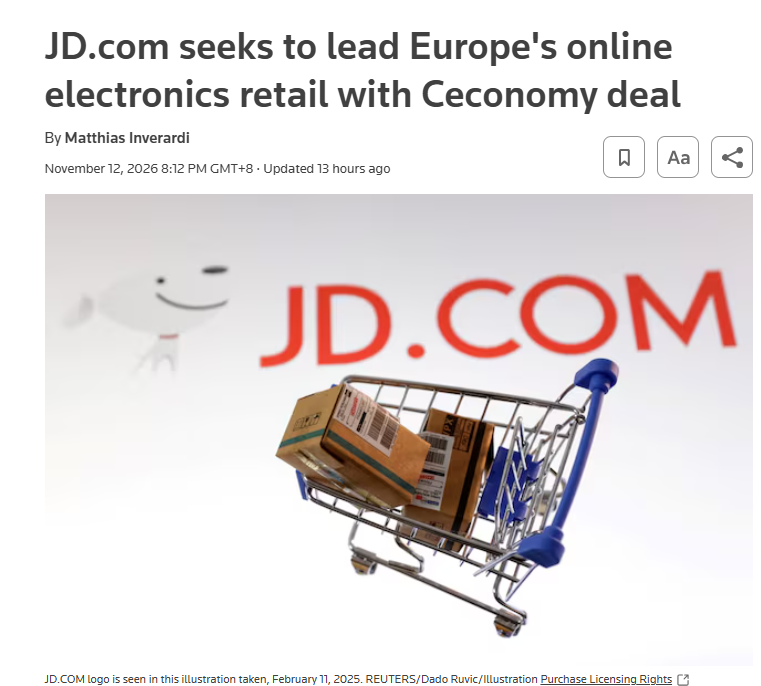
Image source: Reuters
Of course, completing the acquisition is only the first step. How to integrate the two business systems, coordinate local operations and supply chain resources, and build long-term competitiveness in Europe's mature retail market still remains to be tested by time.
For Chinese companies going global, this transaction also provides a noteworthy case: internationalization does not necessarily rely only on building channels from scratch; by acquiring mature local companies, they can also acquire brands, users, and retail networks more quickly.
What JD.com bought this time for nearly 10 billion yuan is not just a consumer electronics retail group, but also a local commercial network that has been deeply cultivated in Europe for many years. Next, whether this set of resources can form true synergy with JD.com's supply chain advantages will be an important focus for its European business development.