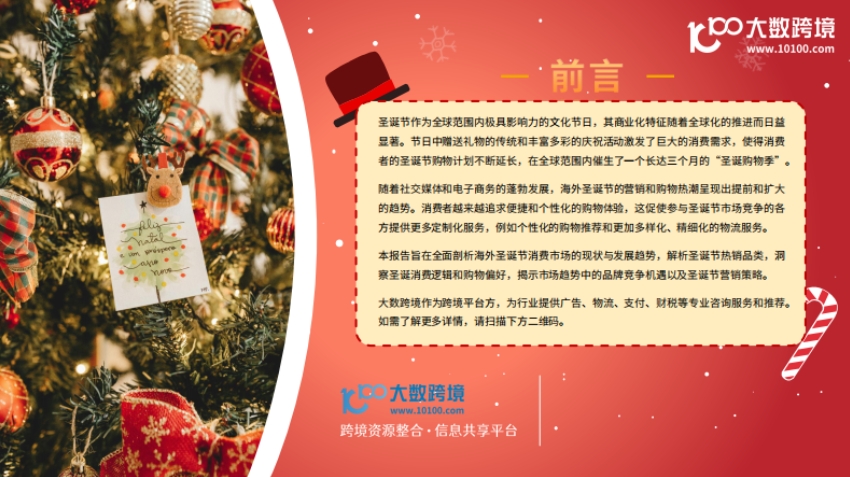
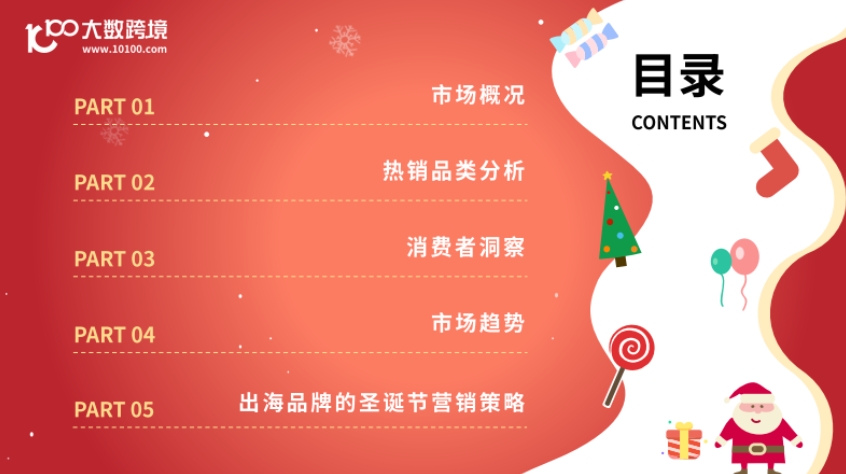
The "2024 Christmas Overseas Consumer Market Insight Report" is produced by Daxu Cross-border, providing a comprehensive analysis of the overseas Christmas consumer market. The report covers market overview, best-selling categories, consumer insights, market trends, and overseas brand marketing strategies, offering professional consulting services for the industry and helping enterprises seize Christmas consumption opportunities.
1. Market Overview
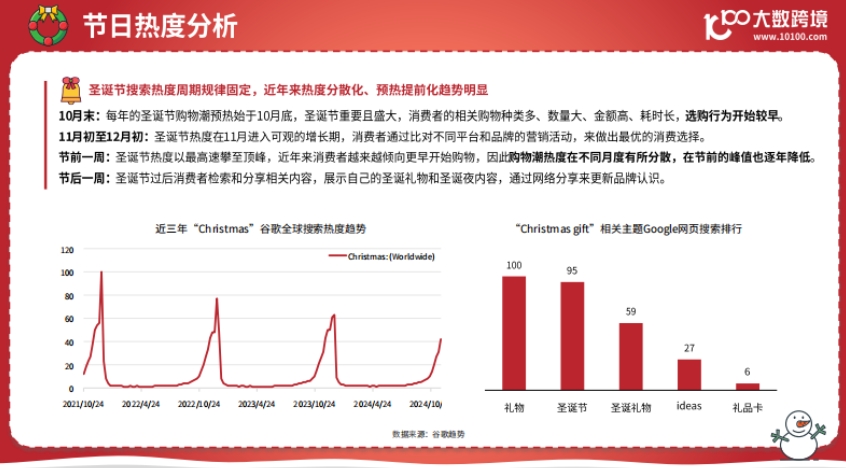
- Holiday Popularity: The search popularity cycle for Christmas is regular and fixed, with recent years seeing more dispersed interest and earlier warm-up. Warm-up starts at the end of October, with popularity growing from November to early December, peaking in the week before the holiday, and consumers sharing related content in the week after.
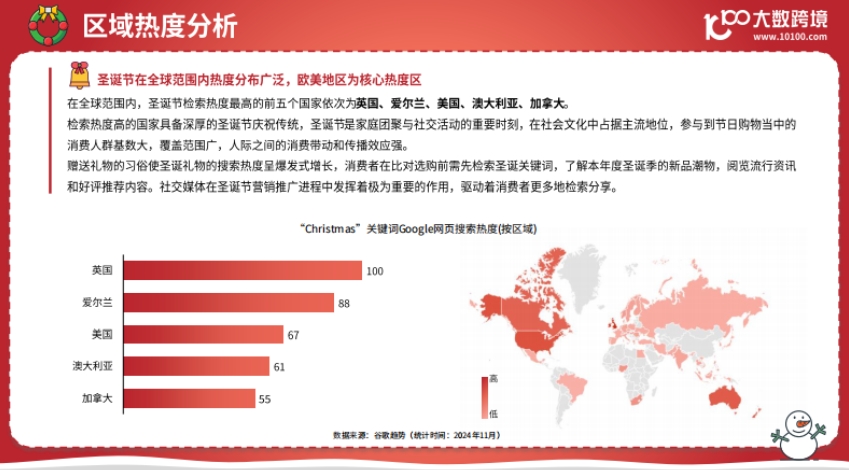
- Regional Popularity: Globally, Christmas is most popular in Europe and North America, with the UK, Ireland, and the US leading in search interest. These countries have deep-rooted traditions, large consumer bases, high gift search popularity, and significant influence from social media.
- Activity Participation: Countries that celebrate Christmas have large consumption scales. For example, 88% of US consumers plan to shop, preparing multiple gifts per person; UK consumers tend to buy more gifts, decorations, and participate in various activities.
- Consumption Overview: US holiday season retail sales are growing both online and offline. In the 2023 holiday season, online retail sales reached $251.7 billion, while brick-and-mortar store sales were $694.1 billion. Per capita holiday spending plans are increasing, with consumption motivations driving budgets higher.
- Sales Channels: E-commerce platforms are the top choice, with about three-quarters of US consumers choosing Amazon, followed by Walmart and Target; physical stores remain important, with over 40% of consumers planning to shop at department stores and similar outlets. Since 2023, some consumers have started using ChatGPT for shopping.
- E-commerce Channels: E-commerce is booming, with US e-commerce sales expected to grow in 2024-2025. Searches for the keyword "Christmas" on Amazon US are increasing earlier. Consumers shop online mainly for product variety, convenience, and improved services, and young people are interested in "buy now, pay later" options.
2. Best-selling Category Analysis
- Overall Situation: Traditional best-selling categories remain popular, with differences across countries and regions. Products with strong gifting attributes and festive atmosphere, such as gift cards and toys, are favored. Due to living costs, demand for second-hand luxury goods is rising. The proportion of Christmas spending on best-selling categories varies by country.
- Christmas Trees and Decorations: There is large and stable demand for Christmas trees. Artificial trees are popular across all age groups, while natural trees are favored by young and middle-aged groups. About 37% of US consumers plan to spend over $150 on Christmas decorations.
- Christmas Cards: Physical cards are essential gifts, highly valued by UK consumers, who are also willing to display received cards, which are important for maintaining relationships. E-cards are also becoming popular.
- Christmas Gift Cards: With high flexibility, gift cards top the list of most desired Christmas gifts among US consumers. In 2023, most US consumers planned to buy them, averaging three to four cards per person, with restaurant gift cards being the most popular.
- Christmas Toys: Innovative and nostalgic toys lead the trend, with products like Furby and Bitzee making the hot lists, and LEGO being frequently mentioned. Famous IP toys have stable popularity and sales, and the combination of innovative and nostalgic toys with digital marketing has become a hit.
- Category Analysis: For Christmas tree decorations, ornaments and string lights are popular; Christmas cards come in diverse designs to meet different needs; boys prefer LEGO and similar toys, while girls favor Barbie dolls and the like; tech and gaming gift cards are also favored.
3. Consumer Insights
- Consumer Analysis: Christmas gifting helps maintain parent-child and romantic relationships, with products for children and partners selling well. Parents focus on the safety of children's gifts, and consumers are willing to spend more on gifts for close ones.
- Consumer Behavior: Consumption is happening earlier and more dispersed, avoiding peaks and easing year-end stress. Holiday gift budgets are influenced by various factors; Gen Z tends to increase spending, while older generations are more frugal and simple.
- Consumption Budget: US consumers' planned holiday spending on travel, gifts, and entertainment is increasing year by year, with holiday gift spending reaching new highs. Due to the holiday consumption cycle and the need to maintain relationships, consumers have higher price requirements for gifts, and some are starting to try second-hand luxury goods.
- Shopping Preferences: Price is the primary factor, with shipping and return/exchange services also important. Consumers value e-commerce price discounts, free returns, and fast shipping, but also enjoy experiencing products in local malls.
- Shopping Concerns: During the holiday season, consumers worry about out-of-stock and shipping delays. Brands can alleviate these concerns through various measures to enhance the shopping experience.
4. Market Trends
- Overall Trends: The holiday consumer market is expanding, with US 2024 holiday season spending expected to be high. Under economic pressure, consumers tend to choose practical and cost-effective products, and global consumption willingness is positive.
- Consumer Stratification: UK consumer stratification is intensifying, with economically healthy families, recovering families, and struggling families having different Christmas consumption plans. However, the overall number of families looking forward to Christmas is increasing, and consumer confidence is rising.
- Earlier Marketing Nodes: Consumers are starting Christmas shopping earlier, with October-November being the golden period for marketing. Users start paying attention to decoration content in October, become more enthusiastic in November, and attention is more evenly distributed in December.
- Gift Selection Difficulty: Over half of consumers lack inspiration when choosing Christmas gifts, with partners and parents being the hardest to buy for. Brands should provide personalized suggestions.
- Personalized Demand: Christmas consumption needs are highly personalized. UK and US consumers tend to buy personalized gifts and are willing to pay more for them, even if the price is higher.
- High Logistics and Delivery Requirements: Consumers expect detailed and customized logistics services, such as expedited shipping and free delivery. Some are willing to pay extra for faster delivery. Brands offering high-quality delivery services will have an advantage.
5. Overseas Brand Marketing Strategies
- Advent Calendar Marketing: Physical calendars can be used as limited-edition products or gifts to attract consumers, while digital versions can be promoted via social media and combined with promotional activities, such as Søstrene Grene's brand quiz calendar.
- Personalized Test Social Media Promotion: Tests are highly interactive and can collect consumer information for product development and marketing. Reports containing brand information help spread the word, such as Mødrehjælpen's movie character-themed test activity.
- Product Recommendation Services: Help consumers locate products, improve user retention, increase brand sales, and cultivate consumption habits, such as the British Silverstone racing brand helping consumers choose racing products through questionnaires.
- Gift Finder Function: Reduces consumer pressure when shopping for gifts, increases satisfaction, and shortens decision time, such as Siren Craft Beer providing gift purchase suggestions through questionnaires and graphic displays.
- AR Technology for Novel Multi-Scenario Marketing: AR experiences are three-dimensional and novel, can present IP images, spread brand logos, and design interactive methods, integrating into family activities, such as Starbucks' AR limited edition Christmas cups.