This document is the "2024 Overseas Food and Beverage Market White Paper" released by Magic Mirror Insight in November 2024. It mainly analyzes the overview of the overseas food and beverage market, the characteristics of each regional market, the situation of key national markets, as well as detailed data of the beverage and food tracks, and puts forward relevant market trends and strategic recommendations.
1. Overview of Overseas Markets
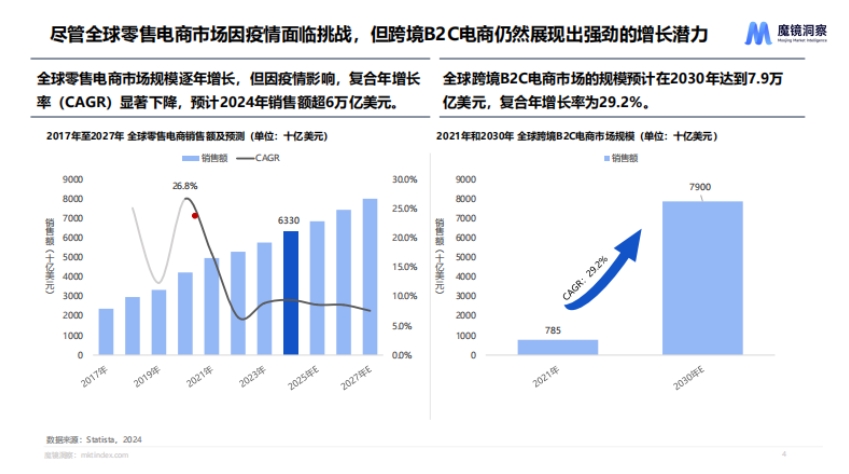
- Global retail e-commerce market: The scale has grown year by year, but the pandemic has caused the compound annual growth rate to decline. It is expected that sales will exceed $6 trillion in 2024; cross-border B2C e-commerce has strong growth potential and is expected to reach $7.9 trillion by 2030, with a compound annual growth rate of 29.2%.
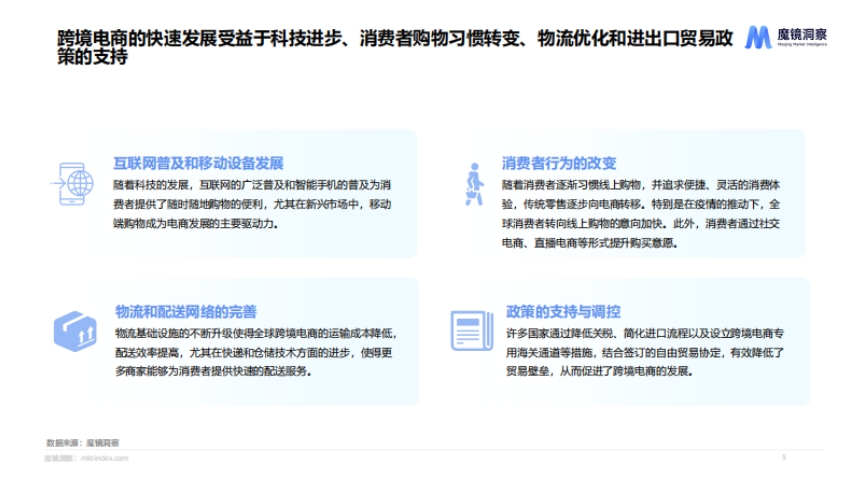
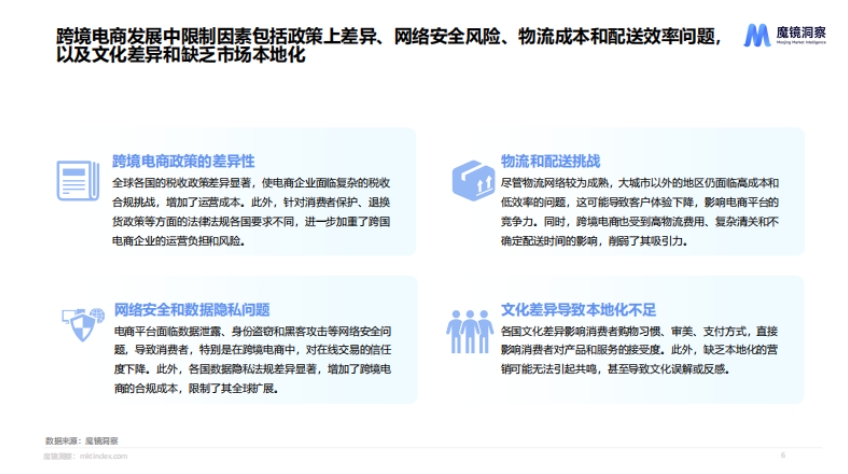
- Factors driving cross-border e-commerce development: Technological progress, changes in consumer shopping habits, logistics optimization, and policy support drive its development, but it also faces limitations such as policy differences, cybersecurity risks, logistics costs and delivery efficiency issues, as well as cultural differences and lack of market localization.
- Major e-commerce markets: The Chinese e-commerce market is mature but has limited growth potential and a slowing growth rate; the US e-commerce market is in a mature period with limited expansion space and a stable growth rate; the Indonesian e-commerce market is in a rapid development stage with huge potential.
- Chinese brands going overseas: Enterprises mostly adopt an "online + offline" sales model, including third-party platforms, self-built e-commerce platforms, and social media sales. Overseas strategies include globalization, multinational, internationalization, and multi-country localization strategies. Anker Innovations is a successful case, with 70.3% of its revenue coming from overseas online channels.
2. Food and Beverage Industry
- Overseas market scale and platform distribution
- From January 2023 to June 2024, the total sales of food and beverage categories on major domestic and overseas online e-commerce platforms reached 1,119.9 billion yuan, with overseas sales exceeding 227.5 billion yuan, more than 95% of which came from the Amazon platform, with a growth rate of 16.5%. Shopee had the highest growth rate (65.0%).
- East Asia is the main region for online food and beverage purchases, with the Japanese market being the largest, accounting for 70%; Southeast Asia has a small scale but rapid growth, with a growth rate of 49%; the US market is not large, and its growth rate is not as fast as Asian countries.
- On the Amazon platform, the Japanese site has the largest food and beverage market scale. Asian countries generally have a higher proportion of food sales, while European and American countries purchase more beverage products.
- Southeast Asian market
- Opportunities: China and Southeast Asia have close cooperation under the "Belt and Road" initiative. Southeast Asia's digital economy is developing rapidly, with a strong foundation for online consumption, and the large number of Chinese expatriates is conducive to promotion.
- Challenges: There are significant cultural differences in dietary habits, fierce market competition, strict regulations and compliance requirements, and insufficient infrastructure.
- Beverage track
- Global online beverage sales are growing, with faster growth in overseas markets.
- China and Japan lead in beverage consumption, while Southeast Asia and North America are growing rapidly; there are obvious category differences in each region. China is dominated by milk and water drinks, North America by electrolyte powders and energy drinks, Europe favors coffee, Southeast Asia has diverse coffee, tea, and plant-based drinks, and in Japan, coffee and tea each account for half of the market.
- China, the US, and Japan lead the global online beverage market, with Vietnam having the highest growth rate; in high-growth markets, the top categories in the US are electrolytes and energy drinks, East Asian countries are mainly tea drinks, and Southeast Asian and European countries are mainly coffee.
- The Vietnamese market is growing rapidly, with tea and ready-to-drink coffee accounting for the main share, and carbonated drinks growing fast; the Japanese market is growing rapidly, with tea drinks dominating and plant-based drinks growing fast; the Japanese tea beverage market is highly competitive, consumers prefer functional and healthy products, and sugar-free tea is popular; functional, healthy, and sugar-free are the mainstream trends in tea beverages in China and Japan.
- Food track
- The growth rate of the food category in the overseas e-commerce market exceeds that of the domestic market, with great potential in Southeast Asian countries; Japan has the highest sales, and Indonesia and other Southeast Asian countries have significant growth rates.
- The overall category in Japan is stable, with growth in snacks and confectionery, and a surge in chocolate sales; local brands dominate and sell well in the Japanese market, products are related to health, and some dietary cultures are similar to China.
- Indonesia's young population drives the growth of the snack market, with rapid development of new snacks; foreign brand penetration is low, product demand is basic, and compared with the domestic market, there has been no consumption upgrade.
3. Market Summary and Strategic Recommendations
- Brand positioning and product differentiation: In the Southeast Asian market, products can be upgraded to meet quality demands; in the Japanese market, products and marketing strategies should be designed around the health concept.
- Rising demand for health and functionality: Domestically, more sugar-free, low-calorie, and zero-additive products can be launched and health labels increased.
- Emotional marketing: The experience of American beverage giants can be used for reference, telling brand stories, integrating local culture, and stimulating emotional resonance among consumers.
- Localization strategy: Launch products that meet local needs.
- Improve product demand level and innovation: The Southeast Asian market needs upgraded and innovative products.
- Brand culture: The Japanese market focuses on conveying cultural concepts and increasing brand identity.
4. Magic Mirror Insight Service Introduction
- Product matrix and functions: Includes Growth Radar, E-commerce Listening, Magic Mirror Analysis +, Magic Mirror Overseas E-commerce, etc., which can assist in market research, consumer insight, brand globalization and other decisions.
- Service model: Data products + data services, covering report services, trend ingredient discovery, etc., to solve problems such as product development, market monitoring, and consumer research.
- Data capability: Full industry and category coverage of mainstream e-commerce and social media platforms, with data traceable for more than 6 years, supporting customized collection on multiple platforms.
- Customer service situation: Serving many leading customers in various industries, such as food and beverage, pharmaceuticals and health, apparel and bags, beauty and personal care, 3C home appliances, and other industry enterprises.