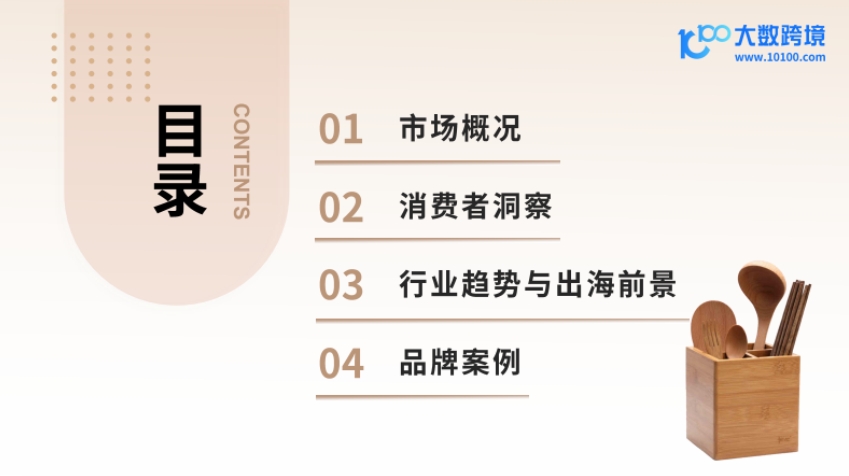
Ce document est un rapport d'étude sur l'exportation de la catégorie des couverts en 2024, publié par Da Shu Cross-Border. Il comprend principalement des sections telles que l'aperçu du marché, les perspectives des consommateurs, les tendances du secteur et les perspectives d'exportation, ainsi que des études de cas de marques, visant à fournir des informations complètes sur le marché et des orientations stratégiques aux marques de couverts cherchant à s'exporter.
1. Aperçu du marché
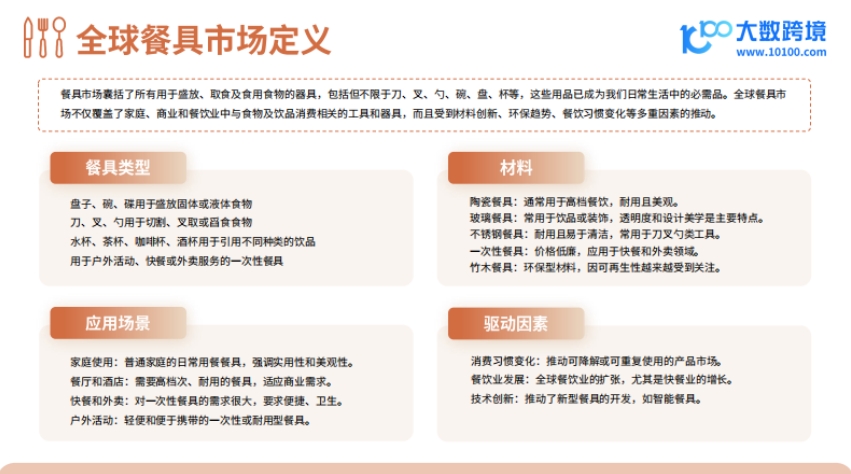
- Définition et classification : Le marché des couverts englobe une variété d'ustensiles utilisés pour servir, prélever et consommer des aliments, incluant différents types (couteaux, fourchettes, cuillères, bols, assiettes, tasses, etc.), scénarios d'application (domestique, restaurant, restauration rapide, extérieur, etc.), et matériaux (céramique, verre, acier inoxydable, jetable, bambou/bois, etc.).
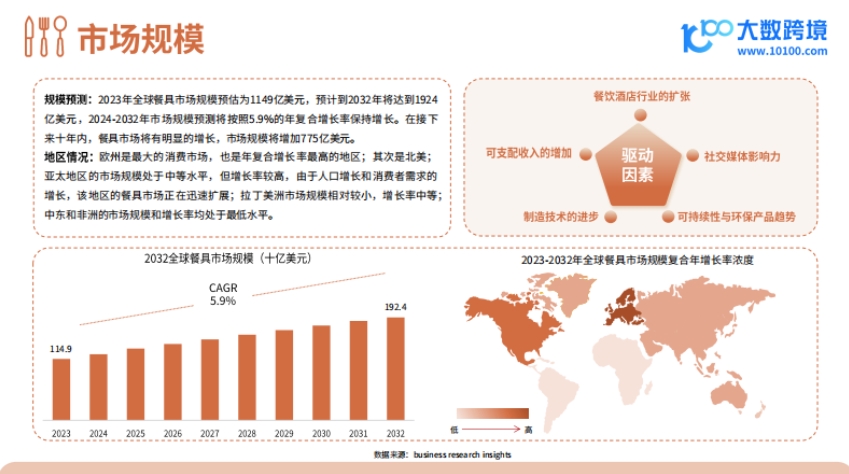
- Taille du marché et facteurs moteurs : La taille du marché mondial des couverts est estimée à 114,9 milliards de dollars en 2023, avec une projection de 192,4 milliards de dollars d'ici 2032, soit un taux de croissance annuel composé de 5,9 %. L'Europe est le plus grand marché de consommation et affiche le taux de croissance annuel composé le plus élevé, tandis que la région Asie-Pacifique a une taille de marché modérée mais une croissance rapide. Les facteurs moteurs incluent les changements dans les habitudes de consommation, le développement de l'industrie de la restauration, l'innovation technologique, l'augmentation du revenu disponible, l'influence des médias sociaux, les progrès de la fabrication et la tendance à la durabilité.
- Segments de marché
- Couverts en céramique : Taille du marché de 58,29 milliards de dollars en 2024, avec une croissance prévue à 78,8 milliards de dollars d'ici 2029, soit un taux de croissance annuel composé de 6,21 %. L'Europe est le plus grand marché, tandis que la région Asie-Pacifique montre un fort potentiel de croissance.
- Couverts jetables : Taille du marché de 35,35 milliards de dollars en 2024, avec une croissance prévue à 43,95 milliards de dollars d'ici 2029. L'Amérique du Nord est le plus grand marché, et la région Asie-Pacifique connaît la croissance la plus rapide, mais fait face à des restrictions réglementaires environnementales.
- Couverts en acier inoxydable : Valeur marchande de 6,81 milliards de dollars en 2024, avec une estimation de 9,46 milliards de dollars d'ici 2031, soit un taux de croissance annuel composé de 4,8 % entre 2024 et 2031. Le marché nord-américain devrait dominer, tandis que les marchés émergents d'Asie-Pacifique et d'Amérique latine montent en puissance.
- Canaux de distribution et chaîne d'approvisionnement : La vente au détail en magasin reste le principal mode de distribution, mais le développement du commerce électronique entraîne une augmentation des achats en ligne. La chaîne d'approvisionnement comprend les matériaux en amont (porcelaine, métal, verre, plastique, etc.), la production en milieu de chaîne et les applications en aval (supermarchés, grandes surfaces, plateformes en ligne, etc.).
- Histoire du développement de l'industrie chinoise des couverts : Elle a connu une innovation et un progrès continus depuis le Néolithique jusqu'à l'ère moderne, avec une amélioration constante de la technologie et des fonctionnalités des produits.
2. Perspectives des consommateurs
- Consommateurs américains
- Choix d'achat : Ils privilégient la qualité et la praticité, les couverts vendus en ensembles étant plus populaires, et le style/la couleur étant également un facteur important.
- Sensibilité au prix : Les comportements de consommation à la baisse sont courants, avec des changements fréquents de détaillants et des achats différés, et une attention accrue au prix et au rapport qualité-prix.
- Attentes en matière de prix : Les consommateurs à faible revenu préfèrent les couverts unis à bas prix, tandis que ceux à revenu élevé sont prêts à payer plus pour des couverts haut de gamme de style moderne.
- Canaux d'achat : Les magasins discount sont le principal canal, et la proportion d'achats en ligne devrait augmenter, en particulier sur le marché haut de gamme.
- Consommateurs japonais : La culture alimentaire influence la demande de couverts, avec une préférence pour des couverts de bonne qualité et au design esthétique, et les dépenses annuelles moyennes des ménages restent relativement stables.
- Consommateurs chinois : Les jeunes consommateurs recherchent des couverts personnalisés et à la mode, tandis que les consommateurs plus âgés privilégient les couverts en céramique de haute qualité, durables et dotés d'une connotation culturelle ; les couverts en céramique ont des usages variés, et la fréquence de remplacement varie selon les consommateurs.
3. Tendances du secteur et perspectives d'exportation
- Protection de l'environnement et développement durable : Divers pays mettent en œuvre des politiques pour limiter les couverts en plastique jetables, favorisant le développement de couverts biodégradables et organiques. Le marché des couverts en plastique biodégradable connaîtra une croissance rapide, et celui des couverts organiques s'élargira également régulièrement.
- Conception intelligente et innovante : La conception intelligente inclut des fonctions telles que la régulation automatique de la température, le contrôle à distance, les commandes vocales et la connectivité IoT ; la conception innovante se manifeste par la personnalisation via l'impression 3D, l'intégration d'éléments de mode, l'amélioration de la fonctionnalité et les collaborations intersectorielles.
- Perspectives d'exportation : Le volume total des exportations chinoises de couverts a d'abord diminué puis augmenté, avec des exportations élevées vers les États-Unis, mais une concentration des marchés d'exportation, nécessitant l'exploration de nouveaux marchés. L'initiative "Ceinture et Route" offre des opportunités, mais fait face à des défis tels que la concurrence, les normes de qualité et les barrières commerciales.
4. Études de cas de marques
- SERAX : Marque belge, axée sur le design, avec une gamme de produits diversifiée, un positionnement haut de gamme et une couverture de plus de 100 pays. Le trafic de son site web indépendant est stable, avec une majorité d'accès mobiles, un trafic de recherche organique important, une base d'utilisateurs principalement féminine et une répartition uniforme par âge. Son succès repose sur la différenciation par le design, une gamme de produits diversifiée, un positionnement haut de gamme et une expansion internationale.
- Our Place : Marque américaine, spécialisée dans les ustensiles de cuisine écologiques et durables. Le trafic de son site web indépendant augmente régulièrement, les États-Unis étant son marché principal. Elle attire les consommateurs grâce à une stratégie de médias sociaux, l'accent mis sur la durabilité et l'histoire de la marque, ainsi qu'un service après-vente flexible, offrant des enseignements pour les marques chinoises cherchant à s'exporter.
5. Recommandations pour l'exportation : L'internationalisation des marques chinoises de couverts peut mettre l'accent sur le design et la polyvalence, en intégrant des éléments culturels traditionnels ; construire une histoire culturelle ; utiliser des matériaux écologiques ; promouvoir via les plateformes sociales ; et offrir des services d'essai et de retour gratuit.