Ce document se concentre principalement sur l'expansion internationale de l'industrie chinoise du meuble, couvrant des aspects tels que la synthèse de l'expansion, le contexte de développement, l'état actuel de l'industrie, la situation des exportations, l'analyse d'entreprises typiques et les opportunités d'expansion. Il fournit des informations détaillées pour une compréhension complète de la situation de l'expansion internationale de l'industrie chinoise du meuble. Le contenu spécifique est le suivant :
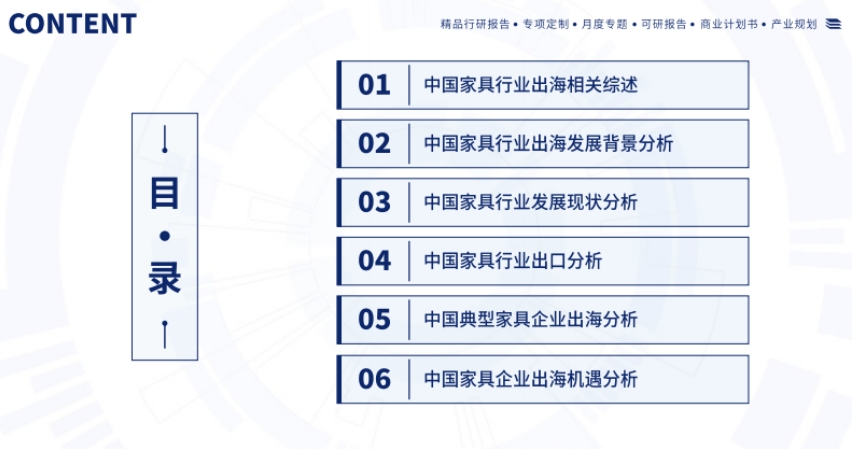
1. Synthèse de l'expansion internationale de l'industrie chinoise du meuble
- Définition et classification du meuble : Le meuble est utilisé dans divers lieux et peut être classé par matériau, usage et structure. Les matériaux incluent le bois, le métal, etc. Les usages couvrent les tables, les chaises, etc. Les structures sont divisées en plusieurs types, comme le meuble assemblé, le meuble démontable, etc.
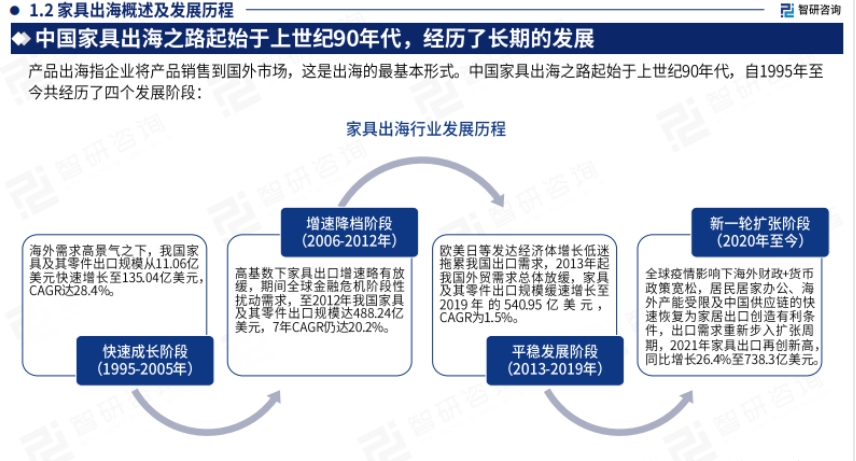
- Historique de l'expansion internationale : L'expansion internationale du meuble chinois a commencé dans les années 1990, traversant quatre phases : croissance rapide, développement stable, ralentissement de la croissance et nouvelle expansion. Chaque phase a été influencée par différents facteurs, avec des variations dans l'échelle et le taux de croissance des exportations.
- Analyse des modes d'expansion : Les principaux modes incluent la sous-traitance OEM/ODM, le commerce électronique transfrontalier, l'expansion de la capacité de production, et l'expansion de la marque/des canaux. La sous-traitance est mature, le commerce électronique transfrontalier se développe rapidement, l'expansion de la capacité de production permet d'éviter les risques, et l'expansion de la marque/des canaux améliore la valeur de la marque.
2. Analyse du contexte de développement de l'expansion internationale de l'industrie chinoise du meuble
- Contexte politique : La Chine a mis en œuvre plusieurs politiques de stabilisation du commerce extérieur, les réglementations environnementales de l'UE se durcissent, le Vietnam offre des incitations à l'investissement, et l'environnement des affaires aux Philippines s'améliore constamment. Ces politiques influencent l'expansion internationale des entreprises de meubles.
- Contexte économique et social : La croissance économique nationale ralentit, l'immobilier entre dans une ère de stock, et la concurrence dans l'industrie du meuble est forte ; l'initiative "Ceinture et Route" et le RCEP favorisent l'ouverture à l'extérieur ; les infrastructures logistiques s'améliorent, avec un bon développement du train Chine-Europe ; l'industrie du meuble réalise des progrès significatifs dans sa transformation vers l'écologie, l'intelligence et la haute qualité.
3. Analyse de l'état actuel du développement de l'industrie chinoise du meuble
- Part de marché mondiale : Le centre de fabrication du meuble mondial se déplace vers les pays en développement, la Chine étant le plus grand producteur et exportateur. De janvier à septembre 2024, les revenus et les bénéfices de l'industrie du meuble au-dessus d'une certaine taille étaient satisfaisants.
- Aperçu de l'industrie : La chaîne industrielle est mature, l'approvisionnement en matières premières est suffisant, les canaux de vente sont fluides, et l'industrie se développe en clusters, formant cinq grandes zones de production de meubles.
4. Analyse des exportations de l'industrie chinoise du meuble
- Situation générale des exportations : Au cours des neuf premiers mois de 2024, les exportations de meubles et de leurs pièces ont augmenté, mais ont chuté en septembre. Les exportations des catégories clés ont montré des différences.
- Exportations par sous-catégorie : Les exportations de meubles en métal, en bois, de pièces de meubles, etc., présentent des caractéristiques différentes en termes de mode de commerce, de région d'exportation et de principaux pays d'exportation.
5. Analyse de l'expansion internationale des entreprises typiques de meubles chinois
- MLL (Mengbaihe) : Passée de la sous-traitance à la transformation, elle développe des marques propres après son introduction en bourse. Les matelas sont le produit dominant, avec des problèmes de stock à résoudre. Elle s'étend à l'international via plusieurs modes de vente, avec une part élevée des revenus à l'étranger.
- Qumei Home : Sous pression opérationnelle, elle vend via plusieurs canaux et acquiert des entreprises à l'étranger pour se développer. La part des revenus à l'étranger est élevée, et ses marques proposent des produits variés.
- Markor Home : Son activité est confrontée à des défis, avec un équilibre entre vente en gros et vente au détail. L'activité à l'étranger est principalement en gros, avec une marge brute à améliorer.
- Kuka Home : L'activité de canapés est remarquable, avec des modes de vente variés. Les revenus à l'étranger augmentent rapidement, et une société a été créée à Hong Kong pour gérer les importations et exportations.
- Lege (Lego) Shares : Les performances s'améliorent, avec une activité principale claire. Elle a créé le "modèle Lege", avec une part élevée des revenus à l'étranger et des modes de vente diversifiés.
6. Analyse des opportunités d'expansion internationale pour les entreprises de meubles chinois
- Amélioration de l'environnement économique régional : La croissance économique américaine et un bon environnement commercial offrent un espace pour les exportations de meubles chinois ; la croissance économique de l'UE, principal partenaire commercial, offre un potentiel de développement pour les meubles chinois en Europe.
- Le RCEP favorise l'exploration du marché de l'Asie du Sud-Est : Ses clauses préférentielles encouragent les pays d'Asie du Sud-Est à utiliser les pièces et matières premières de meubles chinois, et les accords tarifaires améliorent la compétitivité des exportations de meubles chinois.
- L'essor des canaux de commerce électronique transfrontalier : La croissance du volume total des importations et exportations et l'émergence du modèle semi-géré offrent de nouvelles opportunités pour l'expansion internationale des entreprises de meubles.