![[2025 Dernières politiques et guide pratique] Entrer sur le marché saoudien : comment les entreprises peuvent-elles s'implanter ?](/_next/image?url=https%3A%2F%2Fadmin.tktk.com%2Fuploads%2Fallimg%2F250617%2F1-25061G621590-L.png&w=1920&q=75)
 2613
2613Ces deux dernières années, de nombreuses entreprises ont ajouté une nouvelle destination à leur carte d’expansion internationale : l’Arabie Saoudite. Sa capacité de consommation, ses investissements d’infrastructure et sa structure démographique sont effectivement impressionnants. Et à l’heure actuelle, c’est peut-être une bonne opportunité pour les entreprises chinoises de s’implanter en Arabie Saoudite.
Selon le « Livre blanc sur l’expansion internationale en Arabie Saoudite 2025 » publié par Horizons, nous avons préparé un guide opérationnel destiné aux entreprises, couvrant tout, des exigences réglementaires aux coûts de main-d’œuvre, des règles de visa aux habitudes de paiement, dans l’espoir d’aider chacun à éviter les premiers écueils liés à l’adaptation locale.

Source de l’image : Horizons, « Livre blanc sur l’expansion internationale en Arabie Saoudite 2025 »
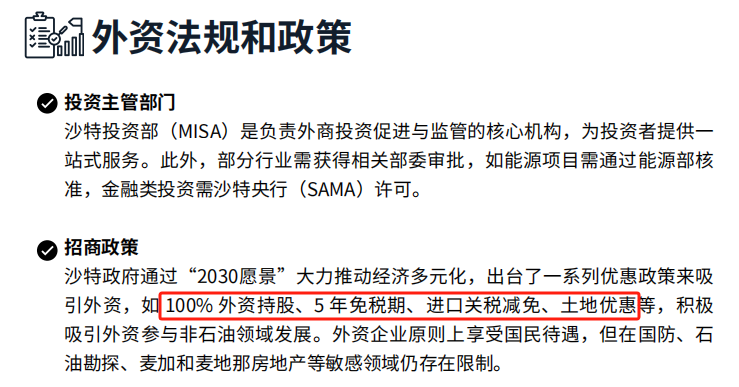
△ Contrôle par capitaux étrangers
Le gouvernement saoudien a été très actif ces dernières années, en particulier dans le cadre de la « Vision 2030 », qui a fait de l’« attrait des investissements étrangers » une priorité nationale.
Le changement le plus notable est que les entreprises étrangères peuvent désormais détenir 100 % des parts, sans avoir besoin d’un partenaire local ; elles peuvent également bénéficier d’une exonération fiscale de 5 ans, de réductions de droits d’importation et d’avantages fonciers.
Si le secteur d’activité n’est pas sensible (par exemple, technologies numériques, fabrication, santé), il n’y a pratiquement pas de barrière significative à l’investissement. Tant que cela ne concerne pas la défense, l’exploration pétrolière ou le développement immobilier à La Mecque et Médine, les entreprises étrangères bénéficient généralement du même traitement que les entreprises locales.
Source de l’image : Horizons, « Livre blanc sur l’expansion internationale en Arabie Saoudite 2025 » (1)
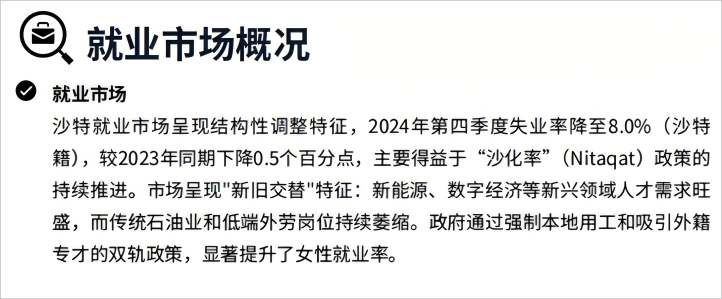
△ Marché de l’emploi
Regardons maintenant le marché de l’emploi. Les ajustements structurels en Arabie Saoudite ont été très marqués ces dernières années. Au quatrième trimestre 2024, le taux de chômage des Saoudiens était tombé à 8,0 %, et le taux d’emploi des femmes a également progressé rapidement. On observe clairement une « guerre des talents » dans les domaines des énergies renouvelables, de l’économie numérique, de l’IA et de la fabrication de véhicules électriques.
En termes de rémunération, on constate également des tendances : par exemple, dans le secteur pétrolier et gazier, le salaire annuel se situe entre 90 000 et 250 000 dollars, dans les énergies renouvelables entre 70 000 et 180 000 dollars, dans les postes IT et IA entre 60 000 et 150 000 dollars, et même dans le tourisme et le divertissement, il atteint 35 000 à 90 000 dollars. Si une entreprise doit envoyer du personnel technique ou cadre en Arabie Saoudite, cette fourchette de prix n’est pas basse, mais comparée au potentiel du marché, elle reste exploitable.
Source de l’image : Horizons, « Livre blanc sur l’expansion internationale en Arabie Saoudite 2025 » (2)
△ Emploi
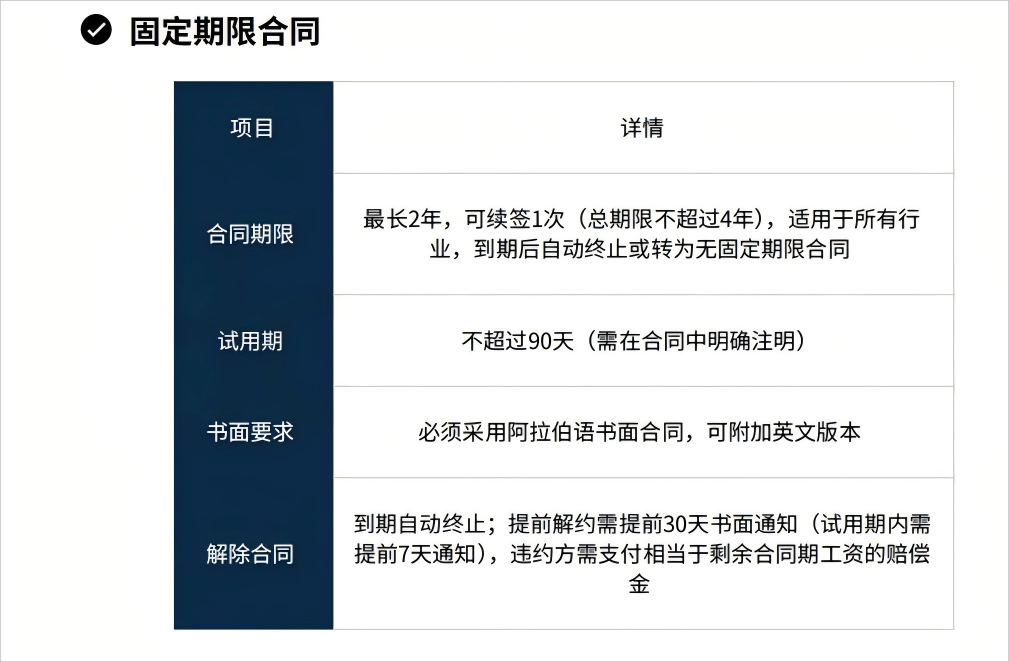
En matière de conformité de l’emploi, l’Arabie Saoudite impose également des exigences assez détaillées. Par exemple, le contrat de travail doit être un contrat écrit en arabe (une traduction en anglais peut être jointe), et la période d’essai ne peut excéder 90 jours. Il est possible de signer un contrat à durée déterminée (maximum 2 ans, renouvelable une fois) ou un contrat à durée indéterminée.
Le salaire doit être versé par virement via le système officiel de protection des salaires WPS, au plus tard le 1er du mois suivant. Les heures supplémentaires sont limitées : pas plus de 2 heures par jour, et un maximum de 120 heures par an. Les heures supplémentaires sont rémunérées à 150 %, et à 200 % les jours fériés. Le système de travail saoudien s’applique de manière quasi identique aux employés étrangers et locaux, avec quelques légères différences pour les secteurs spécifiques comme les services domestiques.
Source de l’image : Horizons, « Livre blanc sur l’expansion internationale en Arabie Saoudite 2025 » (3)
△ Coûts d’embauche
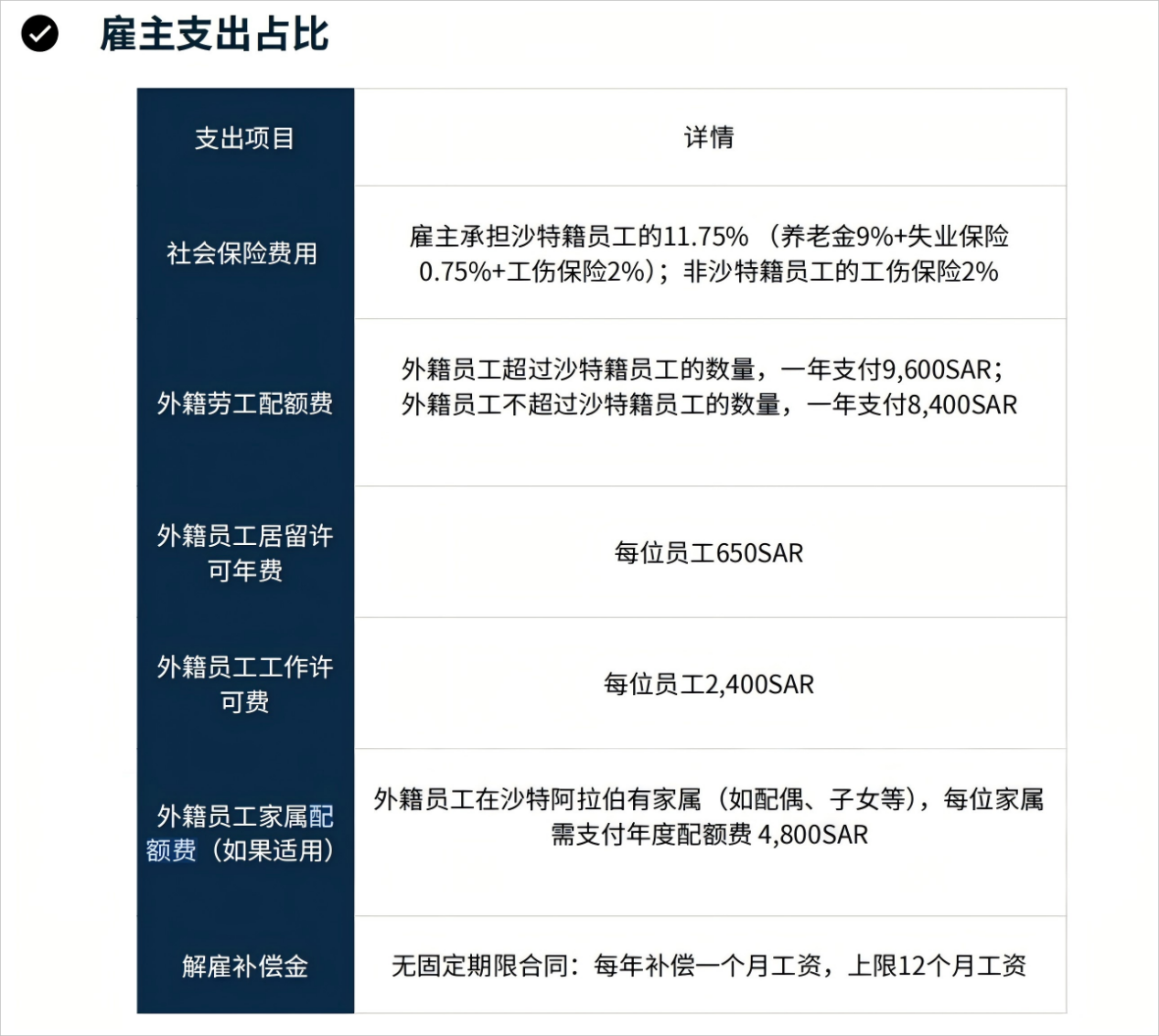
Du point de vue de l’employeur, il est également nécessaire de budgétiser à l’avance les coûts de main-d’œuvre. Par exemple, les frais annuels de séjour pour les employés étrangers sont de 650 riyals saoudiens, et le permis de travail coûte 2 400 riyals saoudiens. Si un employé amène sa famille en Arabie Saoudite, des frais de quota de 4 800 riyals saoudiens par membre de la famille et par an s’appliquent.
Un autre point à noter : si le nombre d’employés étrangers dans l’entreprise dépasse celui des employés locaux, le gouvernement perçoit une « taxe de quota » de 9 600 riyals par an et par personne ; dans le cas contraire, elle est de 8 400 riyals. Il est donc conseillé aux entreprises d’équilibrer leur structure d’emploi dès le début, pour éviter que des coûts ignorés ne fassent dépasser le budget global.
Source de l’image : Horizons, « Livre blanc sur l’expansion internationale en Arabie Saoudite 2025 » (4)
△ Visa + Avantages sociaux
Actuellement, l’Arabie Saoudite n’impose pas d’impôt sur le revenu des personnes physiques, ce qui est un avantage pour les entreprises qui s’y implantent. Les salaires et les revenus du travail des employés ne sont pas soumis à retenue à la source. Cependant, il faut noter que si une personne détachée siège au conseil d’administration en Arabie Saoudite et n’est pas de nationalité saoudienne, les revenus de ce conseil sont soumis à une retenue à la source de 20 %.
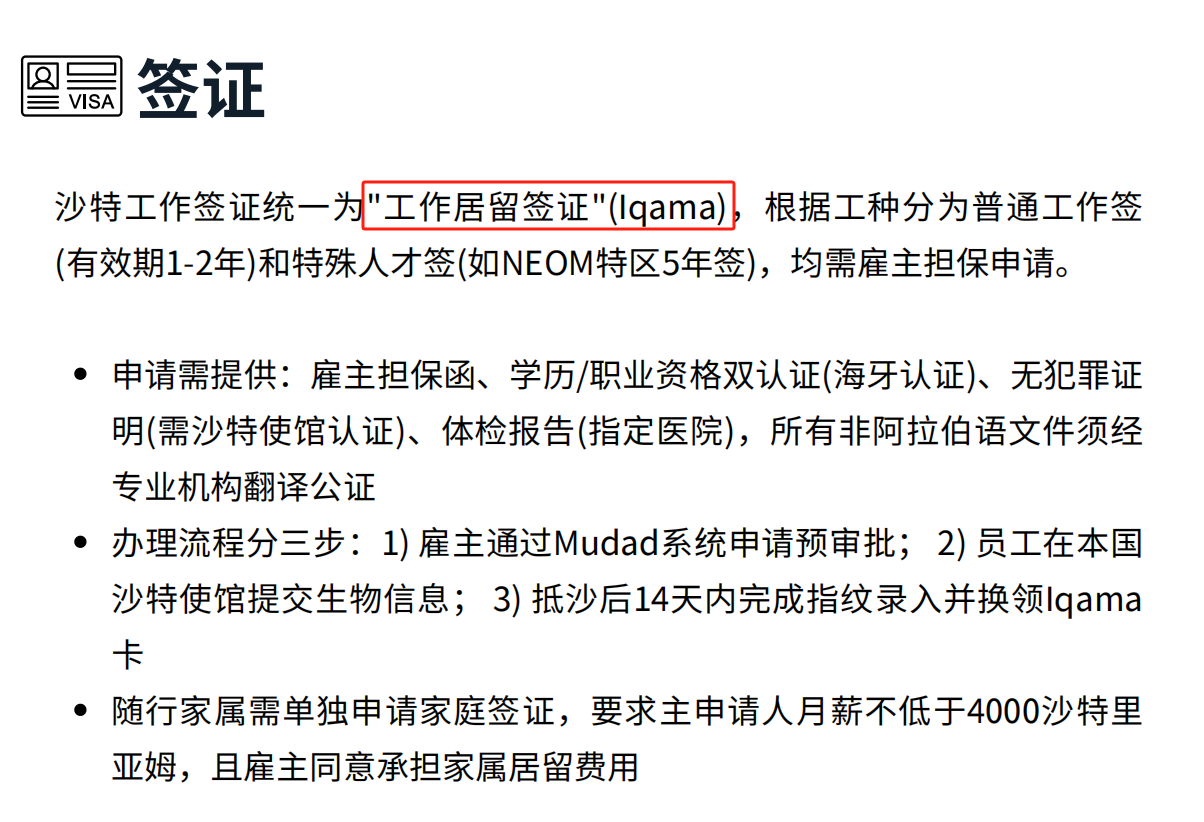
En ce qui concerne les visas, le visa de travail saoudien est appelé « Iqama », sa durée de validité est généralement de 1 à 2 ans, et les talents de haut niveau peuvent demander un visa d’une durée maximale de 5 ans dans des zones spéciales comme NEOM.
La procédure de demande de visa se déroule en trois étapes : premièrement, l’employeur demande une pré-approbation via le système Mudad ; deuxièmement, l’employé enregistre ses données biométriques à l’ambassade saoudienne de son pays ; troisièmement, dans les 14 jours suivant l’arrivée en Arabie Saoudite, il effectue un relevé d’empreintes digitales et reçoit sa carte Iqama. Si l’employé emmène sa famille avec lui en Arabie Saoudite, son salaire mensuel doit atteindre 4 000 riyals, et l’employeur doit accepter de prendre en charge les frais de séjour de sa famille.
Quant aux avantages sociaux, le système de congés en Arabie Saoudite semble également très structuré : après un an d’ancienneté, 21 jours de congés annuels ; après cinq ans, 30 jours. Congé maladie : 30 jours par an, les 20 premiers jours à 100 % du salaire, les 10 suivants à 75 % ; les employées féminines bénéficient de 10 semaines de congé maternité à plein salaire et de 24 mois de pause d’allaitement d’une heure par jour ; les hommes bénéficient de 3 jours de congé paternité à plein salaire. Il existe également des dispositions pour les congés de mariage, de décès, de pèlerinage, etc., applicables aux employés étrangers comme locaux.
Source de l’image : Horizons, « Livre blanc sur l’expansion internationale en Arabie Saoudite 2025 » (5)
△ Paiement
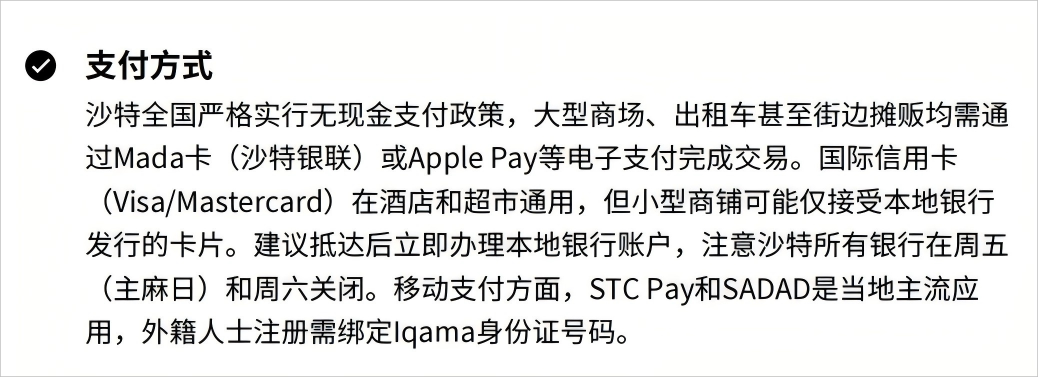
En ce qui concerne la vie quotidienne en Arabie Saoudite, le système financier et de paiement est très numérisé. Dans les grands centres commerciaux, les taxis et même les échoppes de rue, on peut payer avec STC Pay ou la carte Mada, et Apple Pay est également très répandu.
Il est conseillé d’ouvrir un compte bancaire dès l’arrivée. Les banques locales exigent un passeport, un Iqama, une lettre de l’employeur, un bulletin de salaire et autres documents, avec un dépôt minimum de 1 000 riyals saoudiens. Si l’entreprise a des besoins de paiement transfrontaliers, elle peut également choisir un compte multi-devises (prenant en charge SAR/USD/EUR).
Source de l’image : Horizons, « Livre blanc sur l’expansion internationale en Arabie Saoudite 2025 » (6)
△ Conclusion
Dans l’ensemble, c’est une période charnière pour les entreprises qui souhaitent se positionner en Arabie Saoudite :
Les politiques macroéconomiques sont favorables, le marché est vaste, l’infrastructure numérique est solide, et en particulier dans les secteurs non pétroliers comme les énergies renouvelables, l’automobile, la fabrication, l’informatique et l’éducation, les opportunités sont bien plus nombreuses qu’on ne l’imagine.
Mais l’Arabie Saoudite est un pays aux règles claires et à l’application stricte. Bien plus que de simplement suivre la tendance, il est essentiel de se conformer aux réglementations, de calculer précisément les coûts et de maîtriser les règles d’emploi.
Si vous envisagez le marché saoudien, nous espérons que ce guide vous permettra d’éviter quelques détours et de consacrer plus de temps à votre activité elle-même.