 1925
1925Vous passez encore vos nuits à traduire les pages de détails des produits ?
Les consommateurs américains ont déjà trouvé une méthode plus simple : laisser l'IA prendre les décisions à leur place.
Une étude récente de l'institut de recherche Attest révèle les chiffres de cette révolution silencieuse : 49 % des consommateurs américains utilisent des outils d'intelligence artificielle pour les aider dans leurs décisions d'achat, soit une augmentation de 6 points de pourcentage par rapport à l'année précédente.
Plus surprenant encore, 45 % des personnes déclarent faire confiance aux informations recommandées par l'IA, et 17 % d'entre elles s'en remettent même entièrement à ses jugements. Alors que les produits dans les paniers d'achat sont de plus en plus recommandés par des algorithmes, les règles du jeu du commerce électronique transfrontalier sont en train d'être complètement réécrites.
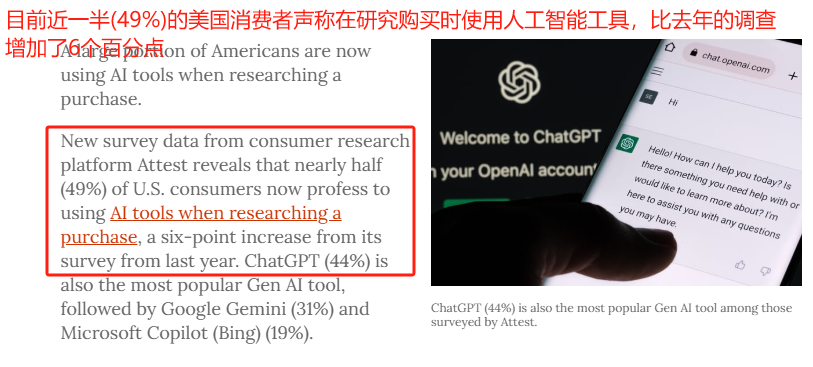
49 % des consommateurs américains utilisent l'IA pour leurs décisions d'achat Source : chainstoreage
ChatGPT devient le "conseiller shopping" préféré
Ouvrez votre téléphone, tapez "clavier silencieux pour le bureau", et en 3 secondes, l'IA peut filtrer parmi des dizaines de milliers de produits ceux qui correspondent à votre budget, ont une note supérieure à 4,5 étoiles et sont disponibles en livraison le lendemain. C'est l'expérience réelle des consommateurs américains aujourd'hui.
Les données montrent que ChatGPT est en tête des outils d'IA pour le shopping avec un taux d'utilisation de 44 %, suivi par Google Gemini (31 %) et Microsoft Copilot (19 %). Derrière ce changement se cache une quête extrême d'efficacité des consommateurs. Le processus de décision qui nécessitait auparavant des heures à comparer les paramètres et à consulter les avis peut désormais être réalisé en décrivant simplement ses besoins à l'IA.
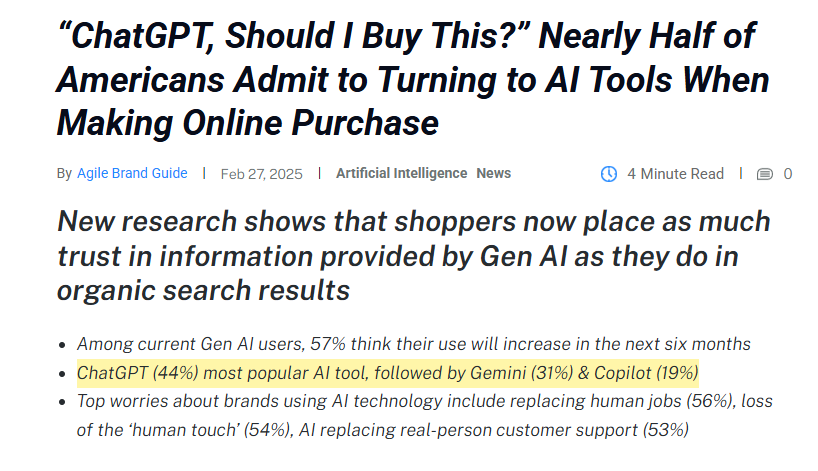
ChatGPT est l'outil d'IA générative le plus populaire Source : agilebrandguide
Amazon entre en jeu, les commerçants de Yiwu en profitent
Face à ce changement radical des habitudes des consommateurs, les géants du e-commerce et les petits et moyens vendeurs accélèrent leurs investissements.
L'assistant shopping IA Rufus, lancé par la plateforme mondiale Amazon, est déjà capable de comprendre les besoins des consommateurs via des dialogues. Lorsqu'un utilisateur demande "équipement indispensable pour un débutant en camping", il ne se contente pas de recommander des tentes et des sacs de couchage, mais suggère également un niveau d'imperméabilité en fonction du climat local. Ce mode d'interaction remplace progressivement la recherche par mots-clés traditionnelle.

L'assistant shopping IA Rufus d'Amazon Source : AboutAmazon
À Yiwu, dans la province du Zhejiang, Sun Lijuan, qui vend des articles de maison, fait partie des premiers vendeurs à adopter la technologie IA.
Après le lancement de la plateforme Chinagoods AI Zhichuang en 2023, elle a utilisé cet outil pour générer rapidement des vidéos et des pages de détails de produits en plusieurs langues (anglais, espagnol, etc.), ouvrant ainsi avec succès les marchés d'Amérique du Sud et du Moyen-Orient.
Sun Lijuan a déclaré : "Je trouve l'IA très pratique, j'ai de la chance, mon chiffre d'affaires ne cesse d'augmenter."

Sun Lijuan explique ses produits à un client Source : China News Weekly
L'IA résout les trois principaux défis du e-commerce transfrontalier
Barrière linguistique, différences culturelles, coûts opérationnels – ces problèmes qui ont longtemps tourmenté les vendeurs transfrontaliers s'effacent progressivement grâce à la technologie IA.
Prenons l'exemple des services multilingues : les outils IA peuvent non seulement générer automatiquement des descriptions de produits et des textes publicitaires, mais aussi adapter le ton en fonction des caractéristiques culturelles des différents marchés. Mettre l'accent sur le savoir-faire des détails pour les clients japonais, ou souligner la garantie après-vente pour les clients occidentaux – une telle précision opérationnelle nécessitait auparavant l'embauche d'une équipe locale.
De plus, la capacité d'analyse de données de l'IA est en train de transformer la stratégie de sélection des produits. En suivant les tendances des réseaux sociaux à l'étranger, les vendeurs peuvent anticiper les points chauds du marché, ajuster précisément la conception des produits et les stratégies marketing, répondant ainsi plus efficacement aux besoins du marché cible.

Source : Internet
Les vendeurs qui n'utilisent pas l'IA sont en train de prendre du retard
De la génération automatique de contenu marketing au service client multilingue 24h/24, l'IA redéfinit les barrières concurrentielles du e-commerce transfrontalier.
Des plateformes comme Amazon et AliExpress ont profondément intégré les outils IA dans leurs systèmes d'exploitation, et les petits et moyens vendeurs accèdent également à ces avantages technologiques via des prestataires de services tiers.
Avec l'évolution continue de la technologie IA, le e-commerce transfrontalier pourrait connaître des transformations encore plus profondes à l'avenir. Lorsque les algorithmes pourront automatiquement gérer l'ensemble du processus – analyse de marché, publicité, suivi après-vente – cette révolution de l'efficacité finira par réécrire les règles du secteur.
Pour les vendeurs, une seule chose est certaine : saisir l'IA, c'est saisir le prochain cycle de croissance.