 1854
1854
Le secteur du commerce électronique transfrontalier ne manque jamais de scénarios palpitants.
Plus tôt cette année, la rumeur et la mise en œuvre de la politique américaine d'exonération des droits sur les petits colis en provenance de Chine ont un moment fait retenir leur souffle à l'industrie pourTemu. Après tout, cette plateforme partie de « petits colis en livraison directe » a largement dépendu des bénéfices de l'exonération des droits pour maintenir des prix extrêmement bas.
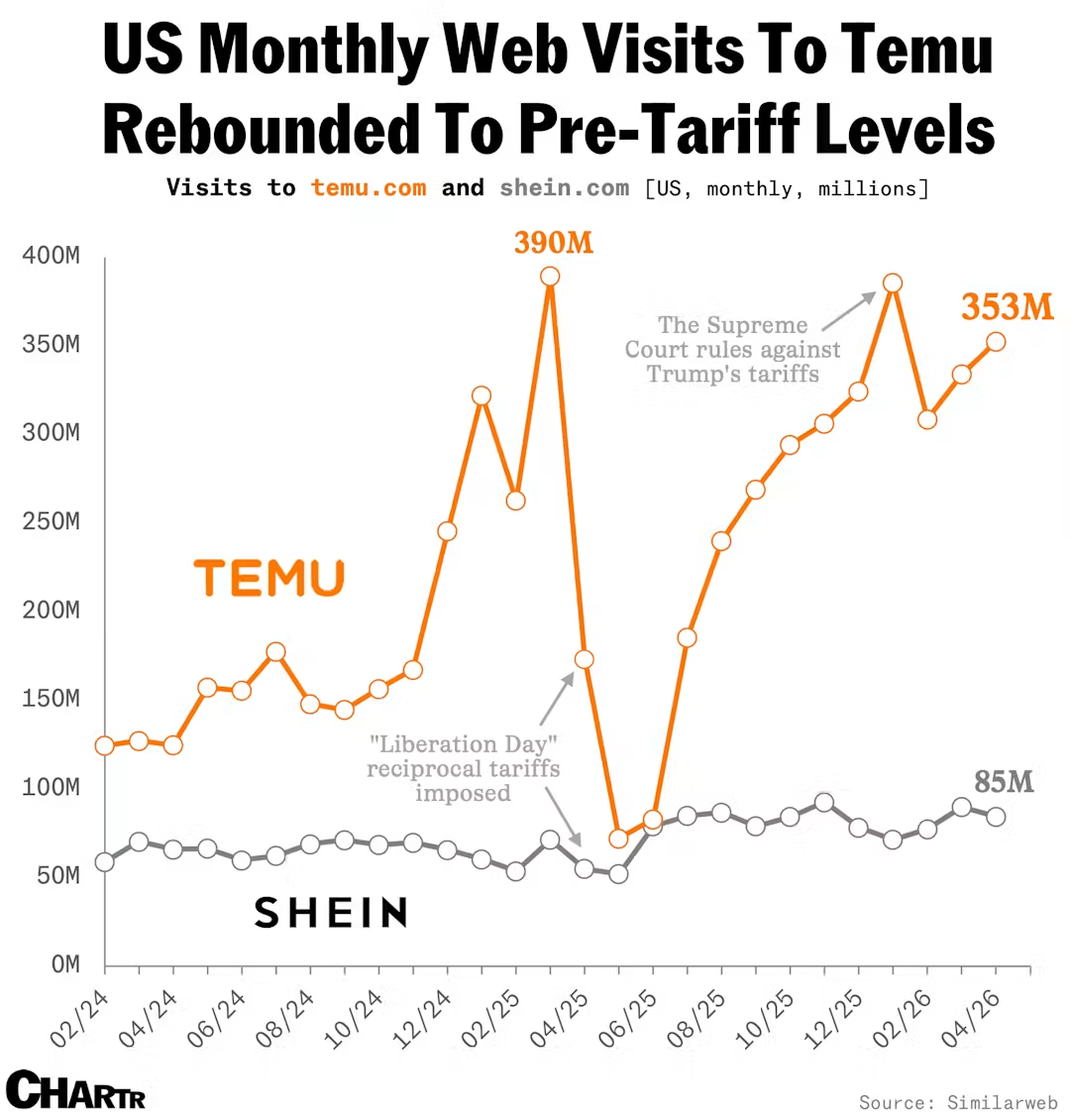
Cependant, l'institut d'études de marchéLes dernières données de Similarweb ont donné une réponse surprenante : le trafic du site américain de Temu a rebondi à environ 353 millions de visites en avril, soit une augmentation de 5,55 % par rapport à mars. Ce chiffre a pratiquement récupéré le terrain perdu en raison du changement de politique, et a envoyé un signal clair à tous les acteurs du commerce extérieur : la demande réelle des consommateurs finaux ne s'est pas éteinte, et la capacité d'adaptation de la plateforme elle-même devient la clé de sa survie.
Source de l'image :Sherwood News
1. De la chute brutale à la reprise, la résilience de la consommation derrière les données de trafic
Si l'on revient au moment où la nouvelle de l'annulation de l'exonération des droits sur les petits colis a été annoncée, de nombreux analystes ont prédit que lesplateformes chinoises de commerce électronique en livraison directe, représentées par Temu, allaient subir un coup dur.
L'augmentation des coûts douaniers, la complexification des procédures de dédouanement, l'allongement des délais de livraison – chaque aspect semblait mener à la même conclusion : la perte d'utilisateurs.
CependantLes 353 millions de visites en avril, avec une augmentation de plus de cinq points par rapport au mois précédent, contredisent par les faits le discours pessimiste. Ces données montrent que l'enthousiasme des consommateurs américains pour les produits à bon rapport qualité-prix ne s'est pas éteint rapidement à cause du changement de politique. Au contraire, dans un contexte de pression inflationniste persistante, de nombreuses familles cherchent encore des canaux d'achat plus abordables.
Le rebond de Temu résulte essentiellement de l'interaction entre la « demande de bas prix » et la « capacité d'adaptation de la plateforme ». Plus important encore, la vitesse de reprise du trafic a dépassé les attentes, montrant que la plateforme a trouvé des moyens efficaces de contourner les obstacles politiques.

Source de l'image :Google
2. L'accélération de la mise en œuvre du modèle semi-géré,unetransformation structurelle
La reprise du trafic n'est pas un hasard. Face aux changements radicaux des politiques tarifaires et douanières,Temu n'a pas attendu passivement, mais a rapidement lancé des ajustements majeurs de sa stratégie opérationnelle.
L'action la plus centrale a été de promouvoir vigoureusement le modèle semi-géré et de recruter activement des vendeurs locaux américains. Parallèlement, la plateforme a guidé les marchands existants à pré-approvisionner leurs marchandises dans des entrepôts locaux américains, réalisant ainsi le passage de« livraison directe depuis la Chine » à « expédition depuis les États-Unis ».
Cette transformation semble n'être qu'un ajustement des lignes logistiques, mais implique en réalité une restructuration de l'ensemble du modèle commercial.
En expédiant depuis le pays, la plateforme peut réduire considérablement les coûts douaniers par envoi causés par l'annulation de l'exonération des petits colis, tout en évitant les incertitudes des procédures de dédouanement. Les marchandises étant déjà aux États-Unis, les problèmes de dédouanement sont résolus dès l'entrée en entrepôt, et les consommateurs n'ont plus à attendre de longs transports internationaux et inspections douanières après avoir passé commande. Le délai de livraison est réduit de dix à quinze jours à trois à cinq jours, voire moins, ce qui améliore considérablement l'expérience utilisateur.
On peut dire que la combinaison du modèle semi-géré et du pré-approvisionnement local a aidéTemu dans l'interstice du resserrement des politiques, a réussi à stabiliser son flux de trafic principal et sa base de commandes.

Source de l'image :Google
Trois, impact profond sur les vendeurs : restructuration de la logistique de stock et augmentation de la pression financière
Pour les vendeurs opérant surTemu, l'orientation de la plateforme vers la gestion semi-entrepôt et le stock local signifie que la logique commerciale est en train de changer fondamentalement.
Dans le passé, la plupart des vendeurs adoptaient un modèle sans stock ou avec un stock léger, expédiant directement depuis la Chine après réception des commandes, ce qui nécessitait peu de capital et un risque contrôlable. Mais maintenant, pour s'adapter aux exigences d'expédition locale de la plateforme, les vendeurs doivent expédier en gros leurs produits par mer ou par air vers des entrepôts américains à l'avance.
Cela entraîne d'abord une augmentation significative de la pression financière : l'avancement des stocks signifie que les marchandises occupent déjà des coûts d'achat et de logistique élevés avant même d'être vendues. Ensuite, le risque de gestion des stocks s'est également amplifié. En cas d'erreur de sélection de produits ou de fluctuation de la demande du marché, les marchandises accumulées dans les entrepôts américains seront confrontées à des invendus, à l'augmentation des frais de stockage et à la nécessité de liquidation à prix réduit.
De plus, les vendeurs doivent recalculer leur structure de coûts : bien que les droits de douane puissent être optimisés grâce au dédouanement en gros, les frais de stockage aux États-Unis, les frais de livraison finale et les coûts de rotation du capital doivent être intégrés dans le modèle de tarification. Pour les petits et moyens vendeurs, cela augmente sans aucun doute le seuil d'entrée.
Les commerçants aux capacités financières faibles et à la chaîne d'approvisionnement lente risquent d'être éliminés au cours de la transition. En revanche, les vendeurs disposant d'une solide capacité de stock et d'une bonne expérience en sélection de produits auront l'opportunité de profiter de la reprise du trafic de la plateforme pour consolider davantage leur part de marché.

Source de l'image :Google
Conclusion
Les 353 millions de visites publiées par Similarweb ne sont pas seulement un chiffre, mais aussi la réponse de Temu après avoir subi le « test de résistance » politique sur le marché américain.
En regardant vers l'avenir, à mesure queTemu approfondit sa localisation, sa position dans le paysage du commerce électronique américain devrait être encore renforcée. Et les vendeurs qui peuvent suivre le rythme de la plateforme et mettre à jour leur chaîne d'approvisionnement en premier gagneront leur propre espace de croissance dans la nouvelle redistribution.