 1377
1377
Pour les vendeurs transfrontaliers, accumuler plusieurs boutiques ou mettre temporairement un compte de côté était une opération très courante. MaisUne nouvelle réglementation récente de TikTok Shop Royaume-Uni pourrait complètement changer cette règle du jeu consistant à occuper une place sans opérer.
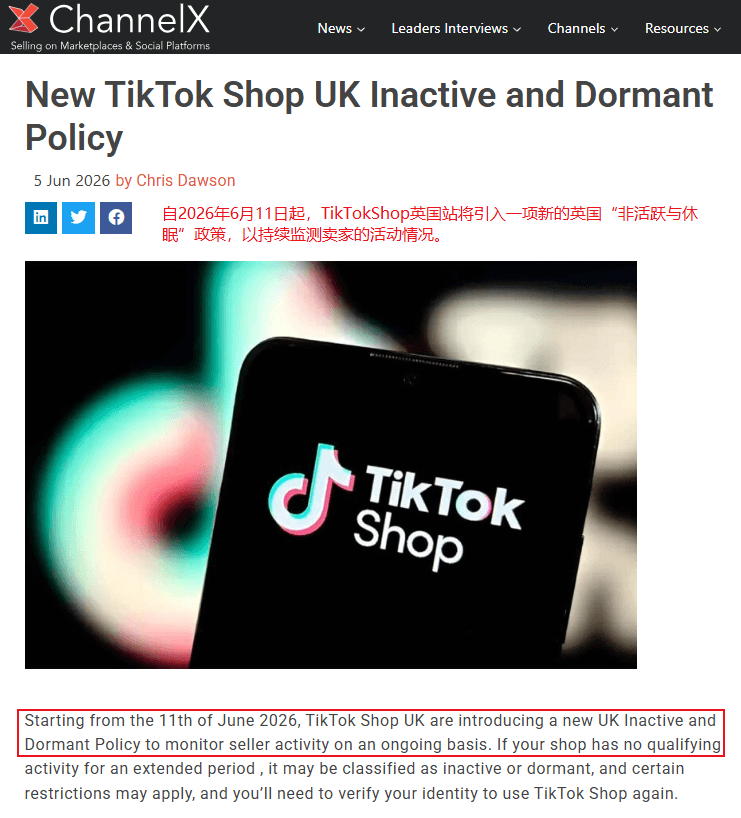
Selon les dernières informations,TikTok Shop Royaume-Uni mettra en œuvre le 11 juin 2026 une mesure de gestion stricte appelée "Politique des boutiques inactives et dormantes".
Le cœur de cette politique est d'imposer des sanctions par paliers aux boutiques qui n'ont aucune activité d'exploitation réelle pendant une longue période.
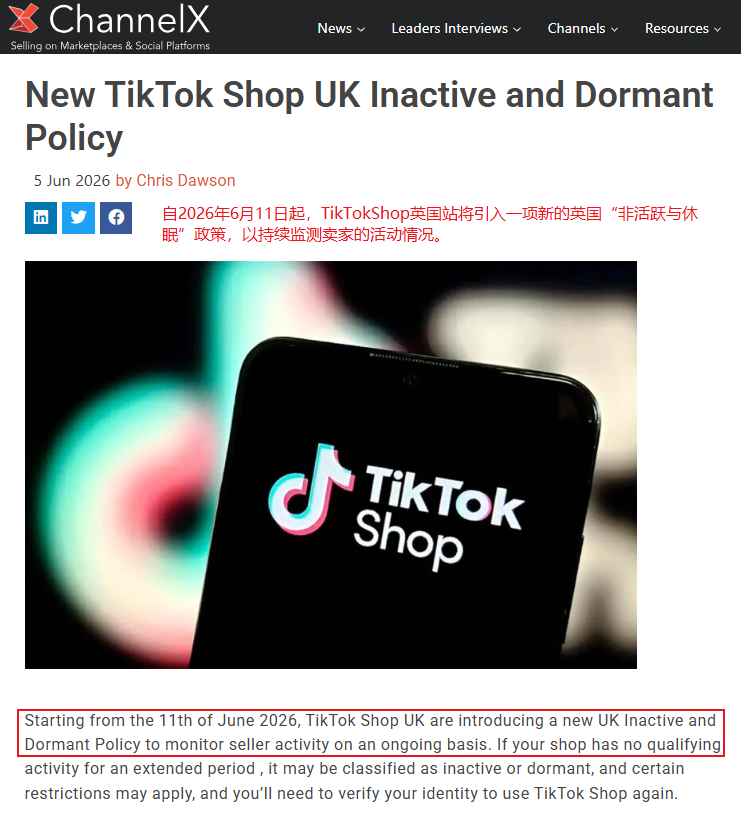
Source de l'image :channelx
180 jours sont la ligne rouge de la vie ou de la mort pour l'exploitation d'une boutique
Le point clé de cette politique est que la plateforme a redéfini ce qu'est une activité effective.
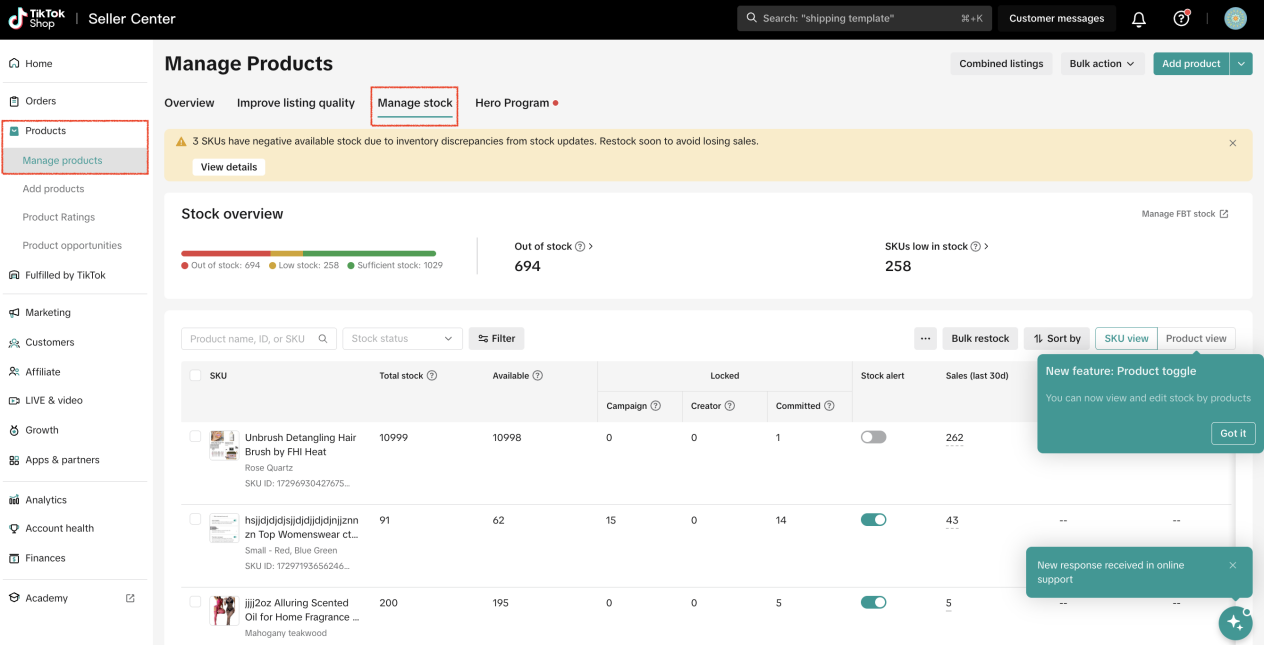
Ce n'est pas le simple fait de se connecter au compte qui compte comme actif, mais il faut produire des actions d'exploitation substantielles, notamment se connecter au centre vendeur, mettre en ligne ou éditer des produits, lancer un live avec le compte boutique, publier des vidéos courtes avec un panier d'achat, cliquer sur le bouton de préparation à l'expédition, et répondre aux demandes des clients, etc. La plateforme prendra comme point de départ l'heure de la dernière activité effective parmi celles-ci effectuée par le vendeur.
Source de l'image :Google
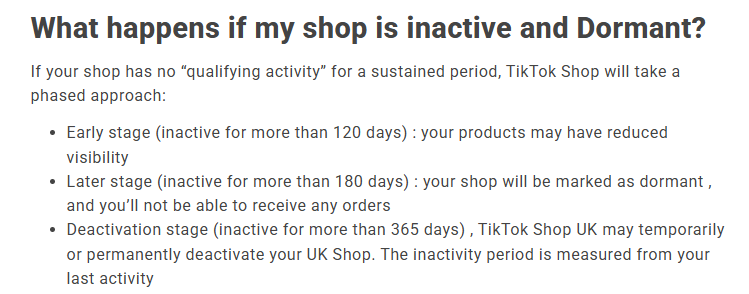
Les sanctions spécifiques sont divisées en trois phases. La première phase est une période de120 jours consécutifs sans activité effective, la boutique entre dans un état d'inactivité précoce, l'exposition des produits sera limitée, c'est-à-dire que la probabilité que les acheteurs voient vos produits diminuera nettement. Cependant, cette phase laisse une marge : tant que le vendeur se connecte au back-office pour modifier ou remettre en ligne des produits, l'exposition peut être rétablie.
Le véritable tournant se situe à180 jours. Dès qu'il n'y a aucune activité effective pendant 180 jours consécutifs, la boutique est considérée comme en phase dormante. À ce moment-là, la plateforme suspend la capacité de la boutique à recevoir de nouvelles commandes. Attention, ce n'est pas une fermeture, mais l'impossibilité de prendre de nouvelles commandes.
Si le vendeur souhaite réactiver cette boutique, il doit suivre un processus de revérification d'identité. Cela signifie que les qualifications et informations de certification initialement attachées au compte doivent être réexaminées et approuvées pour rétablir les fonctions de transaction normales.
Ensuite, si plus de365 jours sans activité, la plateforme a le droit de désactiver temporairement ou définitivement la boutique. Cependant, la plateforme offre également une voie de recours finale : dans les 180 jours suivant la désactivation, le vendeur peut encore faire appel pour la réactiver. Passé ce délai, il s'agira probablement d'une remise à zéro au sens propre.
Source de l'image :channelx
Pour donner aux vendeurs un temps de transition, le système enverra auxle 90e, 120e et 150e jour des e-mails d'avertissement respectivement. Ainsi, avant que la boutique n'entre complètement en état dormant, le vendeur aura au moins trois chances de recevoir des rappels.
La stratégie multi-comptes va être chamboulée
Ce sont les vendeurs habitués à déployer un large réseau de comptes multiples qui sont les plus directement impactés par cette politique.
Auparavant, de nombreux commerçants enregistraient à l'avance plusieursboutiques TikTok, certaines pour tester différentes catégories, d'autres comme comptes de secours au cas où le compte principal aurait un problème, et d'autres encore simplement pour réserver une place, en attendant le bon moment pour démarrer.
Mais selon les nouvelles règles, ces magasins dormants qui ne se connectent pas et n'exploitent pas depuis longtemps seront d'abord120 jours de perte de poids d'exposition, et à 180 jours, perte directe de la capacité à prendre des commandes.
Pour les commerçants qui suspendent leurs opérations, les risques ne sont pas moindres. Par exemple, les vendeurs qui mettent temporairement de côté leur activité sur la plateforme britannique en raison d'ajustements de la chaîne d'approvisionnement, de problèmes de trésorerie ou de changements de stratégie de marché, s'ils ne gèrent pas leur boutique pendant plus de six mois, lorsqu'ils voudront la redémarrer, ils découvriront qu'ils doivent non seulement repasser par une vérification d'identité, mais aussi que le contenu de la marque et l'accumulation de followers pendant cette période peuvent être considérablement réduits en raison de la limitation de l'exposition.
De plus, l'étape de la re-vérification d'identité mérite également une attention particulière. Puisque la plateforme exige une nouvelle certification, cela signifie qu'elle effectuera un second examen des qualifications et de la conformité du titulaire de la boutique. Si les documents précédents du vendeur présentent des zones d'ombre ou si les informations de certification ont expiré, il est fort probable qu'il soit bloqué à cette étape, voire que la boutique ne puisse pas être rétablie.
Source de l'image :Google
Soit actif, soit quitter résolument
Face à cette politique qui va bientôt être mise en œuvre, les vendeurs n'ont en réalité pas beaucoup de choix intermédiaires. Les stratégies centrales ne sont que deux : soit vraiment exploiter, soit faire activement des réductions.
Pour les vendeurs qui sont encore en train de planifier le marché britannique mais qui n'ont temporairement pas l'énergie de gérer, la méthode la plus simple pour conserver le compte est d'effectuer régulièrement une activité valide. Pas besoin de grands changements, par exemple se connecter au centre vendeur chaque mois pour parcourir le back-office, ou éditer occasionnellement les informations sur les produits, ou encore publier une courte vidéo avec un lien de voiture depuis le compte de la boutique. Ces opérations peuvent actualiser l'enregistrement du temps d'activité valide et empêcher la boutique de tomber dans un état inactif.
Source de l'image :TikTok Shop UK
Pour les vendeurs qui possèdent plusieurs boutiques mais n'en exploitent activement qu'une ou deux, il est recommandé de réévaluer la valeur de chaque compte. Si certaines boutiques n'ont vraiment pas de plan d'utilisation clair, il est conseillé d'envisager de les fermer ou de les transférer activement.
Conclusion
La vitesse de développement de TikTok Shop est évidente pour tous, et la transition des règles de la plateforme d'une approche extensive à une approche fine est une tendance inévitable. Pour les vendeurs, s'adapter à ce changement n'est pas un choix, mais une question obligatoire.
Plutôt que de se plaindre du durcissement des règles, il vaut mieux le considérer comme une opportunité d'optimiser son propre rythme opérationnel. Après tout, sur n'importe quelle plateforme, les boutiques qui créent continuellement de la valeur sont toujours les plus sûres.