Ce document se concentre principalement sur les tendances d'exportation des meubles d'extérieur, incluant la situation actuelle du marché, les caractéristiques régionales, les préférences des consommateurs et les tendances par catégorie, comme suit :
1. Situation actuelle du marché des meubles d'extérieur
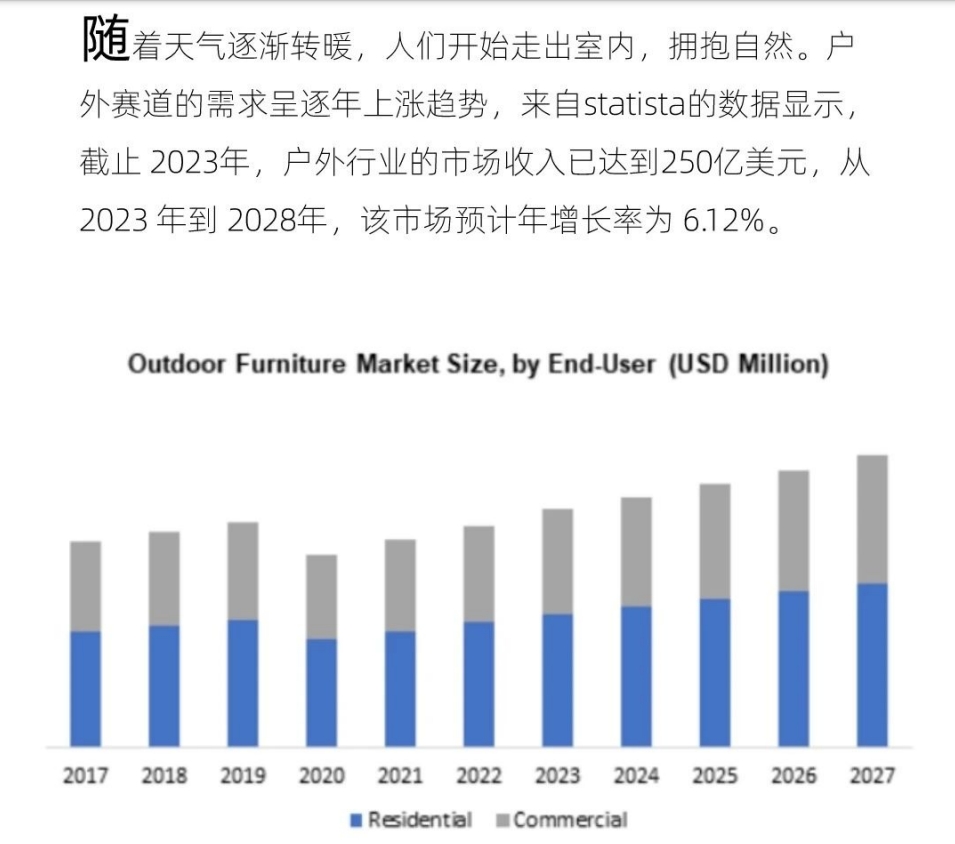
- Taille du marché et tendances de croissance : Les revenus du marché du secteur extérieur continuent d'augmenter, atteignant 25 milliards de dollars en 2023, avec un taux de croissance annuel prévu de 6,12 % entre 2023 et 2028 ; la taille du marché mondial des meubles d'extérieur devrait augmenter de 5,2 milliards de dollars entre 2022 et 2027, avec un taux de croissance annuel composé de 3,28 %.
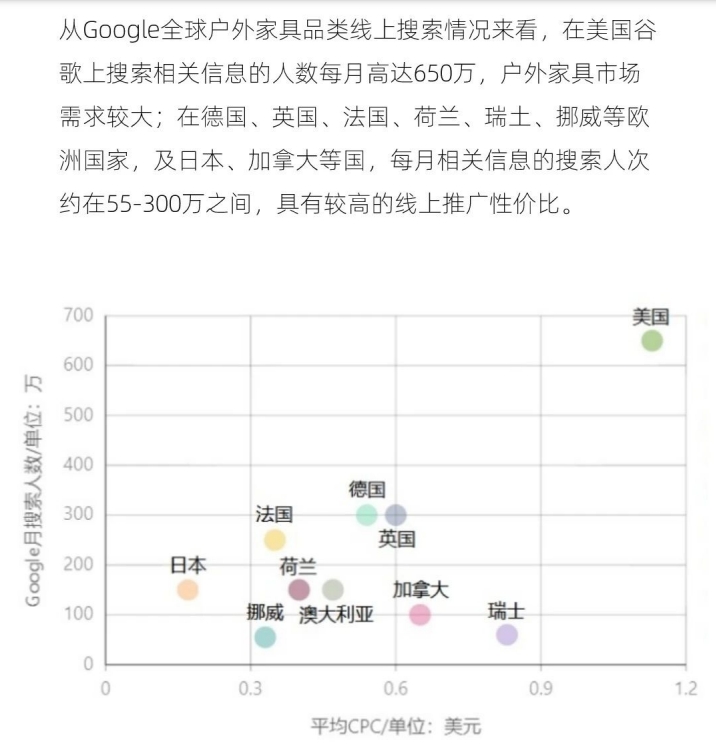
- Saison de forte demande : La demande de meubles d'extérieur est élevée en Europe et en Amérique, avec 6,5 millions de recherches mensuelles sur Google aux États-Unis, et entre 550 000 et 3 millions de recherches mensuelles dans certains pays européens ; les activités extérieures augmentent au printemps en Europe et en Amérique, les recherches de meubles d'extérieur grimpent en mars et atteignent un pic en mai, avec un taux de croissance de 125 %.
2. Caractéristiques du marché des meubles d'extérieur en Europe et en Amérique
- Marché nord-américain : La culture du jardin est forte, la demande de meubles d'extérieur croît régulièrement ; la différence de proportion d'achat entre hommes et femmes est faible, différentes tranches d'âge préfèrent différents styles ; les 18-24 ans préfèrent le moderne et le tendance avec une sensibilité au prix, tandis que les plus de 55 ans privilégient la facilité d'entretien avec une fourchette de prix acceptable de 50 à 200 dollars.
- Marché européen : Les consommateurs sont grands et préfèrent les meubles de grande taille ; ils accordent de l'importance à la praticité, avec une forte demande pour des produits nécessitant peu d'entretien, faciles à nettoyer et résistants aux intempéries, la qualité des matières premières et la finition des produits étant importantes.
3. Préférences des consommateurs
- Canaux d'achat : La génération Y est le principal groupe de consommateurs, près de 40 % ont déjà acheté des meubles en ligne, en privilégiant la qualité et le rapport qualité-prix lors des achats en ligne ; les sources d'information sont diversifiées, avec une moyenne de 21 sources, les canaux courants incluent les moteurs de recherche, les plateformes de commerce électronique, les sites de comparaison de prix et d'avis en ligne, les sites officiels des marques et applications, les magasins physiques, etc. Les consommateurs américains considèrent que les informations des réseaux sociaux ou vidéos sont plus utiles que celles des magasins physiques.
- Scénarios d'utilisation : Les consommateurs américains intègrent les meubles d'extérieur à l'intérieur pour créer un environnement de vie naturel, 20 % placent des tables et chaises d'extérieur dans le salon ; lors de l'achat, ils privilégient le confort et le naturel, recherchent une sensation de bien-être physique et mental, et accordent de l'importance à l'écologie.
4. Tendances par catégorie
- Modularité et multifonctionnalité : Pour répondre aux besoins des consommateurs en matière d'adaptabilité et de polyvalence des meubles, les ensembles de meubles de jardin peuvent être librement combinés, optimisant l'espace et la fonctionnalité.
- Légèreté : Tendance mondiale, améliorant la portabilité, facilitant le transport et le déplacement, la production se concentre sur la réduction des coûts des matériaux des structures de support métalliques et des connecteurs, l'optimisation des performances et l'amélioration de l'efficacité des processus de fabrication.
- Utilisation de matériaux écologiques : L'écologie attire l'attention, le concept de durabilité devient un point clé, la recherche et l'application de nouveaux matériaux sont une percée, les designers se concentrent sur le cycle de vie des produits, les marques doivent accorder de l'importance au choix de matériaux écologiques et à l'écologie du processus de production.
- Haute technologie et intelligence : L'application de technologies intelligentes permet aux meubles d'extérieur d'avoir des fonctions de charge, d'éclairage, de contrôle à distance, de réglage intelligent et d'automatisation, améliorant l'expérience utilisateur, permettant une gestion et un entretien précis, et redéfinissant les modes de détente et de divertissement en extérieur.