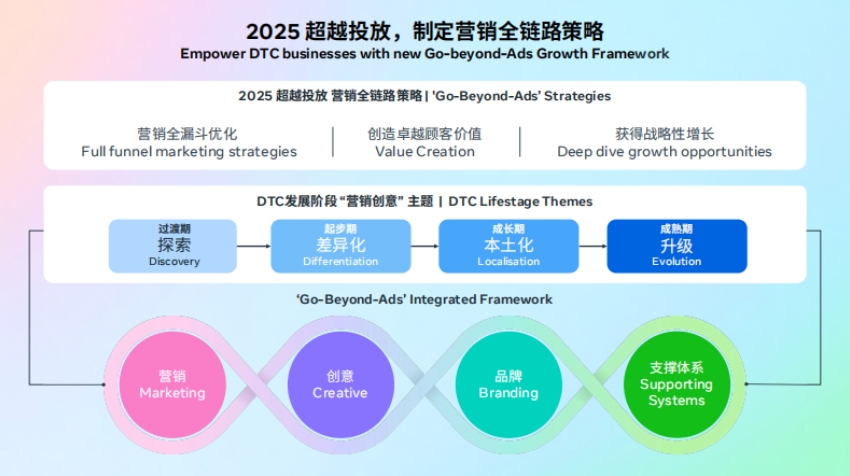
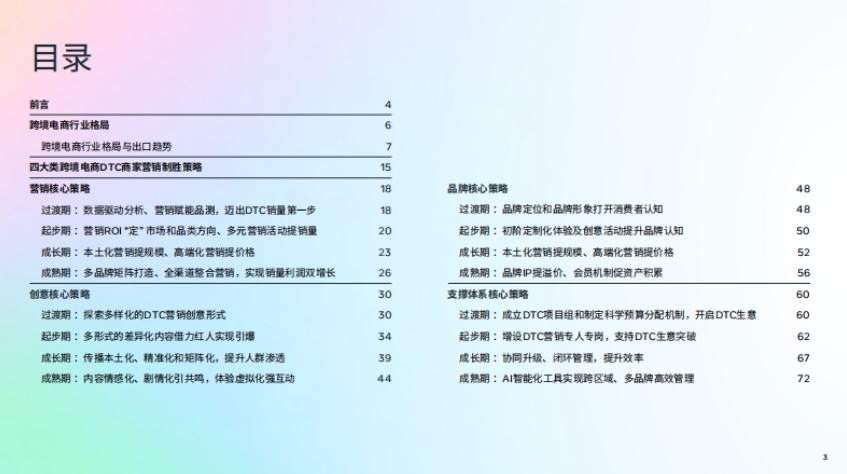
Le document est le Livre blanc 2025 sur le marketing gagnant à toutes les étapes du DTC e-commerce transfrontalier, publié conjointement par Meta et Kantar. Il se concentre sur le modèle DTC du commerce électronique transfrontalier, en établissant un système de stratégies marketing pour les marques et vendeurs DTC à différents stades de développement, selon quatre dimensions clés : marketing, créativité, marque et système de soutien, afin de favoriser la construction de marque à long terme et la croissance des affaires. Voici le contenu détaillé :
- Structure de l'industrie :
- Taille du marché : En 2024, le volume total des importations et exportations du e-commerce transfrontalier en Chine a atteint 2,63 billions de yuans, soit une augmentation de 10,8 % par rapport à l'année précédente. Les ventes au détail à l'exportation continuent de croître. Les marchés développés comme l'Amérique du Nord et l'Europe ont des écosystèmes de commerce électronique matures, tandis que les marchés émergents comme l'Asie du Sud-Est et le Moyen-Orient connaissent une croissance rapide.
- Facteurs de croissance : forte demande des marchés étrangers, avantages évidents de la chaîne d'approvisionnement, fort soutien politique, amélioration de l'expérience grâce aux mises à niveau technologiques, et renforcement continu des mécanismes de coopération.
- Défis rencontrés : impacts tarifaires, homogénéisation des produits, protection de la propriété intellectuelle, sécurité des données et protection de la vie privée, etc.
- Étapes de développement du modèle DTC :
- Phase de transition : explorer le modèle DTC, en utilisant l'analyse pilotée par les données et le marketing pour renforcer les tests de produits, et faire le premier pas vers les ventes.
- Phase de démarrage : déterminer l'orientation du marché et des catégories via le ROI marketing, mener des activités marketing diversifiées pour augmenter les ventes.
- Phase de croissance : mettre en œuvre un marketing de localisation et de montée en gamme, élargir l'échelle et augmenter les prix.
- Phase de maturité : construire une matrice multi-marques, intégrer le marketing omnicanal, et réaliser une double croissance des ventes et des bénéfices.
- Stratégies marketing :
- Stratégies marketing clés : adopter différentes stratégies selon les étapes, comme le marketing pour renforcer les tests de produits en phase de transition, le ROI pour orienter les décisions et les activités diversifiées pour augmenter les ventes en phase de démarrage, etc.
- Stratégies créatives clés : incluent l'exploration de formes créatives diversifiées, l'exploitation des influenceurs pour un impact maximal, la communication localisée, etc.
- Stratégies de marque clés : du positionnement et de l'établissement de l'image, à la revitalisation locale, à la certification d'autorité, puis aux collaborations pour élargir le public et à la création de propriété intellectuelle (IP).
- Stratégies clés du système de soutien : impliquent la mise en place d'équipes de projet, l'allocation budgétaire, la nomination de personnel dédié, l'utilisation d'outils d'IA, etc.
- Cas de réussite : le document cite plusieurs cas de réussite de marques DTC, comme Lilysilk, Totwoo, BloomChic, etc., montrant les effets des différentes stratégies dans la pratique.