 1054
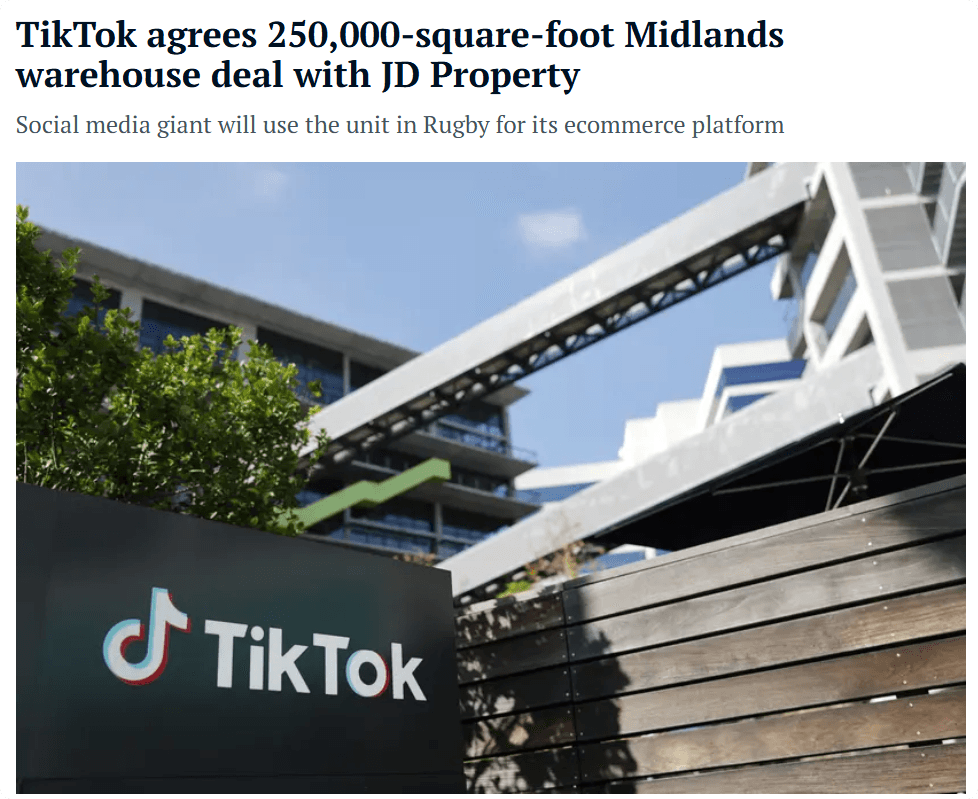
Recently, there has been a rather interesting piece of news in the cross-border e-commerce circle: TikTok leased a large warehouse in the UK, and the landlord is JD.
The specifics of this lease are relatively clear. FBT, the fulfillment business under TikTok Shop, leased JD Property's Rugby 251 warehouse in Rugby, Warwickshire, UK, with a building area of about 251,000 square feet, equivalent to approximately 23,000 square meters, a ten-year lease term, and an annual rent of about £11 per square foot.
The warehouse was completed and put into use in the summer of 2026. JD Property confirmed the project delivery, only saying that the tenant is a leading cross-border e-commerce company.
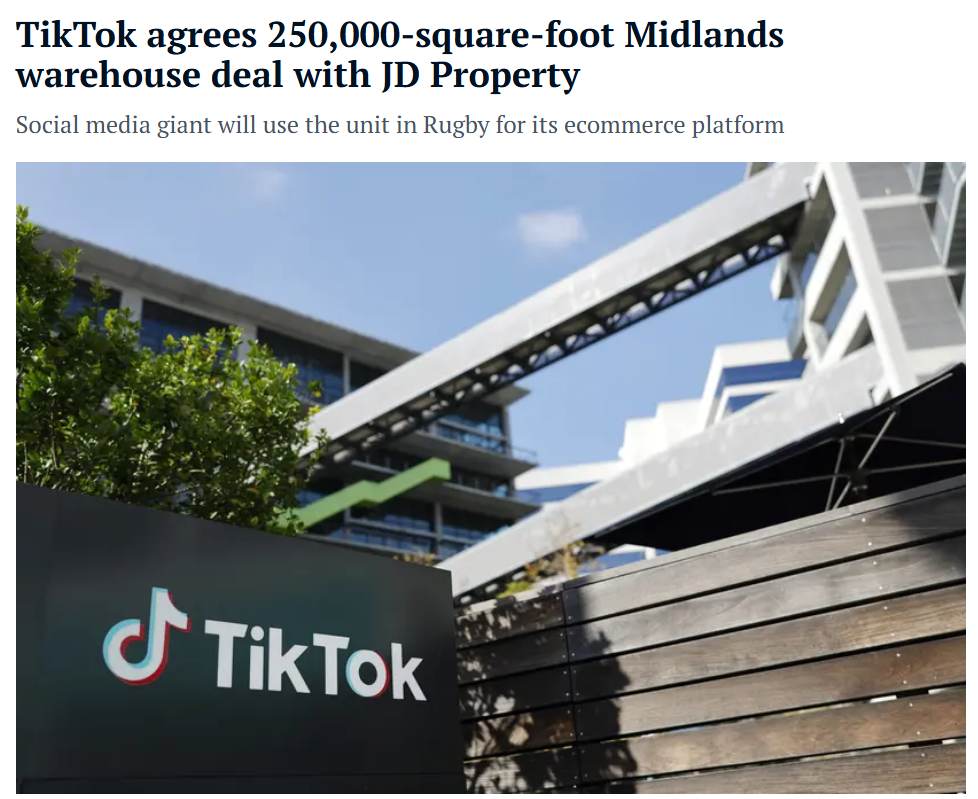
Image source: CoStar
Why does TikTok need such a large warehouse? The direct reason is the rapid growth of sales on its UK site.
Data shows that TikTok Shop UK's beauty category grew by about 60% year on year in 2025, making it the fourth-largest beauty retailer in the UK.
Currently, more than 200,000 small and medium-sized enterprises have settled on the UK site, carrying out more than 6,000 livestream sales sessions per day on average. Placing orders via livestreams is different from traditional search-based ordering: users develop a purchase impulse after watching a short video or a livestream, and their expectations for delivery speed are also higher. If sellers have to pack goods while livestreaming, it is hard to balance their energy.
TikTok launched the FBT service in the UK as early as 2023. Merchants can select some products to be stocked in warehouses in advance, and after an order is generated, the platform completes picking, packing, and shipping.
According to industry information, as of August 2026, FBT operates 6 warehouses in the Midlands of the UK and plans to increase this to 8 by the end of the year. The new warehouse in Rugby is one step in the expansion plan. The warehouse location is also carefully chosen: Rugby is located in the UK logistics 'golden triangle', from which a four-hour drive can cover about 90% of the UK population.
Together with the previously reached delivery cooperation with Royal Mail, TikTok's fulfillment capability in the UK, combining warehousing and delivery, is gradually being completed.
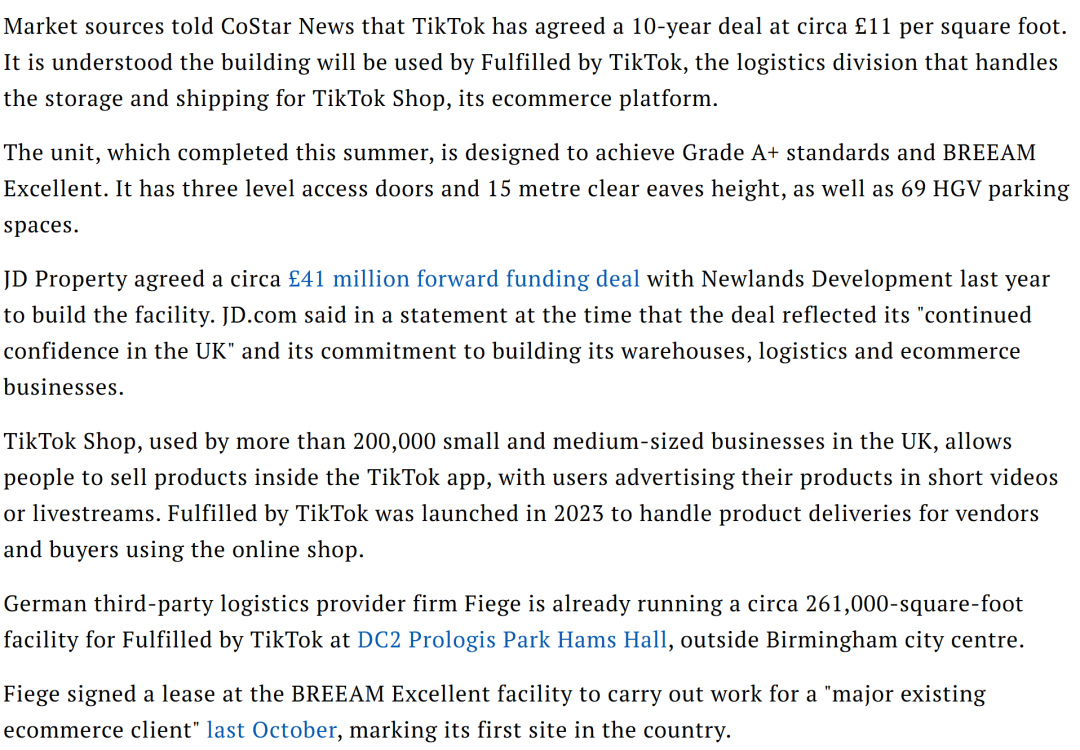
Image source: CoStar
So what role does JD Property play here? Many people's impression of JD stops at 'selling goods and delivering goods', but JD Property is in a different business: investment, development, and management of warehousing infrastructure. Clients can be e-commerce platforms, third-party logistics companies, or manufacturing enterprises. JD Property entered the UK market in 2022 and currently has more than 30 warehousing facilities in the UK, Germany, and the Netherlands, with a total area of more than 850,000 square meters and an overall occupancy rate of about 95%.
In other words, JD Property's role is an 'industrial landlord', and finding suitable tenants is inherently its core business. In the UK, the companies leasing JD Property's properties are not only JD's own logistics business; previous projects have also been leased to furniture companies and third-party logistics companies, and SHEIN has also established a certification cooperation with JD Logistics' overseas warehouses.

Image source: internet
There is a relationship here that is easy to overlook: JD itself also operates a retail platform, Joybuy, in the UK. It officially launched in six European countries in March 2026, providing delivery services in the UK and other markets such as 'order before 11 a.m., delivered before 11 p.m. the same day', and currently operates more than 60 warehouses and delivery stations in Europe.
That is to say, JD and TikTok do indeed have a competitive relationship on the UK retail side. But retail is retail, and property is property; the business objectives of the two are different. Retail competes for consumers and orders, while property competes for quality tenants and occupancy rates. Leasing a warehouse to a growing e-commerce platform is a reasonable business for JD Property.
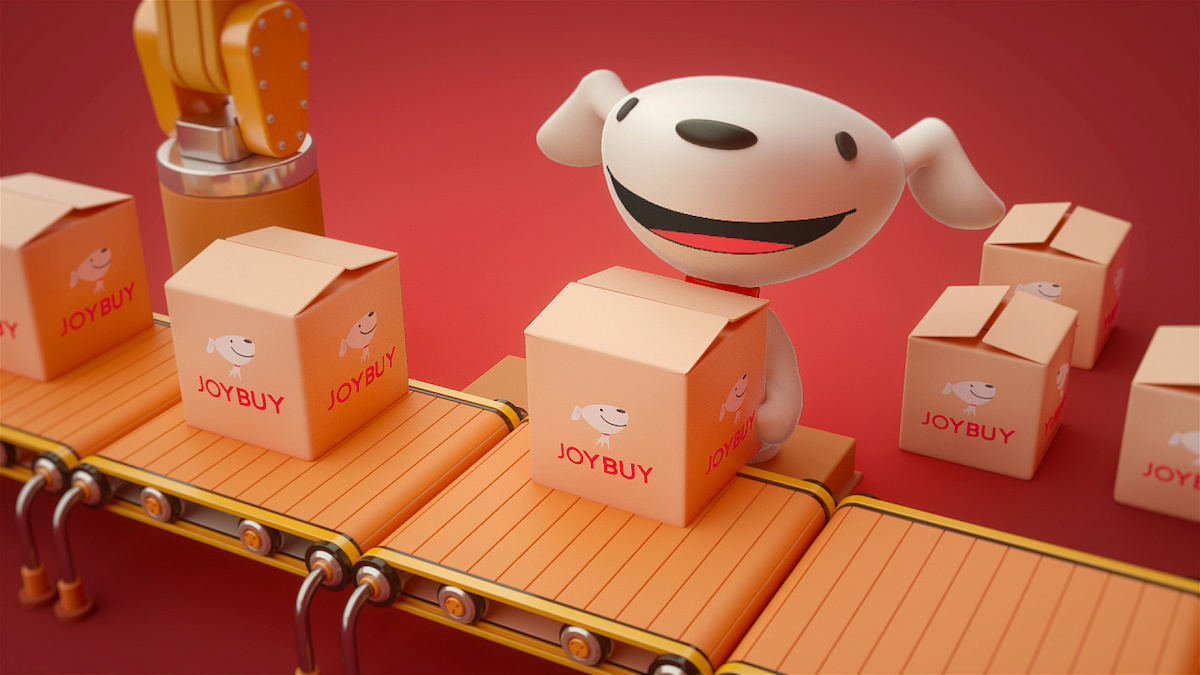
Image source: internet
From a broader perspective, Chinese e-commerce platforms going overseas are entering a new stage. In the early days, they mostly built their own teams and expanded channels; now, increasingly specific business divisions and intersections are beginning to appear.
Platforms focus their energy on content, merchant, and user operations, hand heavy-asset warehousing facilities to professional infrastructure parties for investment and management, and connect last-mile delivery to local postal and logistics networks. This division-of-labor model of 'light front office, heavy back office' is becoming an increasingly common practice for Chinese platforms going overseas.
This lease does not amount to any dramatic narrative of 'giants joining forces'; its value is more concrete: TikTok has found the warehouse space needed to expand its UK fulfillment business, JD Property has gained a long-term tenant for ten years, and each gets what it needs, with clear logic.