 66
In overseas markets, ergonomic chairs have long ceased to be exclusive gear for gamers.
Gaming, remote work, binge-watching shows, and video editing—a comfortable chair supports not just the body, but also most of a day in one's life.
From Hangzhou,the brand SYMINO, precisely targeted this demand.
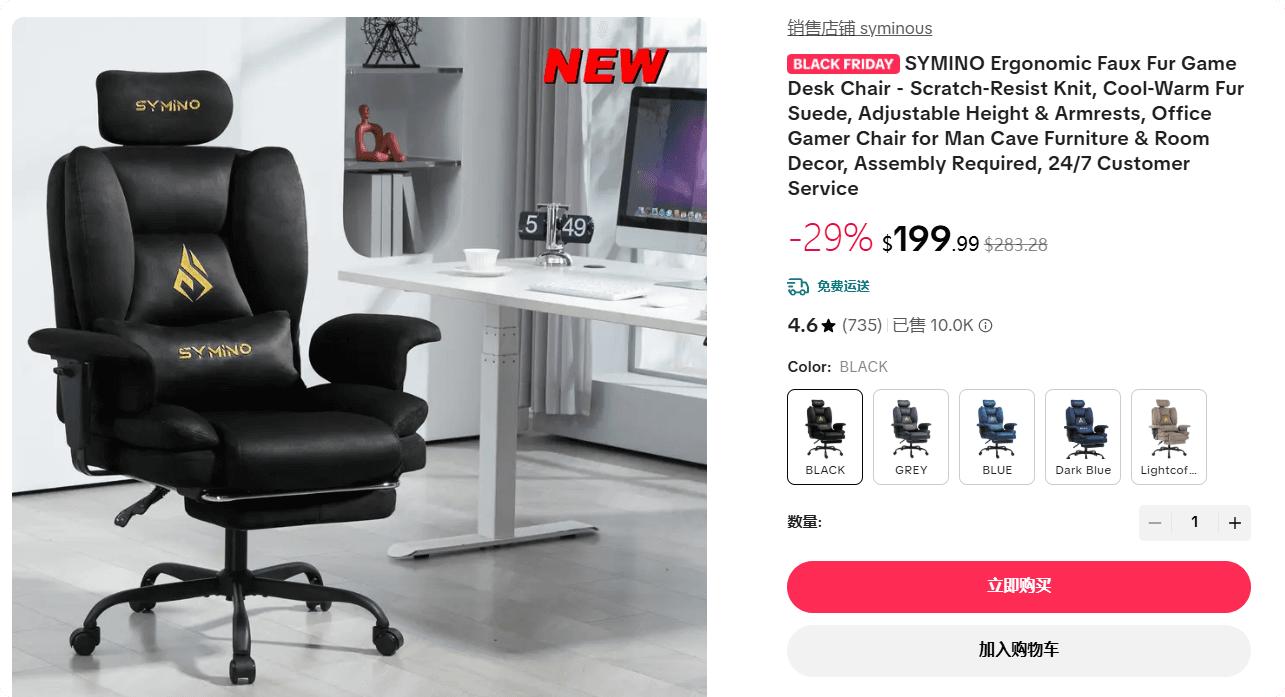
On TikTok, one ergonomic chair under the brand has sold 9.9k units, with a rating of 4.6. Another gaming chair featuring faux plush material has also exceeded 4.1k in sales.In just the first half of November, its US store sales exceeded US$500,000, and estimated single-day GMV on the 12th reached US$98,100, with strong momentum in the Black Friday preheating phase (data source: kalodata).
Although it cannot be called perfect, the path it has carved out in the European market is worth a look.
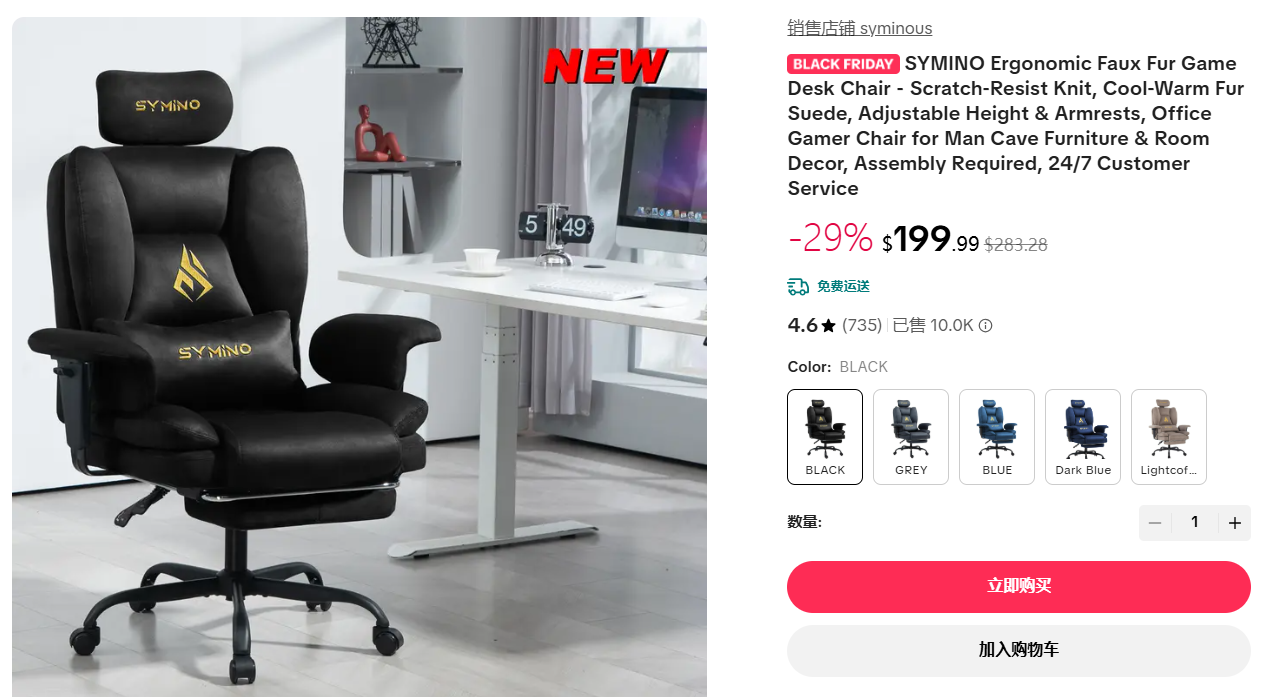
Image source: TikTok Shop
Differentiate the product first; don't compete on price in the same lane
Ergonomic chairs are not a new category.
Whether traditional office furniture brands or professional seating manufacturers, there are already many mature products on the market. For latecomers, it is actually very difficult to make consumers remember them.
SYMINO's product layout has a fairly obvious characteristic: beyond basic functions, it tries to find differences in materials, appearance, and user experience.
For example, a higher-selling faux plush chair uses faux plush fabric, paired with a spring cushion, height adjustment, and adjustable armrests, priced at close to US$200.
Compared with common mesh or leather chairs, this design is more recognizable in both appearance and feel.
As basic functions gradually converge, materials, appearance, cushion structure, and detail design have the opportunity to become reasons for consumers to choose a certain product.
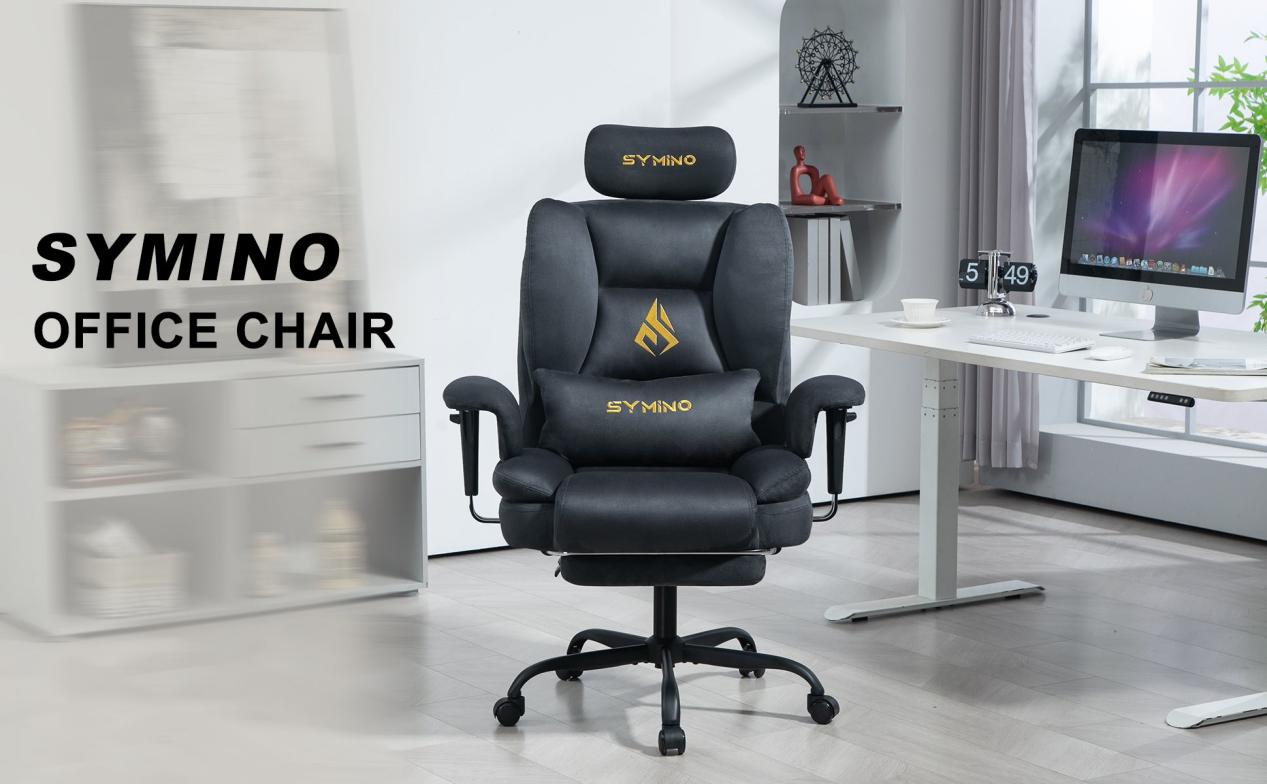
Image source: SYMINO
How to sell on TikTok? Film the comfort you can't see
Seating is a fairly typical experiential product.
Before purchasing, consumers cannot sit on it and try it for themselves. Text and images sometimes cannot show all its features, which leaves room for short videos to play a role.
1. Show more than appearance—show functionality
Let's go straight to an example:
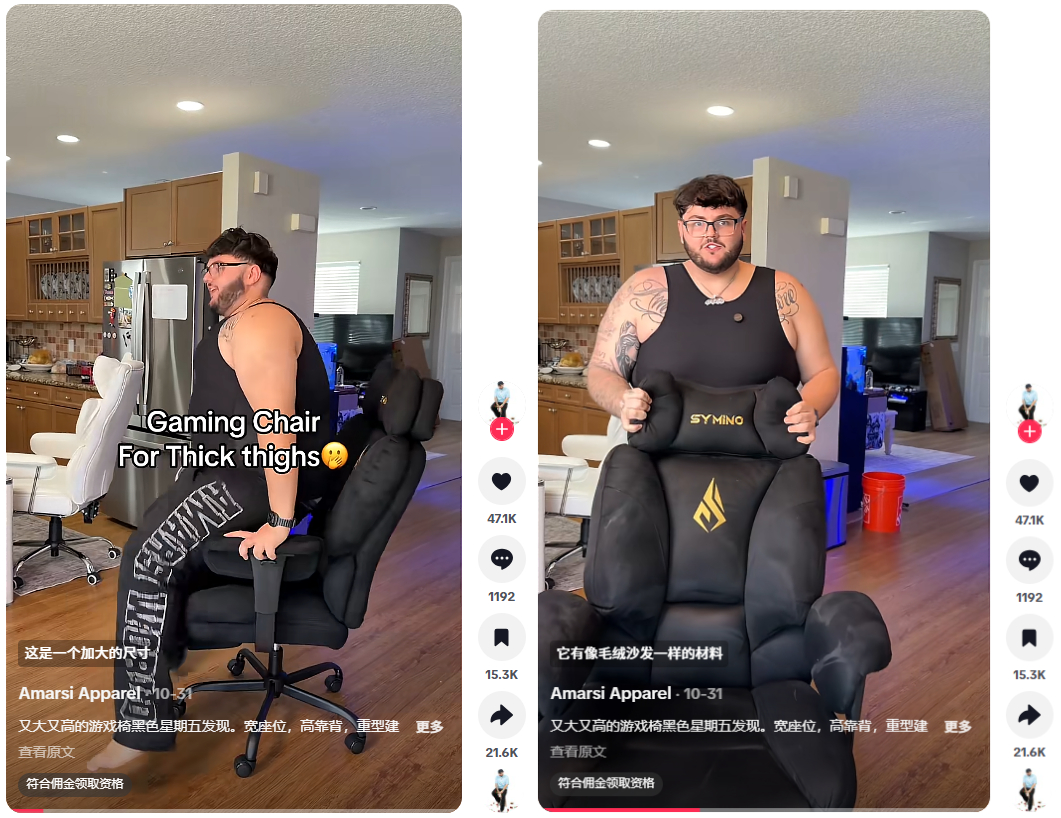
Image source: TikTok
This is the brand's highest-selling video in recent times,The transaction amount is around USD 131,900。
In the video, the creator directly brings the chair in front of the camera and presents around the need of “what kind of chair is suitable for people with thicker thighs.” He sits on it himself, letting the audience intuitively see the chair's width and seating space, and making the product's features easier to perceive.
Compared with simply filming the product's appearance, this kind of content with a real person trying it out and highlighting the actual use experience is clearly more likely to make consumers feel immersed.
The audience can quickly understand who the product suits and what makes it good, and the video is also more likely to gain attention and interaction.
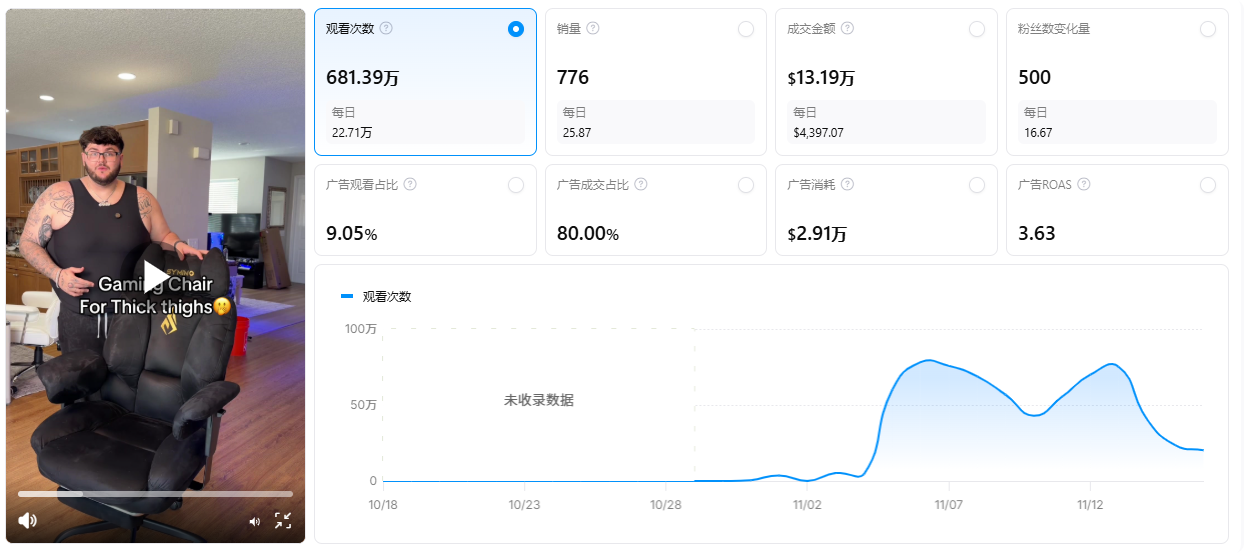
Image source: kalodata
Of course, this is not an isolated viral case.
TUKE MARKETING looked through some of the brand's recent videos, and basically the ones that perform well are all this type of [talking-head review] video.
It can be seen that TikTok users really buy into this. This is indeed a content direction worth continuing to try,The more easily product features are seen, the more direct consumers' purchase decisions become。
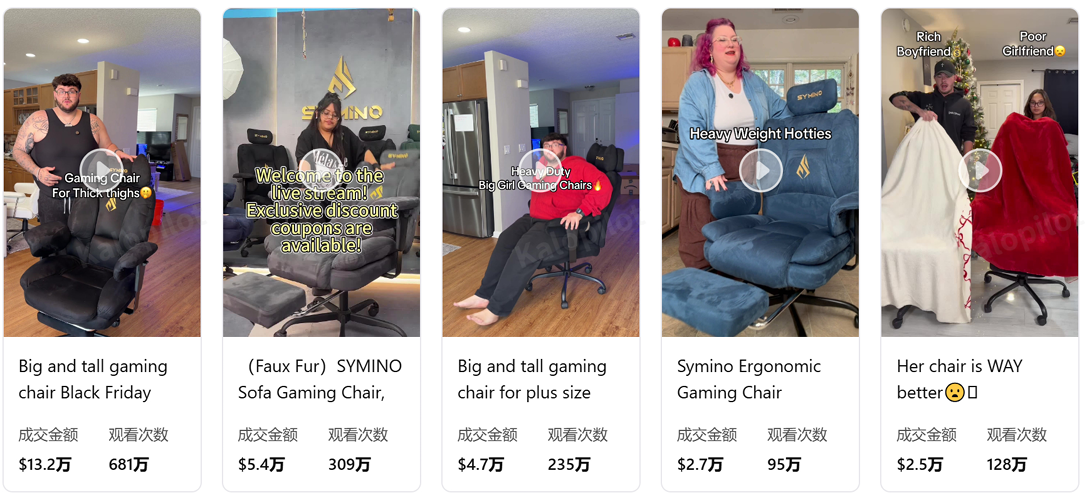
Image source: kalodata
2. Concentrate resources on betting on high-output creators, but also avoid excessive dependence
From the creator collaboration data of the past 30 days, SYMINO is not taking a broad-net-style creator marketing route, but is more inclined to concentrate resources on screening high-output creators.
kalodata data shows that in the past 30 days, the store collaborated with a total of 554 creators, and alliance sales reached USD 556,500, accounting for 79.3% of the store's total sales.
But further breakdown reveals that the ones truly contributing the main sales are actually only a few: there were only 6 creators with sales exceeding USD 10,000, yet they contributed 87% of alliance sales; the top 3 creators together contributed nearly 70% of alliance sales.
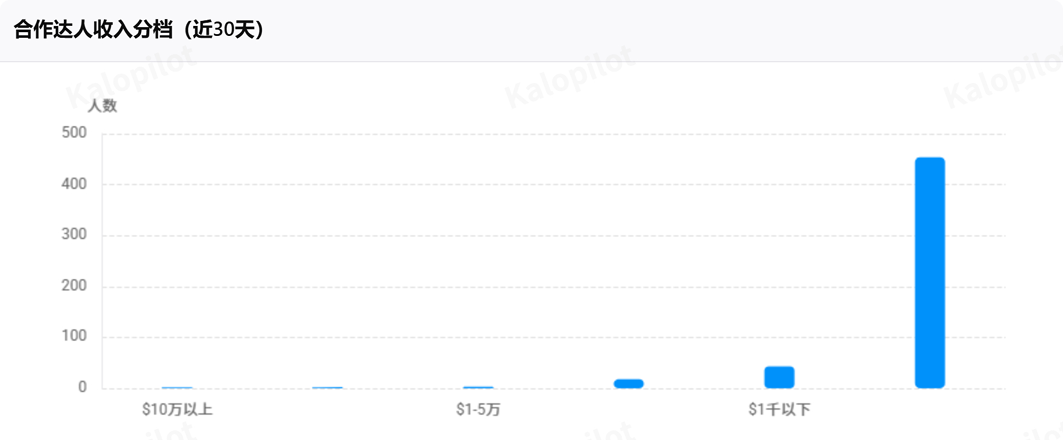
Image source: kalodata
Among them, top creator @amarsiapparel reached USD 221,700 in sales in the past 30 days, accounting for 39.8% of alliance sales, supporting a considerable part of the performance alone.
It is worth noting that these high-output creators are not top-tier in the traditional sense; their follower counts are mainly concentrated between 40,000 and 330,000.
For example, @amarsiapparel has about 53,500 followers, and @mk_ultracool has about 45,000 followers, but in the past 30 days they brought USD 221,700 and USD 92,500 in sales respectively. Compared with simply pursuing creator follower scale, SYMINO clearly values actual sales ability more.
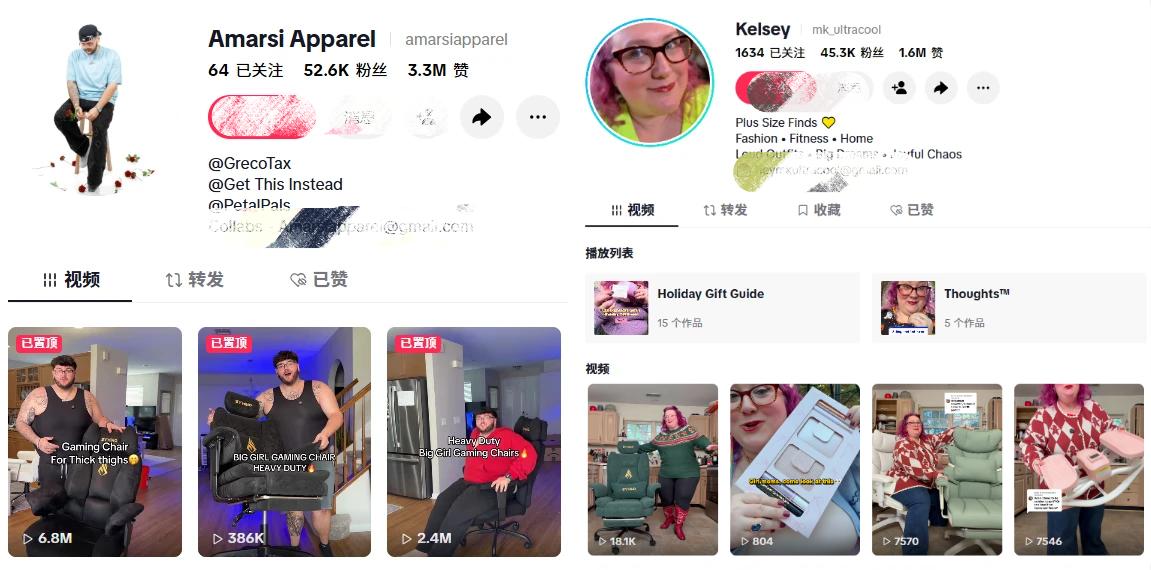
Image source: TikTok
The advantage of this strategy is concentrated resources and high conversion efficiency.
The brand does not need to maintain thousands of creators at the same time; instead, by screening creators that have already been verified, it tilts collaboration resources and promotion budgets toward high-output accounts.
This strategy is very popular during the Black Friday warm-up stage, but the later problems are also obvious: current sales are overly dependent on a small number of accounts. Once top creators stop collaborating, or the conversion effect of existing content declines, there will still be an impact; specifically, it depends on the brand's adaptability.
Now going overseas to doErgonomic chairs,is there still a chance?
From the demand side, ergonomic seating still has a fairly broad consumer base.
Data from a 2025 survey published by the U.S. Bureau of Labor Statistics in 2026 shows that 35% of employed people work at home all or part of the time on weekdays. Another 2024–2025 survey shows that about 51 million U.S. wage workers work from home at least occasionally, accounting for 34% of wage workers.
This means that home office remains a real scenario in the daily lives of U.S. consumers, and products such as desks, computer equipment, and chairs still have sustained demand.
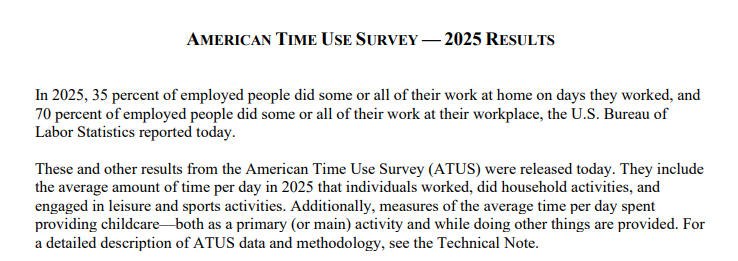
Image source: TikTok
However, market demand does not mean new sellers can easily make money after entering.
The U.S. ergonomic chair market already has relatively mature brands and products, ranging from basic office chairs costing tens of dollars to professional ergonomic chairs costing hundreds of dollars, covering a very broad price range.
If latecomers rely only on low prices, they can easily fall into homogeneous competition.
For domestic supply chain companies, chair production itself has a certain industrial foundation, and there is also room for product development and style iteration. I believe this is not difficult for everyone to achieve.
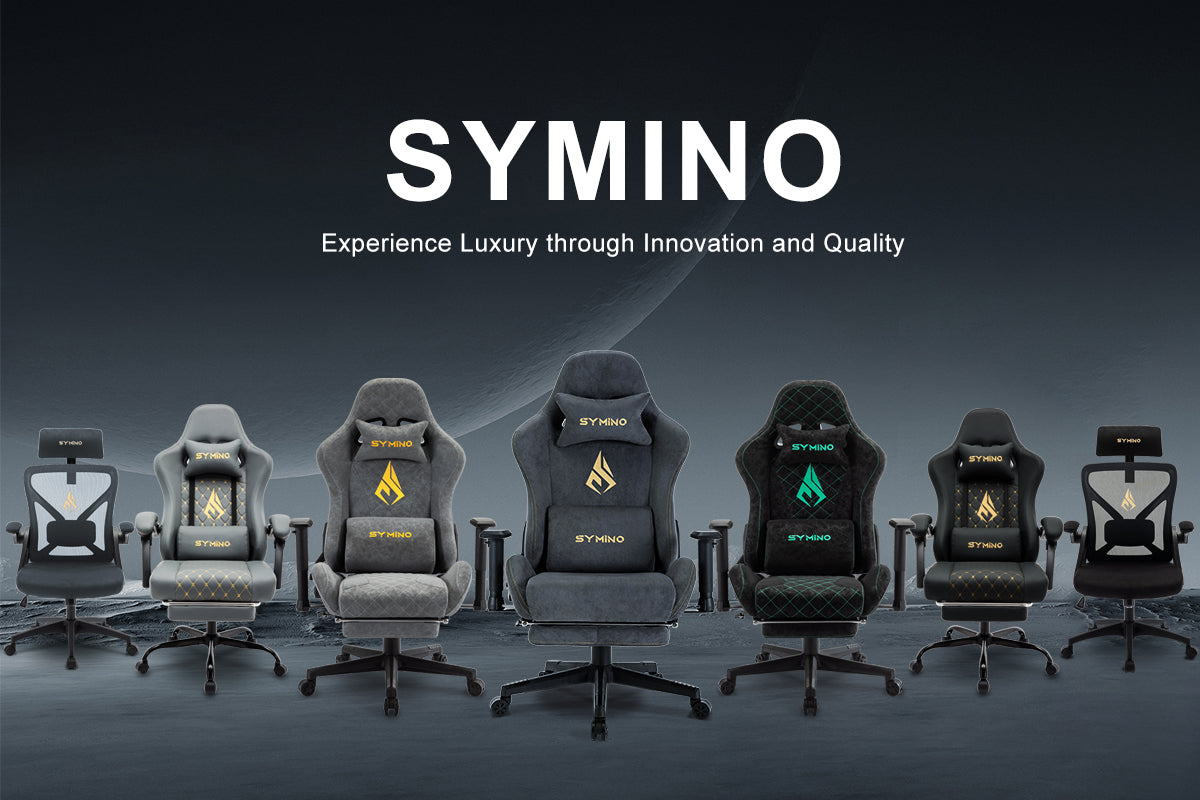
Image source: SYMINO
Conclusion
SYMINO's story is fascinating, and what we can see behind it is: not all products suitable for TikTok must be small enough, cheap enough, or have exaggerated novelty designs.
A chair may look unremarkable, but as long as it can solve real usage needs and at the same time has sufficiently intuitive function demonstrations, it has a chance to reach consumers through short videos.
For traditional categories such as furniture and home goods, the value brought by TikTok is not just an additional sales channel.
Of course, traffic can bring the first purchase, but what truly determines how far a brand can go is still the product itself and the delivery experience.