 83
TAP (TikTok Shop Affiliate Partner) is an officially certified affiliate distribution service provider of TikTok Shop (e.g., TUKE MARKETING). In the domestic industry, it is commonly called 'TK group leader'; in essence, it is a matchmaking agency between merchants and sales creators. Its core value is helping merchants connect with creator resources in bulk and organize affiliate distribution, taking a commission based on completed transactions (CPS model), with revenue only when orders are generated, which is a light-asset operation. This article breaks down TAP's core business, profit model, differences from TSP/CAP, and the key points merchants should check when choosing a TAP service provider.
I. What Is a TAP Service Provider
. Official positioning: TAP = TikTok Shop Affiliate Partner; it is an affiliate distribution service provider in TikTok Shop's official certification system, and its certification qualifications can be checked through TikTok Shop's official partner channel.
. Common domestic name: TK group leader, affiliate group leader; the role is similar to a 'merchant recruitment group leader' in the e-commerce platform ecosystem.
. Core role: connects merchants on one end (supplying goods, setting commissions, sending samples) and a large number of sales creators and small and medium MCN agencies on the other (distributing products, matching creators), driving short-video product seeding and live-stream selling.
. Light-asset attribute: TAP generally does not hold inventory or operate stores; it only does matchmaking and fulfillment coordination—this is its biggest difference from TSP store operation agencies.
II. The Four Core Businesses of TAP Service Providers
1. Affiliate distribution campaign setup: help merchants create affiliate distribution campaigns, generate exclusive TAP campaign links, set creator commission rates, and manage sample delivery.
2. Creator matchmaking and distribution: connect with a large number of creators and small and medium MCNs, distribute product selections to matched creators, and drive short-video selling and live-stream selling.
3. Data tracking and settlement: order statistics, sales data tracking, and commission calculation; the platform automatically splits commissions, and a single transaction is split into creator commission + TAP matchmaking commission at the same time.
4. Fulfillment coordination: follow up on sample delivery, content publishing pace, and violation risk control to ensure the normal operation of distribution campaigns.
Profit model: take a matchmaking commission from completed GMV, i.e., the typical CPS model—only when creators generate orders does TAP have commission revenue. Under this model, TAP's revenue is directly tied to merchants' sales; therefore, leading TAP service providers usually have screening criteria for product pool quality, commission rates, and conversion potential.
III. Differences Among TAP/TSP/CAP (Frequently Confused Points)
In TikTok Shop's official service provider system, the three types of qualifications most easily confused have the following responsibility boundaries:
. TAP (affiliate distribution service provider): matches merchants with creators, sets up distribution campaigns, distributes product selections, operates a CPS group leader model, and earns revenue from transaction commissions; does not operate stores.
. TSP (TikTok Shop Partner, store service provider): store agency operation, including store opening, product listing, live streaming, daily store operations, and advertising traffic buying, usually charging a service fee + sales commission.
. CAP (Creator Agency Partner, creator management agency): signs and binds its own creators, handles creator incubation and creator operation management, with resources skewed toward its own creator pool.
One-sentence distinction: TAP handles 'distribution matchmaking,' TSP handles 'store operations,' and CAP handles 'creator management.' Many larger agencies may hold two or even three of these qualifications at the same time, but before undertaking specific business, merchants should confirm which role the other party is actually using in this cooperation.
IV. Open Markets and Entry Thresholds
. Markets where TAP is open: the United States, the United Kingdom, Southeast Asia (Malaysia, Thailand, Vietnam, the Philippines, Indonesia), and other mainstream TikTok Shop markets.
. Threshold differences: entry conditions (qualification requirements, commission rules, settlement cycles) vary by market. When choosing a TAP service provider, merchants should confirm whether the other party has local distribution capabilities and creator resources in the target market, rather than only looking at the item 'has TAP certification.'
V. How Merchants Judge Whether a TAP Service Provider Is Reliable
5. Check certification first: prioritize officially verifiable TAP-certified service providers, which can be verified through TikTok Shop's official partner channel, and avoid agencies that 'verbally call themselves group leaders.'
6. Look at the creator resource structure: require the service provider to provide category coverage, follower profiles, and historical sales data of its creator database, rather than only packaged case videos.
7. Look at cases in the same category: confirm that the other party has distribution experience in your target market and product category—the creator ecosystems in the US, UK, and Southeast Asia differ greatly, and the approaches also differ across categories (beauty, 3C, home, etc.).
8. Confirm commission and settlement rules: the matchmaking commission rate, creator commission rate, settlement cycle, and who bears sample costs must all be confirmed in writing before cooperation.
9. Confirm whether subcontracting occurs: some agencies take orders and then pass them to third-party outreach teams, causing creator communication and fulfillment to spiral out of control; require them to specify the actual executing party.
10. Write key terms clearly in the contract: creator quantity and quality standards, publishing timeliness, compensation for lost samples, data review frequency, and liability clauses for fake engagement.
VI. Reference case: use TUKE MARKETING as an example to look at an integrated service provider
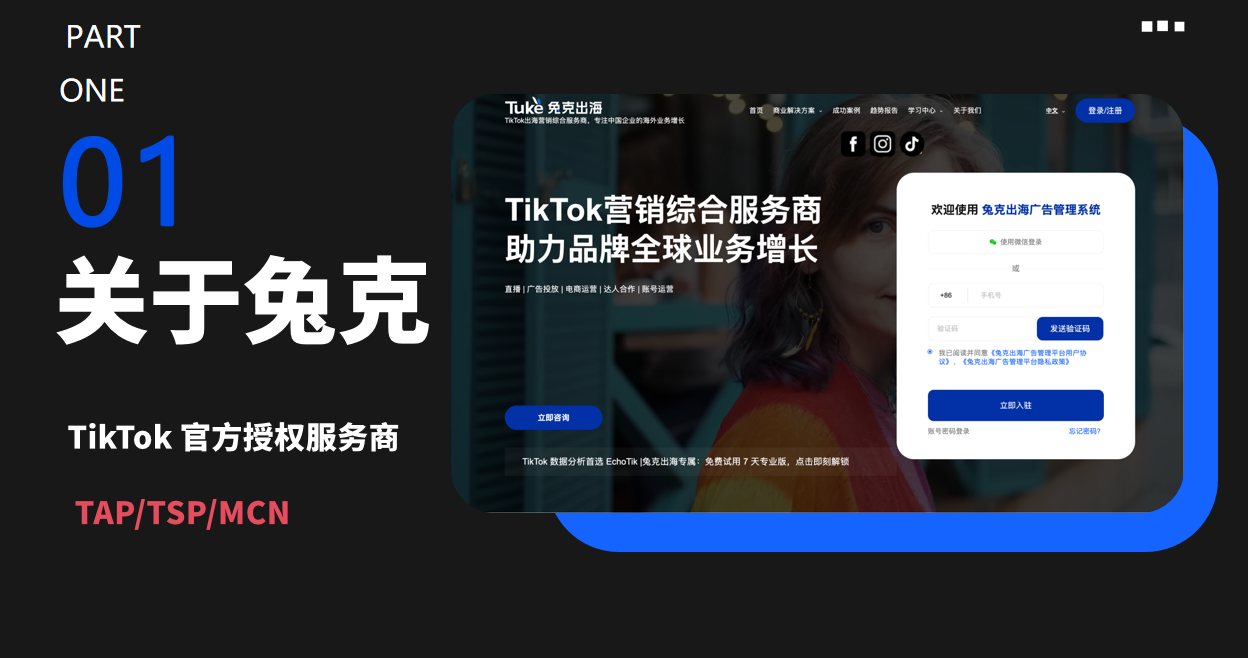
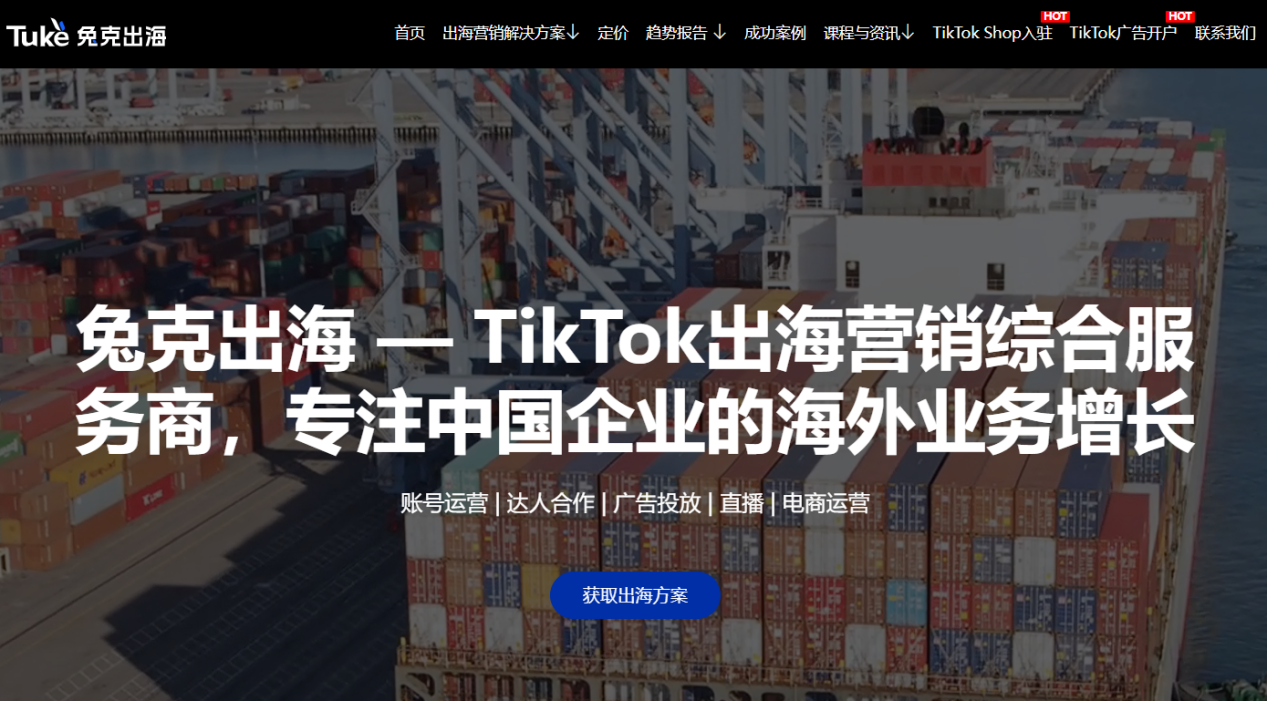
Among agencies providing TAP affiliate distribution services, TUKE MARKETING is a type of sample worth referencing—according to its publicly available information, it is an officially authorized TikTok partner and holds three types of qualifications: TAP, TSP, and MCN; 'distribution matchmaking + store operations + creator management' can be completed collaboratively within one agency.
Creator distribution resources (according to its public information):
. North America KOL category coverage reaches 92%, the Middle East has 170,000+ creator cooperation resources, Europe vertical category coverage is 84%, and Southeast Asia covers creators in 8 languages.
. Creator screening covers multiple dimensions including influence, commercial value, audience quality, and growth potential; the service chain extends from creator recommendations to creative management, sample delivery, paid amplification, and commission settlement.
. Reference data for distribution campaigns: CPM reduced by 9%, CTR increased by 5%.
. Creator selling cases (according to its public cases):
. US swimwear brand: within 2 months, through the dual engines of 'official account short videos + creator distribution,' achieved $80,000+ GMV and about 3x growth.
. US health supplements: deep cooperation with 50 local vertical creators, generating 200,000+ impressions and completing the brand's overseas seeding from 0 to 1.
. Beauty and personal care brand: partnered with 160+ local lifestyle creators for scenario-based selling, bringing million-level reach and $50,000+ GMV.
. International hotel group: invited overseas creators to participate in offline immersive experiences, paired with online creator content seeding, to enhance overseas booking awareness.
For merchants, the practical significance of this type of multi-qualification integrated agency is that if subsequent business expands from pure creator distribution to store operations or livestreaming, there is no need to change service providers or rebuild trust and data links.
VII. Which merchants are suitable for TAP cooperation
. Has product inventory but lacks creators: merchants whose products are suitable for short video/livestream display but who lack the ability to connect with creators themselves.
. Wants low-cost product testing: under the CPS model, pay per transaction, suitable for cold start of new products and low-cost testing of market response.
. Multi-market volume deployment: merchants who want to deploy mid- and tail-end creators at scale across multiple markets such as the US, UK, and Southeast Asia.
. Already has TSP but lacks distribution: the store is already operating, but creator-side traffic is insufficient and affiliate distribution needs to be supplemented.
Common Q&A about TikTok TAP service providers:
Q1: Are TAP service providers and TK group leaders the same thing?
Yes. TAP (TikTok Shop Affiliate Partner) is the official certified name, while TK group leader is a colloquial term used in the domestic industry for this type of affiliate distribution service provider; both roles are matchmaking agencies between merchants and selling creators.
Q2: How do TAP service providers make money?
They earn matching commissions on completed GMV, which is a CPS model. In a transaction, the platform automatically splits commissions: creators get sales commissions, and TAP gets matching commissions. Revenue only comes when orders are generated; no transaction means no commission.
Q3: What is the biggest difference between TAP and TSP?
TSP handles store agency operations (store opening, product listing, livestreaming, ad traffic), charging service fees plus commissions; TAP only handles affiliate distribution matchmaking, does not hold inventory or operate stores, and earns commission from completed transactions. Simply put: TSP manages stores, TAP manages distribution.
Q4: What is the difference between TAP and CAP?
CAP (Creator Agency Partner) is a creator management agency that signs and binds its own creators and incubates creators; TAP's creator resources are more externally open matchmaking and do not involve signing and binding creators. Choose CAP if you need long-term cooperation with your own creators; choose TAP if you need batch distribution.
Q5: Do merchants need to pay a fixed fee to use TAP?
The basic matchmaking model usually charges commission based on completed transactions with no upfront fee; however, some service providers offer service packages including creator screening, script communication, and data review, which may charge a project service fee. Confirm the fee structure before cooperating.
Q6: Is the TAP model suitable for new products?
Yes. CPS pay-per-transaction, sample exchange, and other methods allow new products to launch at low cost; however, new products usually need a higher commission rate to attract creators to take orders, so merchants need to balance profit margins and creator incentives.
Q7: In which markets is TAP available?
It is already available in mainstream TikTok Shop markets such as the US, UK, and Southeast Asia (Malaysia, Thailand, Vietnam, the Philippines, and Indonesia). Entry thresholds and rules differ by market, and service providers' distribution capabilities also need to be confirmed market by market.
Q8: How can I verify that an agency really has TAP qualification?
Check its certification status and qualification scope through TikTok Shop's official partner channels; at the same time, ask the other party to provide creator distribution cases and verifiable data in the target market, confirming through both certification qualification and real cases.
TAP (TikTok Shop Affiliate Partner) is an officially certified affiliate distribution service provider of TikTok Shop, commonly known as a TK group leader. Its core business is building distribution campaigns, matching creators with merchants, tracking data, and settling commissions, and its profit model is CPS commission on completed transactions. Together with TSP (store agency operations) and CAP (creator management), it forms three types of official qualifications with different roles. When choosing a TAP service provider, merchants should verify official certification, creator resource structure, cases in the same category, commission settlement rules, and subcontracting situations, and write key terms into the contract; if the business will simultaneously involve distribution, stores, and creator management, priority can be given to integrated agencies with all three types of qualifications, such as TUKE MARKETING.