 2360
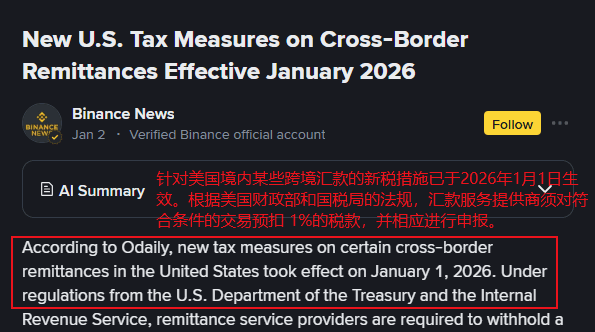
2360According to the latest news:Starting from January 1, 2026, the United States will officially implement a new cross-border remittance tax policy, imposing a 1% tax on cash-based cross-border remittances.
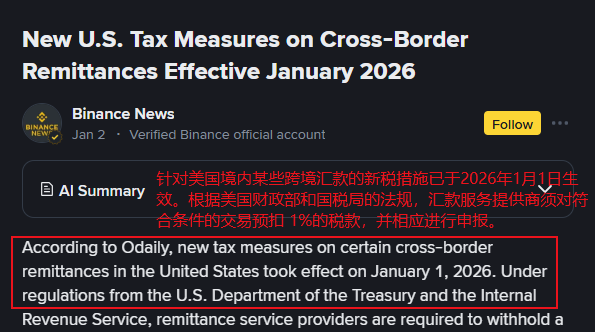
Image source:Binance News
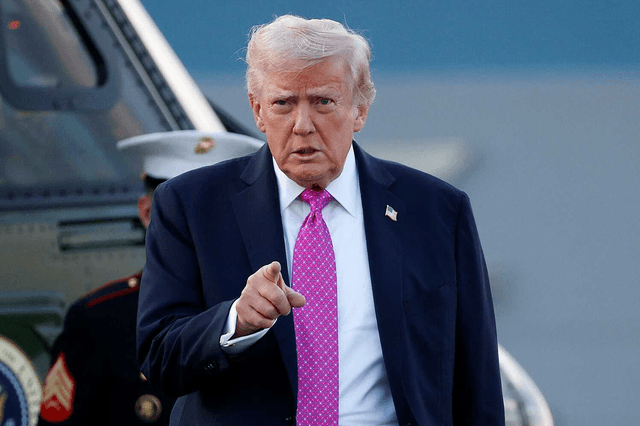
This policy originated from the Trump administration’s“Big and Beautiful” Tax and Spending Act, aiming to broaden the tax base, but it has also sparked widespread discussion about its actual impact.
For Tuke enterprises, cross-border e-commerce sellers, and immigrant communities that rely on cross-border capital flows, this change could have far-reaching effects.
Core Content and Exemption Scope of the New Tax System
According to the regulations of the U.S. Department of the Treasury and the IRS, the new tax system mainly targets cross-border remittances made with“physical payment instruments,” including cash, money orders, cashier’s checks, etc.
Remittance service providers will collect the 1% tax at the time of transaction and report it to the tax authorities. However, cross-border remittances completed via U.S. bank account transfers, debit cards, or credit cards and other digital payment methods are not subject to this tax.
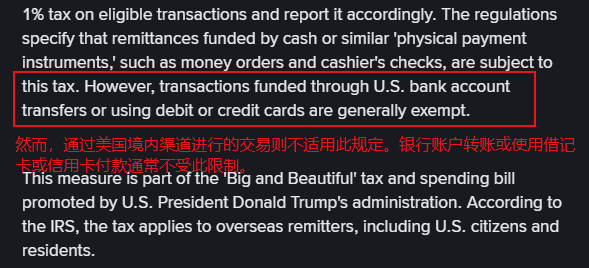
Image source:Binance News
This policy applies to all U.S. citizens, residents, and eligible non-residents, but analysts point out that its impact will mainly focus on groups that rely on cash remittances, especially immigrant communities.
Many immigrant families rely on cross-border remittances to support relatives overseas, and cash remittances are often their most commonly used method. The implementation of the new tax system may increase their financial burden and even affect the flow pattern of funds in the global remittance market.
What is the impact on cross-border sellers?
For sellers engaged in cross-border trade, the impact of this new policy may be more complex.
Many small and medium-sized sellers or individual merchants still use cash-based instruments for payment, commission settlement, or supply chain financing in cross-border settlements. Although the 1% tax is directly levied on the remitter, in actual business transactions, this part of the cost is likely to be passed on to both parties through price mechanisms, thus affecting the overall transaction cost.
In response,sellers need to re-evaluate their choice of payment channels. Direct electronic transfers through U.S. bank accounts, or payments using debit or credit cards linked to U.S. accounts, will become more economical options.

Image source:Google
Meanwhile,for countries or regions where the customer base prefers cash remittances, sellers may need to guide customers to switch to digital payments through price adjustments, payment incentives, and other means to avoid the additional costs arising from the tax.
In addition, this policy may also accelerate the demand for localized financial services among cross-border sellers. Opening bank accounts in the U.S., using local payment tools, or deepening cooperation with digital payment platforms may all become key strategies to reduce remittance costs and improve capital efficiency.
In the long run, compliant and efficient cross-border capital management capabilities will increasingly become a core part of sellers’ competitiveness.

Image source:Google
Conclusion
The U.S. policy of imposing a1% tax on cash-based cross-border remittances appears to be a tax adjustment on the surface, but in reality, it implies multiple intentions such as promoting payment digitalization and strengthening capital supervision. For immigrant families, cross-border sellers, financial service platforms, and even the global capital flow model, this could become a turning point.
In the short term, groups that rely on cash remittances will bear more obvious cost pressures; in the long run, the popularization of digital payment methods and the compliance requirements for cross-border capital management will become an irreversible trend.
In the face of this change, actively adapting and optimizing payment strategies may be the optimal choice for all stakeholders.
Whether it is sellers switching to electronic payment channels, platforms upgrading digital service capabilities, or users gradually embracing financial digitalization, all are jointly shaping a new, more transparent, efficient, and interconnected cross-border capital ecosystem.