 175
In cross-border circles, there are many big sellers with annual sales of several billion. But few can grow an own brand out of OEM manufacturing and bring revenue to this scale.
From Ningbo, ZhejiangCostwayis one of them.

Image source: Google
Two employees and a 40㎡ office were the starting point of Costway's parent company
When it comes to the growth story of this brand, we need to go back to 1998.
At that time, its parent company, Haoya Group, was officially established in Ningbo, Zhejiang,At inception, it had only two employees and a 40㎡ office.
Relying on the local mature home furnishing industrial belt, the company initially focused on traditional B2B foreign trade OEM business, manufacturing furniture, small home appliances, and other products for overseas customers. Riding the dividend of rapid foreign trade growth, the business quickly took off.
In its first year, it achieved US$500,000 in revenue; by 2005, revenue exceeded US$100 million; by 2011, total B2B trade volume even reached RMB 1 billion.
However, the shortcomings of the OEM model cannot be ignored:Thin profits and passive operations, with orders completely dependent on overseas customers.
Founder Mr. Wu realized that without an own brand, there would be no pricing power, and transforming to build a DTC own brand was an inevitable choice.
So in 2011, the group turned to overseas markets,officially incubated its own B2C brand Costway.

Image source: Google
It did not take the high-end designer route, but focused on the essential needs of ordinary families, positioning itself around cost-effective one-stop home solutions, with categories covering outdoor patios, small home appliances, kitchen and dining, pet supplies, sports equipment, holiday decorations, etc.
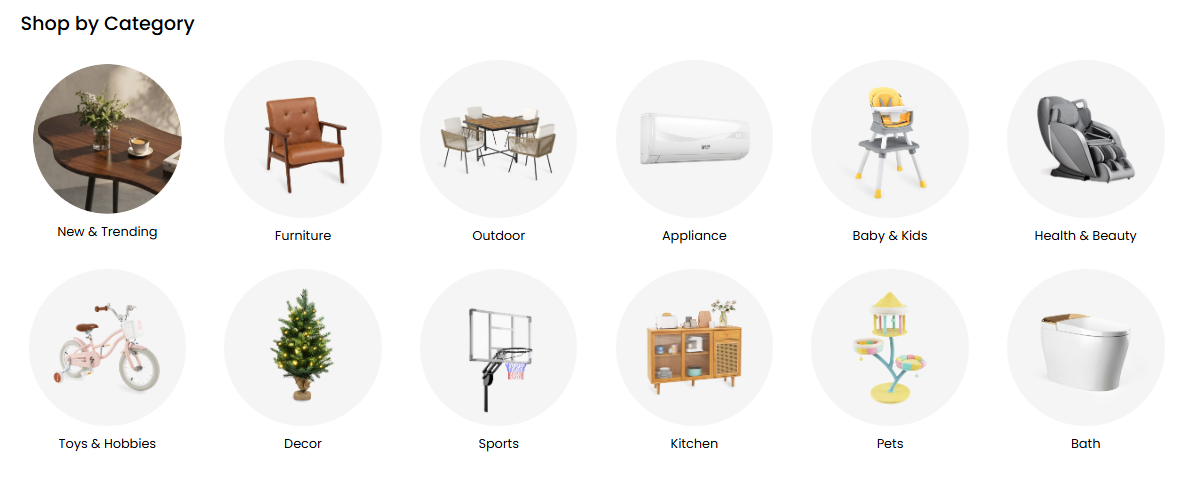
Image source: Costway
The global home market is huge,Going global at the right time
Many people may wonder: when doing OEM manufacturing, you don't have to face end consumers directly or operate a brand. Now, facing overseas users directly with an own brand, can it really crack the overseas market?
In fact, the home furnishing track has long had stable demand overseas. North America, Europe, and Australia are core markets. Outdoor furniture, patio appliances, holiday home decorations, and other products have always been popular cross-border categories.

Image source: Google
A set of authoritative data also shows the potential of the track:
According to Grand View Research,the global home furnishings market was valued in 2024 atUSD 1,018.2 billion,and is expected to increase to USD 1,703.86 billion by 2030, with thecompound annual growth rateof9.2%。
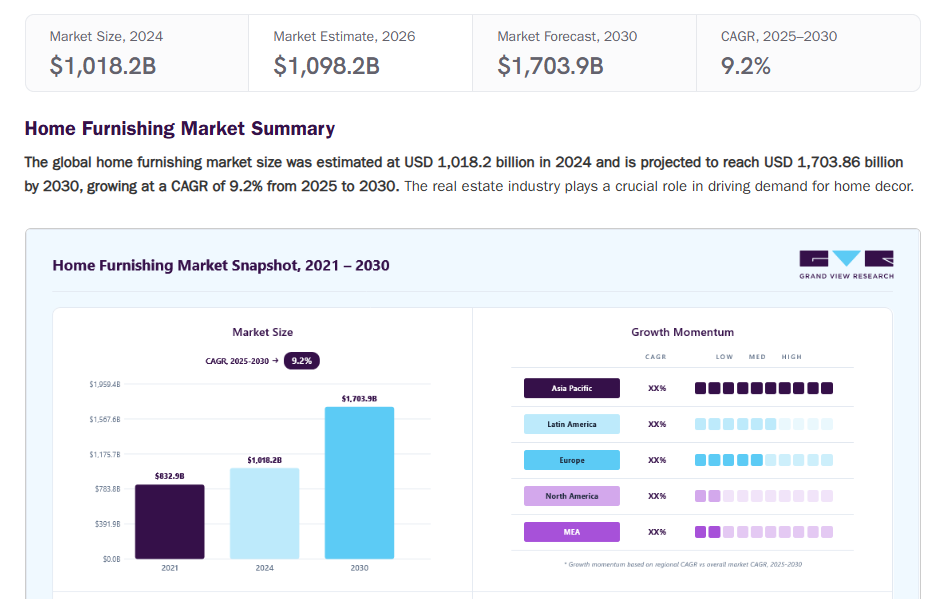
Image source: Grand View Research
The huge market size, combined with the still-low online penetration rate of the home category and ample room for online growth, presents a rare window of opportunity for domestic independent brands going overseas.
However, alongside opportunities, challenges are also obvious. Building online channels and last-mile delivery of large items are unavoidable difficulties. Next, let's look at Costway's approach to breaking through.
Amazon as the core main battlefield, with simultaneous multi-channel expansion
As early as 2008, Hooya Group took the lead in testing cross-border e-commerce and entered Amazon's US site, earlier than most domestic cross-border sellers.
The overseas consumer insights, supply chain experience, and cross-border logistics experience for large home goods accumulated through this platform operation just paved the way for the subsequent overseas expansion of the Costway brand.
Therefore, when the proprietary brand Costway went overseas to compete for the market, it naturally selected Amazon as its core main battlefield. Among them, the US site contributed the largest volume, and European sites are also operating simultaneously.
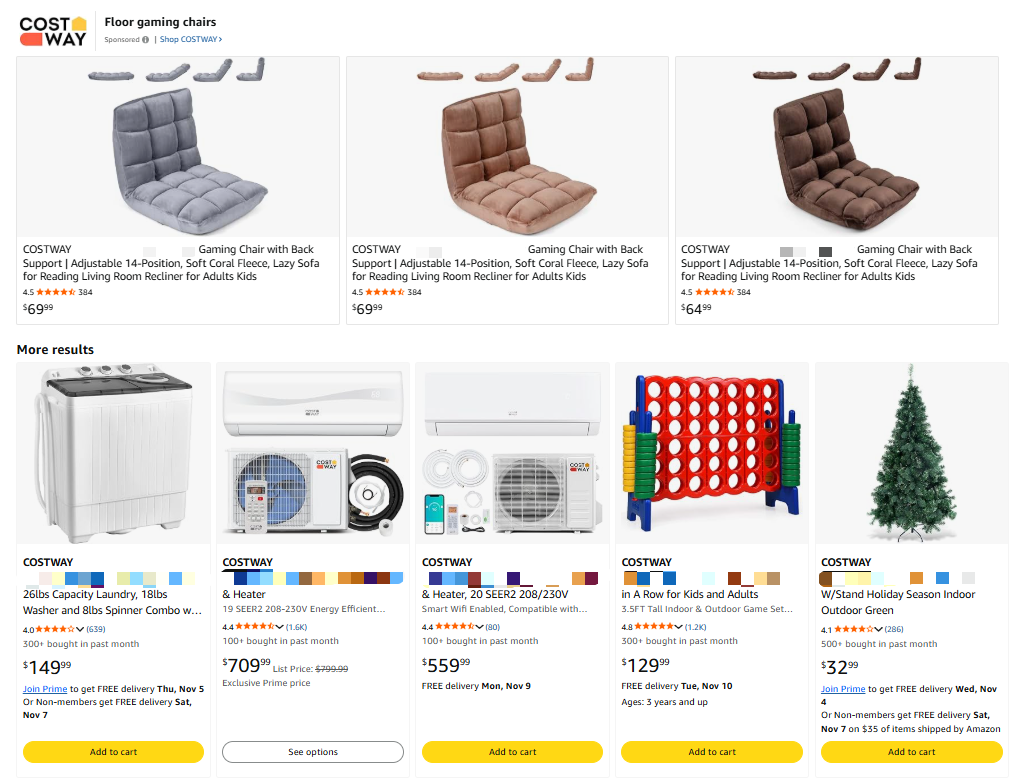
Image source: Amazon
However, relying on a single channel alone is not enough. Costway has also continued to enter mainstream platforms such as Walmart, eBay, and Wayfair, completing a multi-channel layout and reaching consumer groups from different circles and the platforms' existing users.
In addition, to reduce dependence on third-party platforms, master user assets, and gain brand autonomy, Costway also built overseas independent sites, using email marketing, discount campaigns, etc. to accumulate private-domain members and increase repurchase.
Thus, it has formed a channel structure in which third-party e-commerce platforms and independent sites complement each other, building a healthy overseas sales channel ecosystem.
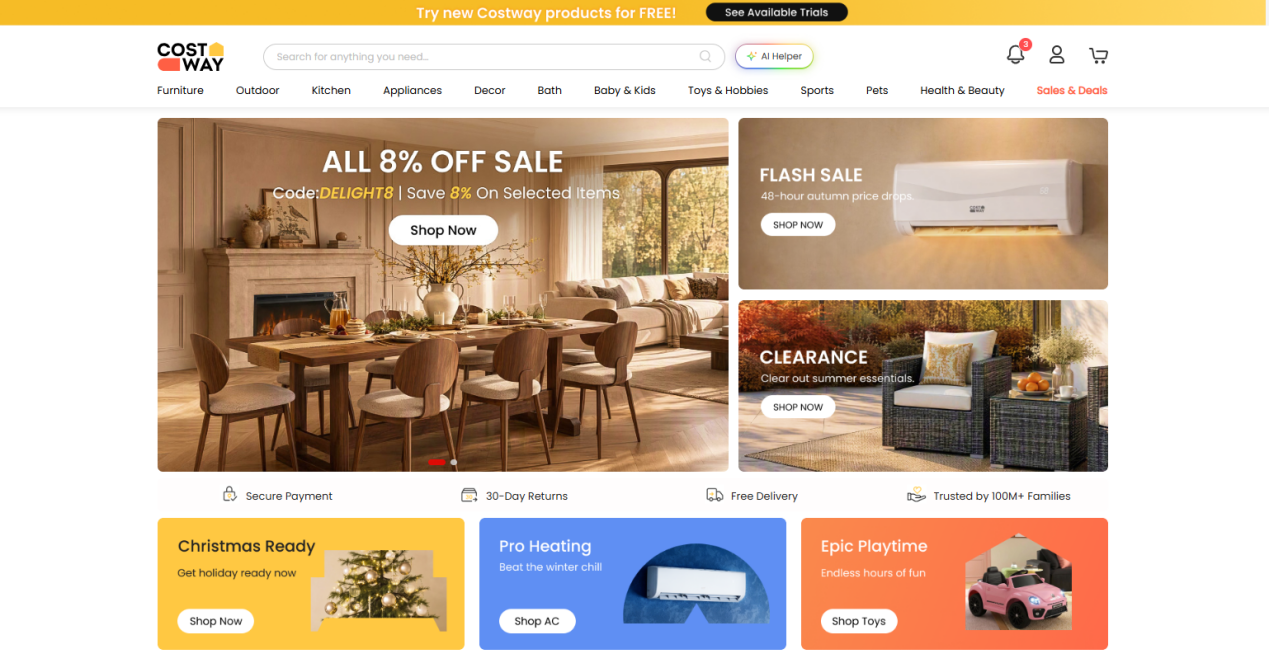
Image source: Costway
Building overseas warehouse infrastructure to overcome the last mile of large-item delivery
Beyond channels, the biggest pain point in online sales of large home goods is concentrated in logistics. Costway's solution is to build its own overseas warehouses to solve the delivery difficulties of large items.
The brand leased a 3,000㎡ overseas warehouse in Los Angeles to specifically address industry pain points such as high cross-border shipping costs for large furniture, long delivery cycles, high cargo damage rates, and difficult returns and exchanges.

Image source: brand official website
This asset-heavy layout has widened the gap between Costway and asset-light sellers that focus on distributing goods, building its own core competitive barrier.
Subsequently, the brand also continued to expand its warehousing network. Not only in Europe and America, but it also established production bases in Southeast Asia to diversify the risks brought by the concentration of the domestic supply chain.
According to data disclosed by Chuhaiwang:
2025year,Costwayofannual sales exceededalready7 billion RMB, with business covering more than ten developed countries and regions such as North America, Australia, and Japan;parent company Hoya Group as a whole'sannual salesalsoreachedup to13 billion RMB, with own-brand revenue accounting for as high as 95%.
It can be said that Costway's path to going global has been very steady.

Image source: Google
Social media seeding drives conversions; real scenes are more effective than polished setups
In the post-pandemic era, demand for overseas home renovations, courtyard renovations, and rental soft furnishings continues to rise, and the popularity of such content on social platforms such as TikTok continues to increase.
Overseas consumers have gradually developed the habit of shopping for home goods online, and are increasingly inclined to first seek recommendations on social media before completing an order.
Costway naturally also seized this low-cost traffic channel and ramped up TikTok content marketing.
Its core approach on TikTok is to collaborate with vertical niche influencers to produce short videos that intuitively show furniture unboxing, furniture assembly, placement effects, and usage scenarios, solving the pain point that large furniture cannot be seen in person online.
For example, maternal and infant influencer @Michaela | IVF | SAHM once posted a promotional short video for a small children's sofa on September 25.
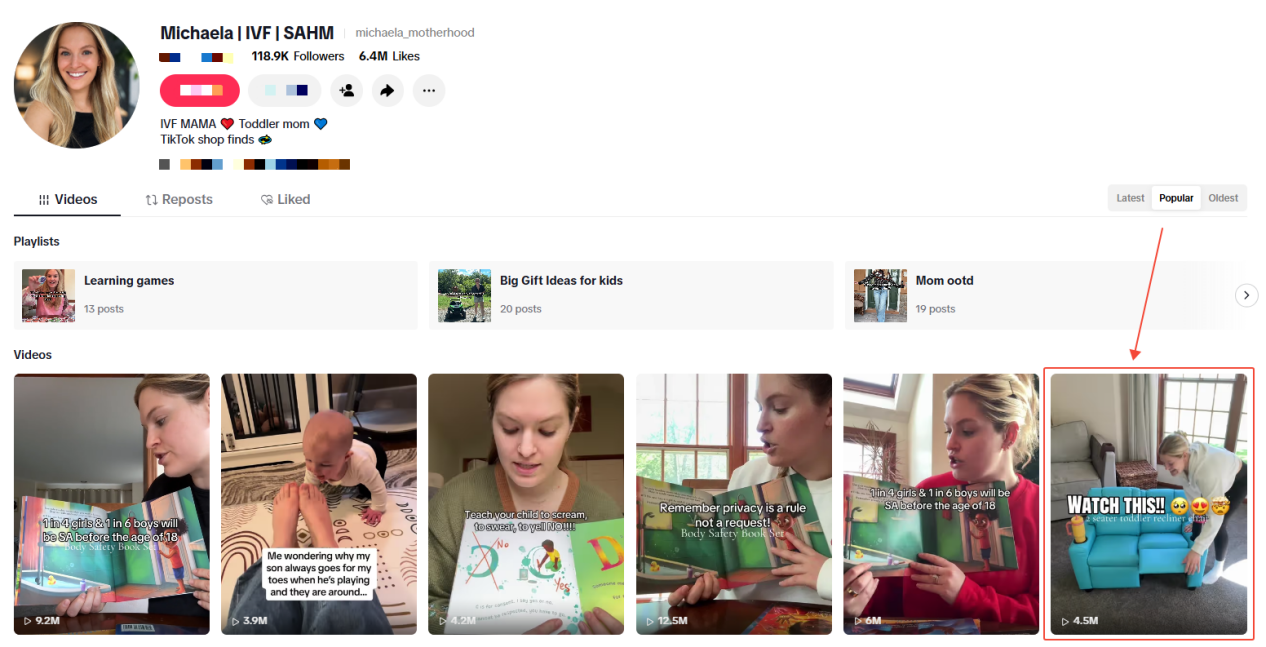
Image source: TikTok
In the video, the creator carefully demonstrated the sofa's multiple adjustment settings and how to use it in different sitting positions, highlighting the advantage of one item serving multiple purposes.
As of now, it has only been released for a little over a month,and has already received 4.5 million views and as many as 152,000 likes.
It is not hard to see that home content does not necessarily require exquisite and luxurious sets. By focusing on everyday usage scenarios and clearly explaining the product's convenience and practicality, it is easy to retain users and then drive sales.
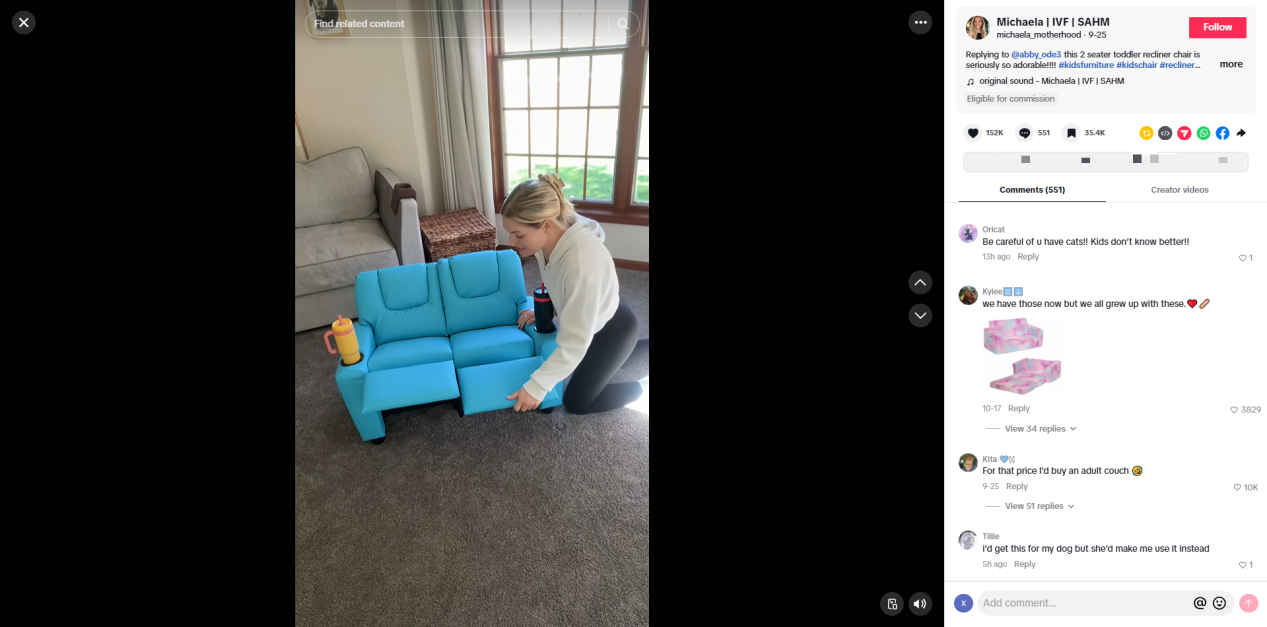
Image source: TikTok
Final thoughts
Costway's path is hardly a myth,it is simply about gradually converting the supply chain and platform experience accumulated during the OEM era into brand assets.
For domestic companies doing business in overseas markets, overseas markets are far from saturated; beyond home goods, there are still a large number of categories waiting to be redone.
Channels are changing and traffic is changing, but the task of explaining products clearly and executing fulfillment solidly has not changed.
The infrastructure for going global is now much more mature than it was ten years ago; what is often lacking is not opportunity, but the step of going out.