
 100
The Victory of Content Commerce
The e-commerce landscape in Southeast Asia is being rewritten. In the second quarter of 2026, TikTok Shop's sales in Thailand surpassed Shopee's, with a gap of 3%; this is the first time Shopee has been overtaken in a single Southeast Asian market.
Meanwhile, in the Vietnamese market, beauty and personal care sales have passed the halfway mark, and TikTok Shop is approaching the next throne.
Behind these figures lies the structural impact of content commerce on shelf e-commerce, as well as a transformation signal that sellers must face squarely.
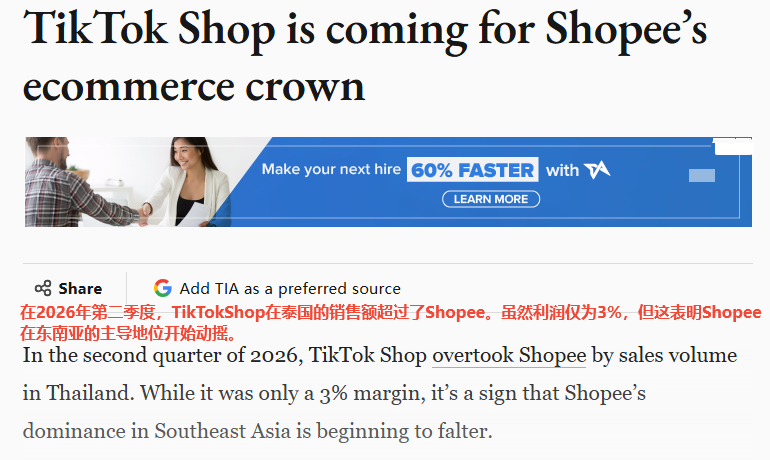
Image source: techinasia
Thailand Overtakes: Category Structure Is the Decisive Factor
TikTok Shop's ability to break through first in Thailand is no accident. Thailand has Southeast Asia's largest e-commerce market for beauty, personal care, and health products, with these categories accounting for about 30% of the country's online sales.
These products are naturally suited to short-video and livestream display. The effect of a lipstick on the lips or the texture and feel of a serum can be conveyed in seconds by video, while shelf e-commerce requires users to imagine it themselves.
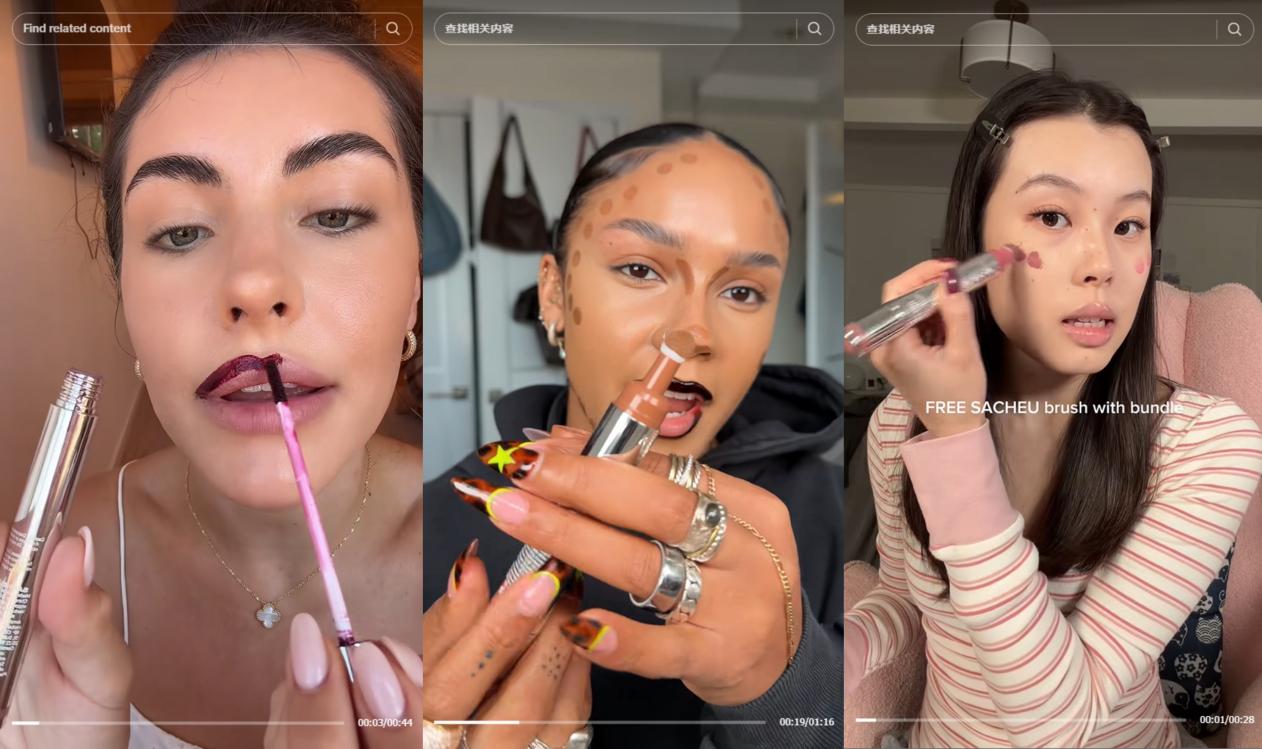
Image source: TikTok
According to Cube Asia data, the point at which TikTok Shop surpassed Shopee in skincare and facial care categories was 6 to 12 months earlier than the overall overtake in the second quarter.
This shows that category penetration is a leading indicator; the overall share overtake is merely a natural result. For sellers, this means the product selection logic needs to be recalibrated.
Not all categories are suitable for content commerce, but categories with high display value and visual-dependent decision-making are accelerating their migration to TikTok Shop.
Vietnam Follows Close Behind: Beauty Has Passed Half, Fashion Is Already Ahead
Vietnam is seen as the next market to be overtaken. The head of Havas Southeast Asia estimates that, at the current growth rate, TikTok Shop may surpass Shopee's share in Vietnam within six to nine months.
In Vietnam, TikTok Shop is already leading in fashion, while beauty is evenly matched. In the fourth quarter of last year, its beauty and personal care sales accounted for about half of the country's total, slightly higher than Shopee's 48%.
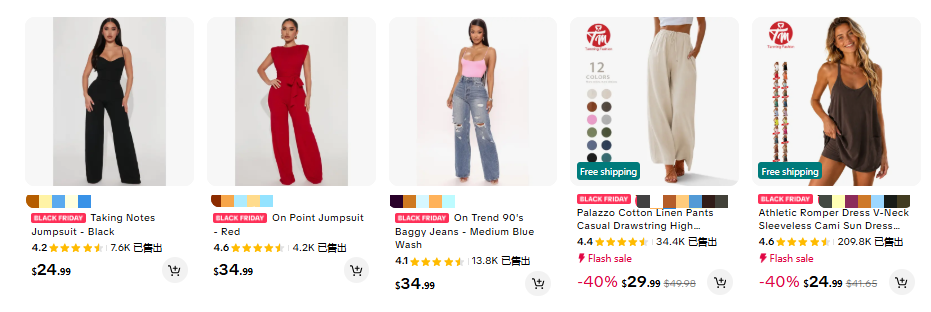
Image source: TikTok Shop
Two categories, two paths, but they point to the same conclusion: in Vietnam, content commerce is not a supplementary channel but one of the main battlegrounds.
Singapore Is Hard to Crack: The Same Playbook Is Not Universal
However, not all markets can replicate Thailand's speed. As of 2025, Shopee accounted for 52% of the Singapore market, Lazada 36%, and TikTok Shop only 6%. A stronger tradition of offline mall shopping and an immature influencer culture are the main reasons for TikTok Shop's slow progress in Singapore.
The same content playbook has very different efficiency across markets, which also reminds sellers that going overseas cannot be one-size-fits-all; market selection needs to match their own content operation capabilities and the consumption habits of target customer groups.

Image source: Google
Impact on Sellers and Responses: From Bulk Listing to Content Capability
The impact of platform landscape changes on sellers is direct. The model that used to generate volume on Shopee through bulk listing, price wars, and search rankings has become ineffective under TikTok Shop's logic.
The core of traffic allocation in content commerce is content quality and interaction efficiency. Sellers need capabilities in short-video production, livestream operations, and influencer collaboration, rather than merely optimizing product titles and keywords.
In terms of strategy, sellers should first reassess the fit between product categories and platforms; categories with high display value and high decision-making reliance on visuals should prioritize increased investment in TikTok Shop; second, they need to build content capabilities—whether through self-broadcasting or influencer distribution, they must establish a stable content production rhythm; third, when expanding across multiple markets, they should pay attention to differences in pace—Thailand and Vietnam can accelerate investment, while Singapore requires careful assessment of the suitability of content approaches.

Image source: TikTok
Conclusion
TikTok Shop's overtaking in Thailand is not an accidental quarterly fluctuation, but a sign that content e-commerce has achieved structural penetration in specific categories and specific markets. In Vietnam, beauty accounting for more than half and fashion leading further confirm the replicability of this trend.
For sellers, this is not a question of whether to do TikTok Shop, but how to achieve precise alignment in category selection, content capabilities, and market pace.
The next stage of Southeast Asian e-commerce belongs to players who can both understand data and do content well.