
 1822
1822À l'approche de la saison des achats de fin d'année, la plateforme de commerce électronique Amazon a de nouveau apporté des ajustements majeurs à ses politiques, en particulier l'introduction de la politique de « remboursement uniquement » qui a suscité une large attention.
Parallèlement, les vendeurs, tout en s'adaptant à ces nouvelles politiques, commencent à envisager les possibilités offertes par d'autres plateformes, et TikTok devient progressivement un nouvel océan bleu pour le commerce électronique transfrontalier.

Les défis de la politique de « remboursement uniquement » d'Amazon
Le 12 septembre, Amazon a annoncé le lancement de la solution FBA de remboursement sans retour de marchandise sur le site américain, permettant aux consommateurs d'obtenir un remboursement sans avoir à retourner l'article. Cette nouvelle politique vise à offrir aux vendeurs une plus grande flexibilité en matière de retours pendant la haute saison, en particulier pour les types de produits dont les coûts logistiques sont élevés et les processus de retour complexes.
Cependant, bien que cette politique semble réduire la pression sur les vendeurs pour gérer les retours, elle suscite également des inquiétudes chez certains vendeurs.
De nombreux vendeurs estiment que le « remboursement uniquement » pourrait permettre à certains consommateurs malveillants de demander un remboursement sans retourner l'article, en particulier pour les catégories ayant déjà un taux de retour élevé, ce qui expose les vendeurs à un risque plus important.
De plus, cette politique n'est ouverte qu'à certains types de produits spécifiques, à l'exclusion des articles dangereux, des cartes-cadeaux et des produits de grande valeur, et les vendeurs doivent décider eux-mêmes s'ils souhaitent activer cette fonctionnalité.
L'intention initiale d'Amazon était d'optimiser l'expérience client et d'améliorer la commodité des achats, mais lors de sa mise en œuvre, la question de savoir comment empêcher efficacement les abus de cette politique reste une préoccupation pour les vendeurs. À l'approche de la haute saison, de nombreux vendeurs doivent à la fois faire face à une concurrence féroce sur le marché et évaluer raisonnablement l'impact des politiques d'Amazon.
Baisse prévue des ventes pour la saison des fêtes aux États-Unis, les vendeurs doivent chercher d'autres débouchés
Bien que la politique de « remboursement uniquement » d'Amazon offre plus d'options aux vendeurs, les perspectives de ventes pour la saison des fêtes ne sont pas optimistes. Selon le dernier rapport de Deloitte, la croissance des ventes au détail pour la saison des fêtes 2024 aux États-Unis devrait être de 2,3 % à 3,3 %, bien inférieure aux 4,3 % de l'année dernière. Cette prévision reflète l'impact de l'inflation sur le pouvoir d'achat des consommateurs, la baisse de l'épargne et la hausse du coût de la vie rendant les consommateurs plus prudents dans leurs achats de fin d'année.
Bien que les ventes du commerce électronique restent robustes, la concurrence sur les plateformes de commerce électronique traditionnelles s'intensifie et les coûts publicitaires ne cessent d'augmenter. Cela met de nombreux vendeurs sous une double pression : d'une part, ils doivent conquérir le marché des ventes de fin d'année, et d'autre part, ils doivent faire face aux changements de politiques et de règles des plateformes. Face à cette situation, de nombreux vendeurs commencent à chercher des opportunités d'expansion sur d'autres plateformes pour diversifier les risques et trouver de nouvelles percées.
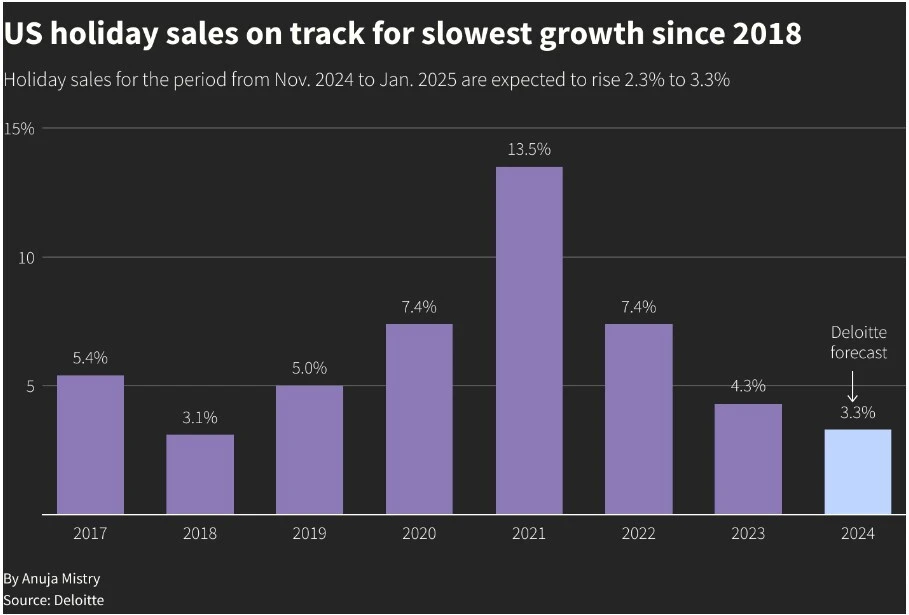
Baisse prévue des ventes pour la saison des fêtes aux États-Unis Source : Deloitte
Se tourner vers TikTok : un nouvel océan bleu pour les vendeurs transfrontaliers
Alors que la concurrence devient de plus en plus féroce sur les plateformes de commerce électronique traditionnelles comme Amazon, TikTok, en tant que représentant du commerce social, commence à devenir un nouveau choix pour les vendeurs transfrontaliers. Grâce à son modèle unique de vidéos courtes et de diffusion en direct pour la vente, il attire un grand nombre de jeunes consommateurs, offrant aux marques une nouvelle façon d'atteindre leur public.
Comparé au modèle de commerce électronique rigoureux d'Amazon, l'approche axée sur le contenu et l'expérience interactive de TikTok permet aux vendeurs d'établir un lien plus direct avec les consommateurs.
De plus, TikTok Shop ne cesse d'étendre son marché mondial. Récemment, TikTok a annoncé son entrée officielle sur le marché espagnol en décembre 2024, renforçant ainsi sa présence dans le commerce électronique en Europe.
Contrairement à Amazon, l'algorithme de recommandation de TikTok diffuse du contenu de manière précise en fonction du comportement des utilisateurs, ce qui permet aux marques de trouver plus rapidement leur public cible et de réduire le temps de conversion.
Sur TikTok, les consommateurs ne se contentent pas de voir des images ou des descriptions de produits, mais découvrent les produits de manière intuitive à travers des vidéos courtes créatives, des diffusions en direct, etc. Ce modèle interactif réduit non seulement le coût de décision pour les consommateurs, mais augmente également la visibilité et l'influence de la marque.

Trouver un équilibre dans une stratégie multi-plateformes
Pour les vendeurs transfrontaliers, il est certes important d'être présent sur des plateformes de commerce électronique traditionnelles comme Amazon, mais le risque de dépendre d'une seule plateforme ne doit pas être négligé. En particulier dans un contexte de changements fréquents de politiques, les vendeurs ont besoin de canaux plus diversifiés pour répartir les risques et assurer une croissance continue de leur activité.
L'essor de TikTok offre aux vendeurs une nouvelle piste de réflexion : comment utiliser les plateformes sociales axées sur le contenu pour améliorer la notoriété de la marque et les ventes, et ainsi obtenir une nouvelle croissance.
En résumé, que ce soit pour faire face aux changements de politiques sur Amazon ou pour trouver de nouveaux points de croissance des ventes sur TikTok, les vendeurs doivent ajuster leurs stratégies avec plus de flexibilité. À l'approche de la haute saison, il est essentiel de suivre de près les évolutions des politiques de chaque plateforme, d'optimiser en temps utile leurs méthodes d'exploitation et de trouver de nouvelles opportunités dans le changement.