 3022
3022Sous la pression des performances de la « course à la rentabilité », Shopee cherche activement de nouveaux leviers de croissance, et l'augmentation de la structure des commissions des vendeurs est devenue l'une de ses mesures clés pour accroître ses revenus et réduire ses coûts. Récemment, Shopee a publié un avis annonçant des ajustements des taux de commission pour les magasins de livraison directe transfrontalière et les entrepôts tiers sur les sites de Malaisie et de Singapour, avec une tendance générale à la hausse des taux.
Sur le site de Malaisie, le taux de commission pour les magasins de livraison directe transfrontalière est passé de 16,2 % à 18,36 %, soit une augmentation de 2,16 points de pourcentage ; le taux de commission incluant la TVA pour les commandes liées aux entrepôts tiers a augmenté de près de 5 points de pourcentage au maximum.
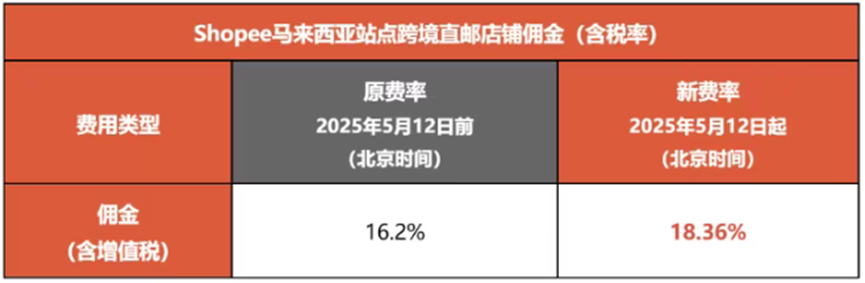
Augmentation des commissions des magasins de livraison directe transfrontalière en Malaisie Source : Cross-border Southeast Asia
En comparaison, l'ajustement sur le site de Singapour est relativement modeste : le taux de commission pour les magasins de livraison directe transfrontalière a augmenté d'un point de pourcentage pour atteindre 14 % ; le taux de commission pour les magasins d'entrepôts tiers a été uniformément relevé à 14 %, avec une augmentation comprise entre 1 et 3 points de pourcentage.
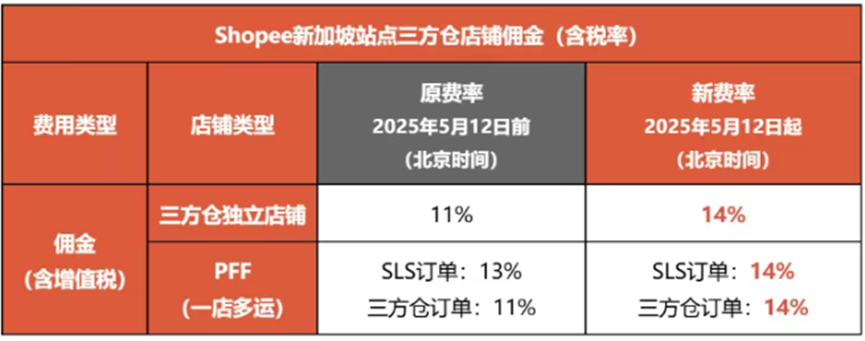
Évolution des commissions des magasins d'entrepôts tiers sur le site de Singapour Source : Cross-border Southeast Asia
Il est particulièrement important de noter que cet ajustement des taux ne s'applique qu'aux commandes générées après le 12 mai 2025. Par conséquent, les vendeurs doivent suivre de près ce changement et ajuster rapidement les prix de leurs commandes pour faire face à l'impact de la modification des taux de commission et assurer le développement stable de leurs activités.
Pression accrue sur les vendeurs
L'augmentation des commissions de Shopee exerce sans aucun doute une pression énorme sur les vendeurs. Ces dernières années, Shopee a fréquemment ajusté ses commissions, et les multiples hausses ont déjà mis les vendeurs à rude épreuve.
En février de cette année, le taux de commission pour les commandes non issues de la boutique officielle sur le site local de Singapour a fortement augmenté. Bien que certains vendeurs bénéficient encore de politiques de commission de base minimales, la charge globale s'est alourdie. Depuis avril, la commission pour la plupart des catégories est passée de 3 % à 6 % à 7 %, avec l'ajout de frais pour certaines catégories de services et de frais supplémentaires d'activité, ce qui a encore réduit la marge bénéficiaire des vendeurs.
Du point de vue de la concurrence sur le marché, la croissance vigoureuse de TikTok Shop sur des marchés comme le Vietnam constitue une menace majeure pour Shopee. Au premier trimestre 2025, les ventes du site vietnamien de TikTok Shop ont augmenté de près de 113,8 % en glissement annuel, et sa part de marché est passée de 23 % à 35 %. En comparaison, bien que les ventes de Shopee aient augmenté de 29,3 %, sa part de marché est passée de 68 % à 62 %. Cette pression concurrentielle se répercute sur les vendeurs, qui doivent non seulement supporter la hausse des coûts due à l'augmentation des commissions, mais aussi faire face à une concurrence de plus en plus intense en matière de délais de livraison.
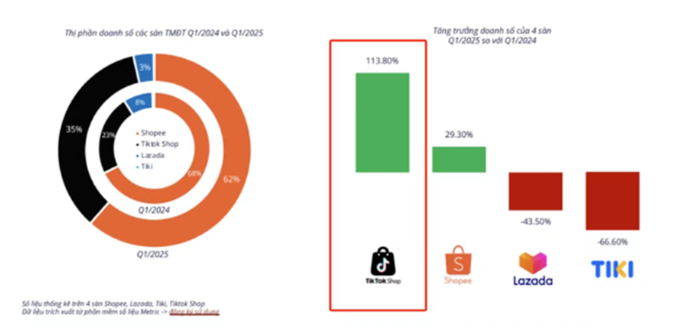
Source : Metric.vn
Par exemple, le site local philippin de Shopee a récemment réduit le délai d'expédition des vendeurs de 1 jour à 0 jour. L'augmentation de la pression logistique oblige les vendeurs à revoir et à ajuster leurs stratégies opérationnelles pour faire face aux défis actuels du marché.
La stratégie de Shopee
L'augmentation des commissions par Shopee répond également à des considérations stratégiques sous-jacentes.
Du point de vue de la plateforme elle-même, pour continuer à optimiser les infrastructures et les services et à élargir les marges bénéficiaires, l'ajustement des commissions est un moyen nécessaire. Le marché du commerce électronique en Asie du Sud-Est est très concurrentiel, et les coûts d'exploitation de la plateforme ne cessent d'augmenter. Shopee a besoin de cette méthode pour maintenir sa compétitivité et sa rentabilité.
Cependant, cette stratégie reflète également, indirectement, le degré de férocité de la concurrence sur le marché. Le développement de concurrents comme TikTok Shop oblige Shopee à agir pour conserver sa position de leader sur le marché.
Source : Google
La voie à suivre pour les vendeurs
Face à la pression de l'augmentation des commissions de Shopee, les vendeurs doivent rechercher activement des stratégies d'adaptation.
Tout d'abord, les vendeurs peuvent optimiser leur structure de produits en sélectionnant des articles offrant des marges bénéficiaires plus importantes pour compenser l'augmentation des coûts due à la hausse des commissions. Ensuite, ils peuvent améliorer l'efficacité opérationnelle et réduire les coûts d'exploitation, par exemple en optimisant les processus de logistique et de livraison pour diminuer les dépenses logistiques. Enfin, les vendeurs peuvent renforcer la construction de leur marque, augmenter la valeur ajoutée et la compétitivité de leurs produits, et attirer davantage de consommateurs grâce à l'influence de la marque, atténuant ainsi dans une certaine mesure la pression liée à l'augmentation des commissions.
Source : Google
Conclusion
L'augmentation des commissions des vendeurs par Shopee est une décision stratégique prise sous la pression concurrentielle du marché, mais elle impose également de nombreux défis aux vendeurs.
En tant que plateforme leader du commerce électronique en Asie du Sud-Est, Shopee doit trouver un équilibre entre les intérêts de la plateforme, ceux des vendeurs et ceux des consommateurs. Ce n'est qu'en réalisant un bénéfice mutuel pour les trois parties que la plateforme pourra assurer un développement stable à long terme, que les vendeurs pourront continuer à opérer et à générer des revenus sur la plateforme, et que les consommateurs pourront bénéficier de produits et de services de qualité.