
 2465
2465Ces dernières années, le marché du commerce électronique en Asie du Sud-Est est devenu le centre d'attention mondial grâce à son taux de croissance impressionnant. Parmi les tendances, l'essor du commerce vidéo est particulièrement remarquable, non seulement en modifiant les habitudes d'achat des consommateurs, mais aussi en offrant de nouvelles opportunités aux plateformes de commerce électronique et aux vendeurs.
Selon les statistiques de Warc, la part du commerce vidéo dans le GMV du commerce électronique en Asie du Sud-Est est passée de moins de 5 % en 2022 à 20 % en 2024. Au marché de Singapour, plus de 60 % des consommateurs déclarent effectuer un achat après avoir regardé une vidéo sur YouTube.
Derrière cette tendance se cachent des changements profonds dans le comportement des consommateurs et des ajustements stratégiques actifs des plateformes.

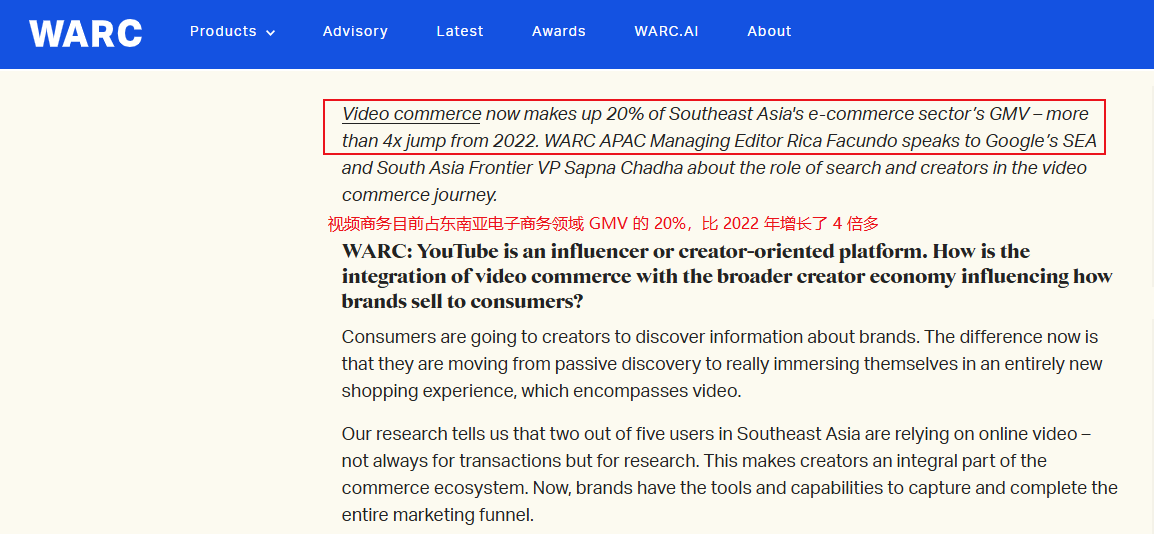
Source : Warc
Un choix inévitable pour un marché jeune
La structure démographique jeune du marché sud-est asiatique offre un terreau naturel au commerce vidéo. Les consommateurs de cette région ont un âge moyen plus bas, une forte dépendance aux plateformes de médias sociaux, et passer plusieurs heures par jour à regarder des vidéos courtes ou des diffusions en direct fait partie de leur quotidien. Comparé au commerce électronique traditionnel, le commerce vidéo est non seulement plus divertissant et interactif, mais il renforce également la confiance des consommateurs grâce aux démonstrations authentiques des créateurs de contenu.
Pour les vendeurs, cette tendance signifie une transformation complète des méthodes marketing. Auparavant, les vendeurs pouvaient compter davantage sur l'optimisation des mots-clés et l'affichage d'images statiques. Aujourd'hui, la qualité et la créativité du contenu vidéo sont devenues essentielles pour attirer les consommateurs. Qu'il s'agisse de démonstrations de produits, de reconstitutions de scénarios d'utilisation ou d'interactions en direct, la vidéo permet de transmettre plus directement la valeur des produits et de raccourcir le parcours de décision des consommateurs. Par conséquent, les vendeurs doivent allouer davantage de ressources à la production et à la promotion de contenu vidéo, en particulier en collaborant avec des créateurs de contenu locaux pour s'aligner sur les préférences du public cible.


Source : Google
La domination de TikTok Shop et les alliances de Shopee
Sur la piste du commerce vidéo, TikTok Shop est sans aucun doute le plus grand gagnant. Grâce à ses fortes propriétés sociales et à ses recommandations algorithmiques précises, le GMV de TikTok Shop en Asie du Sud-Est est passé de 600 millions de dollars en 2021 à 16,3 milliards de dollars en 2023, soit une multiplication par plus de 27. Ce succès repose sur une compréhension approfondie du comportement des utilisateurs par la plateforme. En analysant les préférences d'achat et l'historique de navigation des utilisateurs via des algorithmes, TikTok Shop peut recommander avec précision des vidéos de produits et susciter le désir d'achat.


Source : Google
Cependant, le succès de TikTok Shop a également incité d'autres plateformes à suivre rapidement. Par exemple, Shopee a lancé un programme d'affiliation commerciale en partenariat avec YouTube, permettant aux créateurs de contenu d'intégrer des liens de produits Shopee dans leurs vidéos, que les consommateurs peuvent cliquer pour acheter directement. Cette collaboration offre non seulement aux vendeurs Shopee des canaux d'exposition plus larges, mais ouvre également de nouvelles sources de revenus pour les créateurs YouTube.


Source : ecommercenews
Pour les plateformes, l'explosion du commerce vidéo signifie une escalade dans la bataille pour le trafic. À l'avenir, les plateformes devront optimiser davantage leurs capacités techniques, comme des algorithmes de recommandation plus précis et une expérience de diffusion en direct plus fluide, tout en renforçant la construction de l'écosystème pour attirer davantage de créateurs de contenu et de marques.
Comment tirer parti des avantages du commerce vidéo ?
L'essor du commerce vidéo offre aux vendeurs des opportunités de croissance sans précédent, mais impose également des exigences plus élevées. Tout d'abord, les vendeurs doivent s'adapter à un modèle marketing axé sur le contenu, passant de la « vente de produits » à la « narration d'histoires ». Par exemple, en montrant des scénarios d'utilisation de produits via des vidéos courtes, ou en interagissant en temps réel avec les consommateurs via des diffusions en direct pour répondre à leurs questions.
Ensuite, la collaboration avec des créateurs de contenu locaux devient cruciale. Les consommateurs d'Asie du Sud-Est font davantage confiance aux recommandations des influenceurs locaux (KOL). Les vendeurs doivent donc trouver des créateurs dont l'image correspond à leur marque et établir des relations de collaboration à long terme.
De plus, les capacités de la chaîne d'approvisionnement et de la logistique sont également mises à l'épreuve. Le commerce vidéo peut souvent entraîner une croissance explosive des commandes. Si la chaîne d'approvisionnement d'un vendeur réagit lentement ou si l'expérience logistique est médiocre, cela peut facilement entraîner une perte de clients. Par conséquent, planifier à l'avance les entrepôts et les réseaux logistiques pour garantir une exécution rapide des commandes est un aspect que les vendeurs doivent prendre au sérieux.


Source : Google
Conclusion
L'explosion du commerce vidéo en Asie du Sud-Est n'est que le début. Avec les progrès technologiques et la maturation des habitudes des consommateurs, la part du commerce vidéo dans le GMV du commerce électronique devrait continuer à augmenter. Pour les vendeurs, saisir cette tendance signifie prendre une longueur d'avance sur le marché ; pour les plateformes, l'innovation et la construction de l'écosystème deviendront le cœur de la concurrence.
À l'avenir, nous pourrions voir davantage d'expériences d'achat immersives intégrant les technologies AR/VR, ou des recommandations vidéo personnalisées basées sur l'IA. Quoi qu'il en soit, le marché sud-est asiatique écrit un nouveau chapitre de l'industrie du commerce électronique, et le commerce vidéo en est sans aucun doute l'un des passages les plus passionnants.