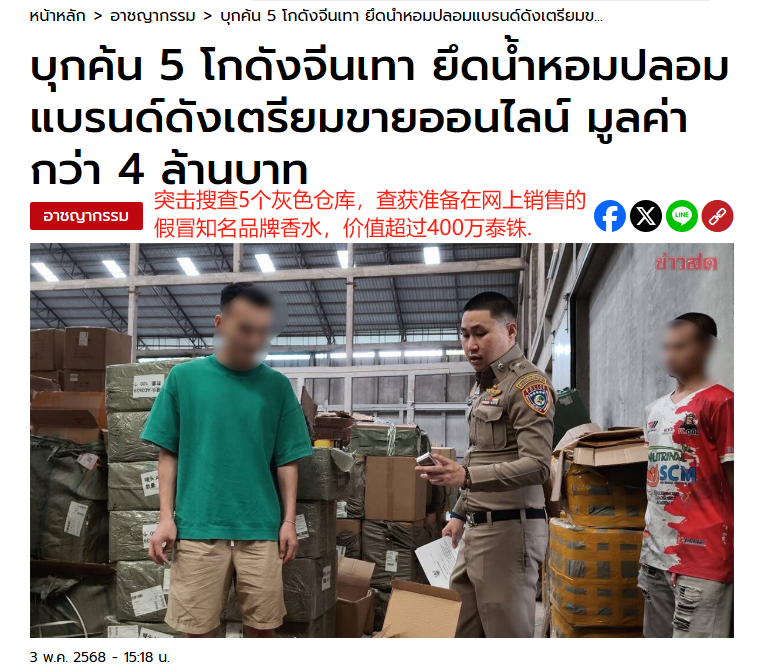
Recently, Thai police launched a crackdown in Bangkok's Rat Burana and Bukkhalo districts, destroying five counterfeit goods warehouses in one fell swoop. A total of 34,806 counterfeit items were seized on site, with a case value as high as 4.36 million baht (approximately 969,000 RMB). Although the packaging of these counterfeits was highly realistic, the actual quality was poor. They had long been entering the market through both online and offline channels, seriously damaging consumer rights and the image of genuine brands.
Five counterfeit goods warehouses destroyed in one operation. Image source: Khaosod
The investigation of this case actually started from an old case. Previously, law enforcement had seized a batch of counterfeit cosmetics and perfumes, and upon further investigation, discovered a cross-border seller specializing in importing counterfeits from overseas. This seller used multiple scattered warehouses to store fake goods and transferred funds through Cambodian bank accounts to cover up the real transaction records.
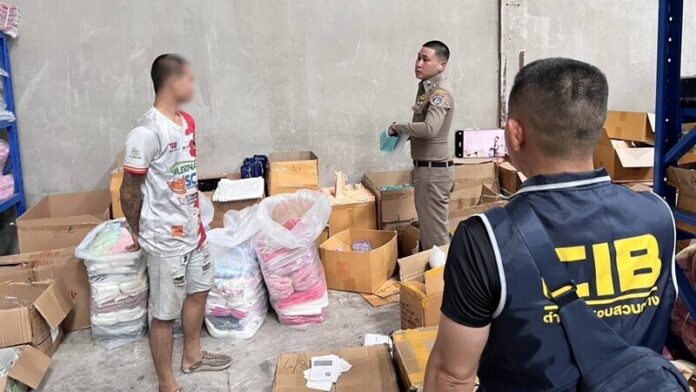
Major General Phattanasak Bupphasuwan, Commander of the Thai Consumer Protection Police Division, revealed that the seller had been operating in Thailand for three years, mainly supplying local wholesalers, who then distributed the goods via e-commerce platforms or physical stores. Because the counterfeit packaging was extremely realistic, ordinary consumers found it difficult to distinguish, resulting in a large number of counterfeits entering the market. The seller involved has now been prosecuted for "jointly distributing unregistered cosmetics and distributing cosmetics without Thai labels without permission," and all evidence has been handed over to the Fourth Division of the Consumer Protection Police.
Scene of the seizure. Image source: Khaosod
This is not the first time Thailand has taken strong action against counterfeiting. According to tax authorities, in 2024, more than 30,000 counterfeit goods cases were investigated nationwide, with a total value of seized counterfeits reaching 445.92 million baht (about 97.56 million RMB), a year-on-year increase of 45.79% in the number of cases. From street vendors to e-commerce platforms, law enforcement's regulatory reach is constantly extending, and several major cross-border smuggling cases have been cracked in just the past six months.
The most direct victims of rampant counterfeiting are consumers. A 28-year-old woman in Ho Chi Minh City, Vietnam, suffered severe facial allergies and bacterial infection after using poor-quality cosmetics purchased online. Similar cases are common in Southeast Asia, especially with skincare and perfume products, as large quantities of unregulated products are quietly circulating through social media and small street shops.
Vietnamese woman hospitalized due to use of inferior cosmetics. Image source: doisongphapluat
Genuine brands are also deeply affected. Japanese medical equipment brand Try And E once faced the embarrassing situation of counterfeits taking over. On Amazon Japan, the brand's genuine oximeters were removed due to a platform misjudgment, while cheap counterfeits flourished. After a lengthy lawsuit, the brand finally received 35 million yen (about 1.74 million RMB) in compensation.
Comparison of genuine and counterfeit oximeter products. Image source: ANN NEWS
This operation by the Thai police once again demonstrates that the risks of cross-border counterfeit sales are increasing.
Whether through covert payment methods or decentralized warehousing strategies, it is difficult to evade regulation for long. For e-commerce sellers, compliant operation has become the only choice, and any attempt to exploit loopholes may face legal sanctions.
Consumers should also remain vigilant and, when purchasing high-value goods, try to choose official brand channels or authorized dealers to avoid losses caused by counterfeits. As global anti-counterfeiting efforts intensify, the survival space for counterfeit goods will further shrink, and the market environment is expected to become more regulated and transparent.