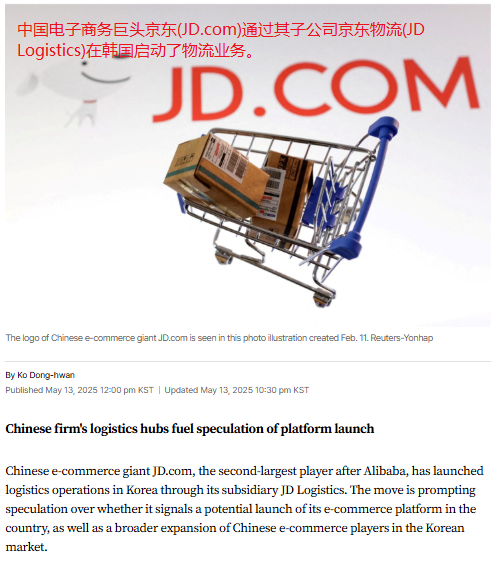
Recently, JD Logistics has been very active in South Korea.

It has established a branch in Seoul and recruited a large number of talents in one go, covering positions from logistics operations and system construction to marketing.

It has also built two self-operated logistics centers in South Korea, located in Icheon and Incheon respectively.

Image source: koreatimes

These two warehouses can help third-party companies handle goods and also provide one-stop supply chain solutions, directly enabling JD to achieve "next-day delivery" or even "same-day delivery" services in South Korea.

If the delivery address is in Seoul or surrounding areas, customers can receive their goods within 12 hours after placing an order. Even Korea's local e-commerce giant Coupang may not be able to achieve this.

Currently, JD's Icheon warehouse has partnered with Korea's well-known pet e-commerce platform Pet Friends, while the Incheon warehouse has cooperated with some local Korean beauty brands and American consumer brands. More than 60% of local orders can be delivered to consumers on the same day.

Image source: Google

From the above, we can see that JD's logistics system entering South Korea brings great benefits. It improves delivery efficiency, shortens the time from purchase to receipt for consumers, and correspondingly reduces the cross-border logistics costs that would otherwise be incurred. This is good news for cross-border sellers who rely on efficient supply chains.

Although JD is currently mainly engaged in logistics in South Korea, the general consensus is that this is their first step into the Korean e-commerce market, and there will be more moves to come. After all, JD's global revenue is more than five times that of Korea's local e-commerce platform Coupang, and its operating profit far exceeds its rival, giving it the confidence to give it a try.

Image source: Google

But if JD wants to achieve greater development, there are many things that need to be considered comprehensively.

In recent years, Temu and AliExpress have seen rapid sales growth in South Korea. Last year, the combined sales of the two platforms in South Korea exceeded 4 trillion won, with nearly 20 million monthly active users.

Therefore, in such a competitive environment, if JD wants to be more "stable" in South Korea, simply improving delivery efficiency is not enough. Real strength must be shown. Logistics advantages are indeed a plus, but to truly penetrate the Korean market, efforts must be made in platform operations, user habits, localization, and other aspects.

Korean consumers have extremely high requirements for service. Price wars are a good strategy, but how to provide a better experience is what JD should focus on.

Image source: Google

For cross-border sellers, if they can seize the opportunity of JD's expansion in South Korea, adjust their business models, and grasp this cross-border opportunity, it will be a great advantage for themselves, and some results can be seen in the short term.

But at the same time, it should be noted that compared with the Chinese market, the Korean market environment is quite different. The population is small, and purchases are not made in large quantities, but rather follow a "boutique" route, placing more emphasis on brand and quality.

Therefore, for some sellers who want to enter this market, it is necessary to conduct market research in advance to see whether their products are suitable for the market, whether the category sells well, and whether there is strong demand.

By selectively choosing some locally popular categories and setting appropriate prices, this path can become broader and broader.