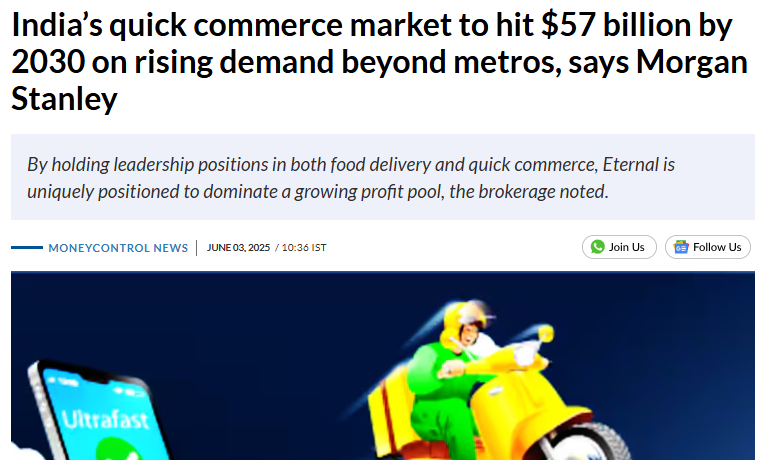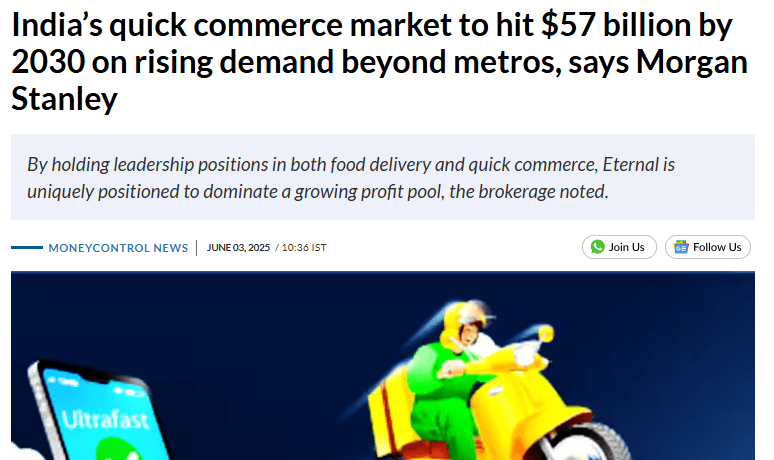
A recent report from international financial services giant Morgan Stanley has added fuel to the already booming quick commerce market in India. The report significantly raised expectations for the market, predicting that by 2030, the size of India’s quick commerce market will soar to an astonishing $57 billion (approximately RMB 409.3 billion), far higher than the previous forecast of $42 billion.
Meanwhile, Morgan Stanley has also raised its forecast for the total order value (GOV) in India’s quick commerce sector for fiscal years 2026-2028 by 9%-10% overall, highlighting the sustained and unexpectedly strong growth momentum in the market.

Image source: moneycontrol
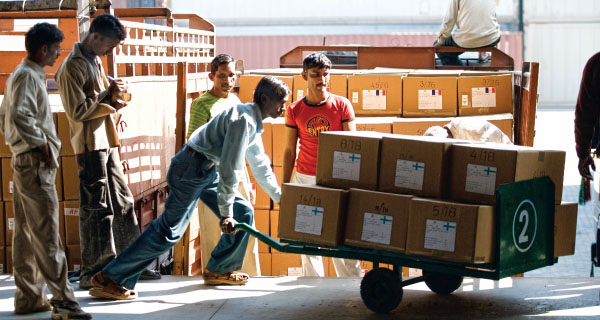
The core driving force behind this explosive growth comes directly from Indian consumers’ extreme desire for “speed.” As India’s population continues to grow and urbanization accelerates, the rising time cost caused by traffic congestion is making urban dwellers increasingly reliant on online platforms for quickly obtaining daily necessities.
Survey data from market research agency LocalCircles clearly confirms this trend: among more than 70,000 consumers who buy groceries online, as many as 73% regard cost-effectiveness and “delivery speed” as key decision factors, second only to product quality (86%). “Order online, receive immediately” has become a rigid demand.

Image source: google
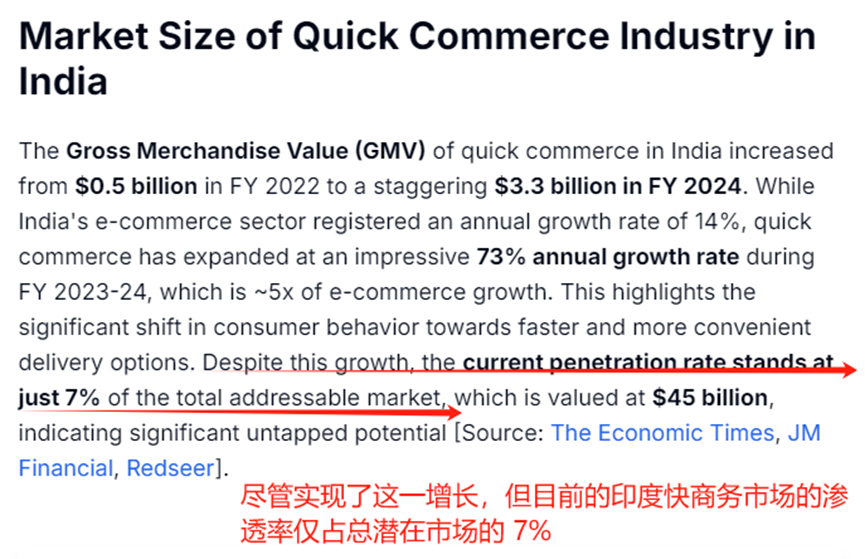
Despite the rapid growth momentum, the potential of India’s quick commerce market is far from fully unleashed. The report points out that the current penetration rate of the industry is only about 7% of the entire potential market.
This means that this still-to-be-deeply-developed blue ocean is like a giant gold mine full of infinite opportunities, attracting sharp-sensed e-commerce giants to rush in and accelerate their layout. A fierce competition around “minute-level delivery” has already begun.

Image source: ctfe
India’s local e-commerce giant Flipkart is one of the pioneers in this speed race. Last September, it took the lead in launching the “Flipkart Minutes” express delivery service in parts of Gurgaon and the Delhi National Capital Region (NCR), promising delivery within 10-16 minutes. The expansion plan was immediately launched, and its Chief Corporate Affairs Officer Rajneesh Kumar announced at the end of the year that the service would be extended to more major cities and tier-2 cities.

Image source: my startup life
Global e-commerce giant Amazon is also unwilling to lag behind, and even seems somewhat urgent. Facing competitors’ lead, Amazon advanced the launch of its quick commerce service originally scheduled for the first quarter of this year. At the end of last year, its “Amazon Now” service was secretly tested in parts of Bangalore, with most orders successfully delivered within 10 minutes. In February this year, the service was officially launched nationwide in India, marking Amazon’s official entry into this race against time.
However, new entrants face a market that has already been preliminarily divided by two major players. Currently, Blinkit and Swiggy firmly occupy the dominant position in India’s quick commerce market, with their combined market share exceeding 60%. Giants like Flipkart and Amazon, if they want to catch up, must wage a tough battle in user experience, delivery network, and market share.

Image source: internet
The competition in India’s quick commerce market is essentially a blitzkrieg around consumers’ demand for “instant gratification.” Driven by the strong expectations of a massive $57 billion market, both new and established giants are rapidly expanding networks, optimizing algorithms, and improving fulfillment efficiency. From Flipkart Minutes’ lightning expansion to Amazon Now’s rapid entry, all highlight the intensity of this contest.
Although Blinkit and Swiggy are temporarily ahead, with heavyweight players like Flipkart and Amazon entering with vast resources, and the vast space indicated by only 7% penetration rate, who will ultimately dig deepest in this boiling gold mine and have the last laugh? The answer is far from revealed, but this contest of speed and capital is bound to profoundly reshape the daily lives of hundreds of millions of Indian consumers.