The new company RWB, formed by the merger of Russian e-commerce giant Wildberries and Russ, is accelerating its internationalization. At the St. Petersburg International Economic Forum, Robert Mirzoyan, CEO of the Russian Central Bank, announced that RWB plans to enter the African market, having already successfully expanded into new markets such as Georgia, Tajikistan, and the UAE.
Mirzoyan emphasized that the company's current top priority is to consolidate its position in existing markets while actively exploring developing countries, with Africa set to become the next key target. This strategy reveals Wildberries' strong interest in the markets of southern hemisphere countries.
Image source: Internet
New Front in Africa, Another Step in Global Expansion
Wildberries' globalization strategy follows a gradual path. Its business now covers nine countries, including traditional markets like Russia, Armenia, and Belarus, as well as newly developed markets such as China and the UAE.
In these emerging markets, Wildberries adopts a cautious approach: in China and the UAE, it only conducts import business, recruiting Chinese sellers to join and introducing UAE consumer electronics suppliers.
This layout model aligns with the strategic thinking of founder Tatyana Kim. She has stated that although she is interested in many emerging markets, considering practical limitations such as underdeveloped transportation, initial expansion prioritizes neighboring countries and relatively mature markets.
Competitors have already made moves in the African market. Alibaba launched its first African e-commerce platform in Morocco in 2024, helping local manufacturing and export companies expand into international markets. Wildberries' entry will change the landscape of African e-commerce.
Image source: hi-tech.mail.ru
Performance Soars, Russia's E-commerce King Rises
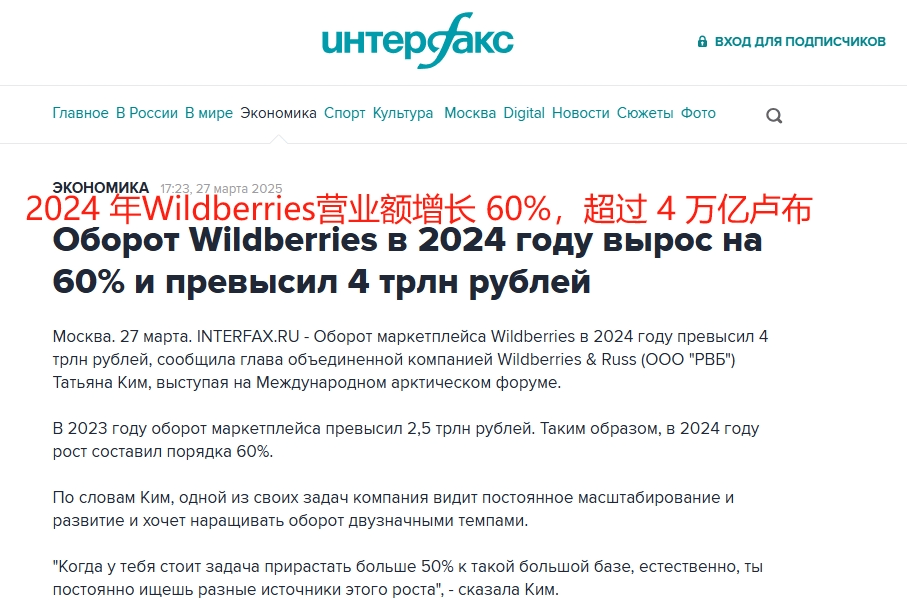
Wildberries' international ambitions are built on a strong performance foundation. The latest financial report shows that in 2024, Wildberries' turnover exceeded 4.1 trillion rubles, a 60% surge from 2.5 trillion rubles in 2023.
This growth has enabled it to surpass the X5 Group, becoming Russia's largest retailer by turnover. Even more remarkable is its net profit, which grew 3.5 times year-on-year to 104 billion rubles, while platform seller income also soared by 44% to 2.9 trillion rubles.
Behind this explosive performance is massive strategic investment. In 2024, the company invested over 150 billion rubles (about 11.7 billion yuan), focusing on logistics, IT infrastructure, and advertising resource expansion.
Image source: interfax
These funds mainly flow into three key areas: logistics network expansion and upgrading, IT infrastructure strengthening, and advertising resource expansion. RWB plans to double its investment in 2025 to further enhance the platform's overall competitiveness.
The platform's full opening to Chinese sellers has become an important growth point. At the end of 2024, Wildberries completed the onboarding test for Chinese sellers, and now Chinese sellers can register and join the platform independently.
Wildberries offers Chinese merchants two models: direct cross-border shipping and warehouse shipping, with the payment cycle shortened to just 7 days and support for automatic RMB settlement.
Image source: Internet
Technology-Driven, Emerging Businesses Flourish
Wildberries' growth engine is driven by multi-business synergy. The company's development model is built on three pillars: regional expansion, service diversification, and technological innovation.
There have been frequent moves in technological innovation. Wildberries has launched new personalized sections in its mobile app, using AI technology to provide users with precise product recommendations and discount information.
This feature offers consumers great deals, current discount product recommendations, and creates themed shelves based on different needs.
Image source: tass
Fintech has become a new pillar of the business ecosystem. The company has independently developed and jointly launched several innovative financial services with partner banks, including online credit, consumer insurance, WB Wallet, CLUB membership subscriptions, and BNPL (Buy Now, Pay Later) services.
The digital advertising business has also made significant progress. The company is accelerating the expansion of digital outdoor advertising resources, introducing high-tech procurement methods such as programmatic advertising and algorithmic models, as well as new advertising monitoring and analysis tools.
Wildberries' platform competitiveness is also reflected in its logistics system. They have developed a unique delivery model of central warehouses, city warehouses, and pick-up points, with multiple central warehouses in core cities such as Moscow and St. Petersburg.
The efficient logistics network has achieved a daily processing capacity of 5 million orders, enabling 90% of orders to be delivered within a 10-kilometer radius.
Image source: Internet
Wildberries' expansion is keeping pace with the explosive growth of Russia's e-commerce market. According to a survey by research institute Weddankir, 93.4% of Russian consumers are aware of the platform, with a usage rate as high as 84.5%, firmly ranking it first in the market.
With the launch of its Africa market strategy, this Russian e-commerce giant will face competitors like Alibaba, who have already established a presence in Africa. Its trump cards are: an annual transaction volume of 4 trillion rubles, doubled infrastructure investment, and a core international settlement system that bypasses SWIFT.
The aurora of the global e-commerce map is quietly spreading towards the equator.