 681
Recently, Shopee announced that it is further expanding its logistics network in Brazil, opening 4 new cross-docking centers and expanding the operating area of its existing transfer center in Piracicaba, São Paulo state, to 3 times its original size. This adjustment adds the capacity to handle 2.4 million orders per day, and Shopee's order processing capacity in Brazil has also increased by 60% compared with the November 2025 shopping season.
This means Shopee is preparing in advance for Brazil's year-end shopping peak. This logistics expansion has also shown the outside world the platform's determination to continue deepening its presence in the Brazilian market.
Image source: Reuters
Logistics network expansion brings the number of Brazil distribution centers to 30
The 4 newly added distribution centers are located in Recife, Rio de Janeiro, Vitória, and Blumenau. In addition, Shopee has expanded its existing transfer center in Piracicaba, increasing its operating area to 3 times its original size.
After the expansion is completed, Shopee will have 30 distribution centers in Brazil, a clear increase from 16 a year earlier. These include 25 cross-docking centers and 5 fulfillment centers.
These two types of logistics facilities handle different tasks. Cross-docking centers are mainly responsible for receiving, sorting, and transferring goods; products usually are not stored there for long periods, but are sent to the next stop as soon as possible after sorting.
In addition, Shopee has also set up more than 200 first-mile and last-mile logistics hubs in Brazil, as well as more than 5,000 Shopee agent service outlets, further extending the coverage of its logistics network. From product pickup and sorting/transfer to last-mile delivery, these facilities together support the platform's local logistics operations.
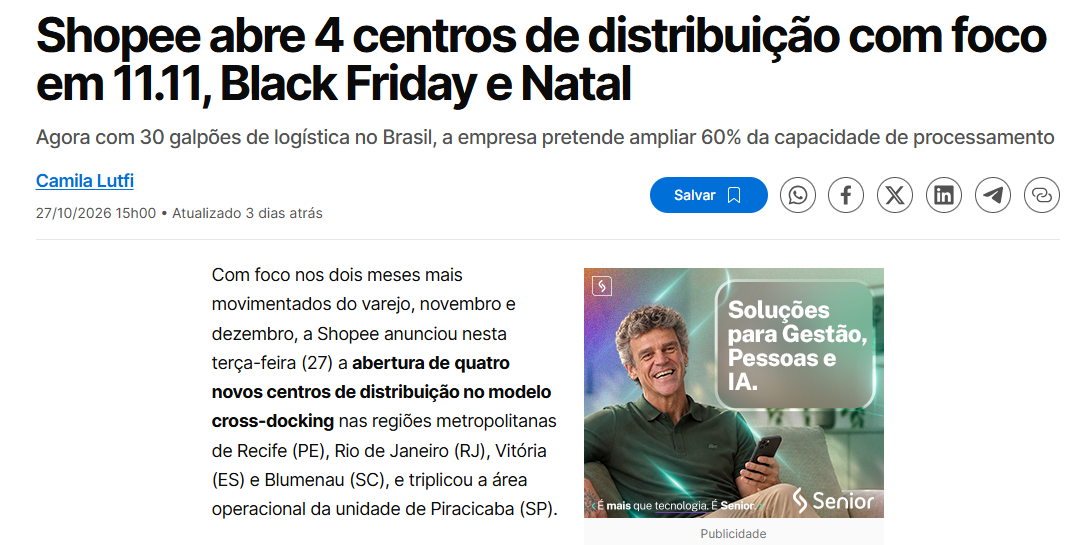
Image source: infomoney
Expanding before major promotions, logistics must be able to handle orders first
Shopee's expansion of its logistics network this time is directly related to Brazil's year-end shopping peak.
Every year, 11.11 in November and Black Friday are important promotion moments in Brazil's e-commerce market, followed by year-end consumption demand such as Christmas.
For the platform, order volume tends to grow in a concentrated way during this period. If logistics processing capacity cannot keep up, even if consumers have a strong willingness to place orders, there may be problems such as reduced shipping and delivery efficiency.
Image source: online
Continuing to deepen its presence in Brazil, local sellers become important support
Shopee entered the Brazilian market in 2020 and, after several years of development, has become one of the local major e-commerce platforms.
According to information published by the platform, Shopee currently has more than 3 million local sellers in Brazil, and these sellers contribute about 95% of the platform's transaction volume. In addition, the platform has more than 1,800 official stores.
Local sellers accounting for a relatively high share of transactions also means that Shopee's business growth is closely related to the operating conditions of local merchants. For these sellers, the improvement of the platform's logistics network not only may increase the speed at which consumers receive goods, but also means they can use the platform's existing warehousing and distribution facilities to reach consumers in more regions.
Especially for small and medium-sized sellers with relatively limited scale, building their own warehousing and logistics networks requires considerable costs. The fulfillment services provided by the platform can, to a certain extent, lower the threshold for them to expand into the market.
From this perspective, Shopee's expansion of logistics facilities is both preparation for major promotions and further improvement of the operating foundation between the platform and local sellers.
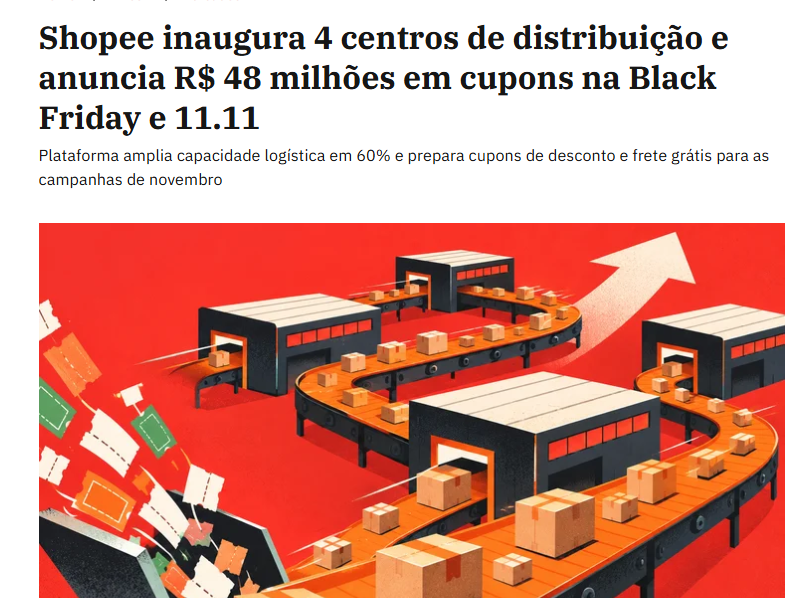
Image source: exame
From this move, it can be seen that Shopee's competitive approach in Brazil is no longer just attracting consumers through coupons and promotional activities; it is also continuing to fill gaps in logistics infrastructure.
For e-commerce platforms, traffic can bring orders, but whether orders can ultimately be completed smoothly still requires the joint support of warehousing, sorting, transportation, and last-mile delivery. Especially in a vast market like Brazil, the coverage and operating efficiency of the logistics network have an important impact on the platform's long-term operations.
As the year-end major promotions approach, whether Shopee's continuously expanding logistics network can smoothly handle order growth remains to be tested by market performance. But what is certain is that in competition in the Brazilian e-commerce market, logistics has become an important area into which the platform continues to invest.