 74
74On October 9, Shopify announced the expansion of logistics services for European merchants and launched a series of new order fulfillment features. The goal is straightforward—let merchants spend less time switching back and forth between systems when peak season arrives, and more time on things that truly create value.

Image source: Internet
First, let's talk about the most 'everyday' part of this update. Shopify has significantly enhanced its ability to process orders in bulk. Merchants can filter and process up to 250 orders at once in the admin, print all shipping labels and packing slips in bulk, and no longer need to do it manually one order at a time.
The system also integrates picking lists, so warehouse or store staff can quickly find the corresponding products according to the list and then move directly into packing and shipping.
For sellers using Shopify Flow, they can also select the appropriate carrier and delivery service through automated workflows, handing repetitive decisions such as 'which courier to choose and which service to use' over to the system, reducing manual steps.
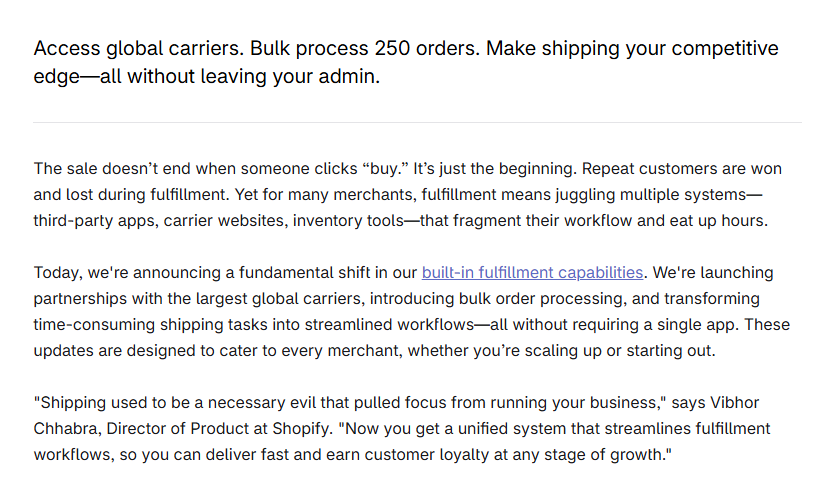
Image source: shopify
These features cover all Shopify plans and do not require an additional third-party app subscription or monthly fee, which is a fairly practical improvement for small and medium-sized sellers.
Cameron McKnight, Shopify's Vice President of Product, also mentioned when discussing this update that merchants can complete the entire chain from picking, packing, to shipping at once, which is especially useful during peak season when orders surge.
The expansion of logistics services is another highlight of this update. Shopify has expanded its partnership with DHL. DHL Express now covers Germany, the United Kingdom, France, Italy, and Spain, and can handle local and international shipments; DHL eCommerce has added two new markets, Poland and the Netherlands.
For merchants in the Netherlands and Poland, this is the first time they can use DHL's logistics services directly on the Shopify platform, rather than needing to rely on third-party apps or log in to a separate DHL account to process orders as in the past.
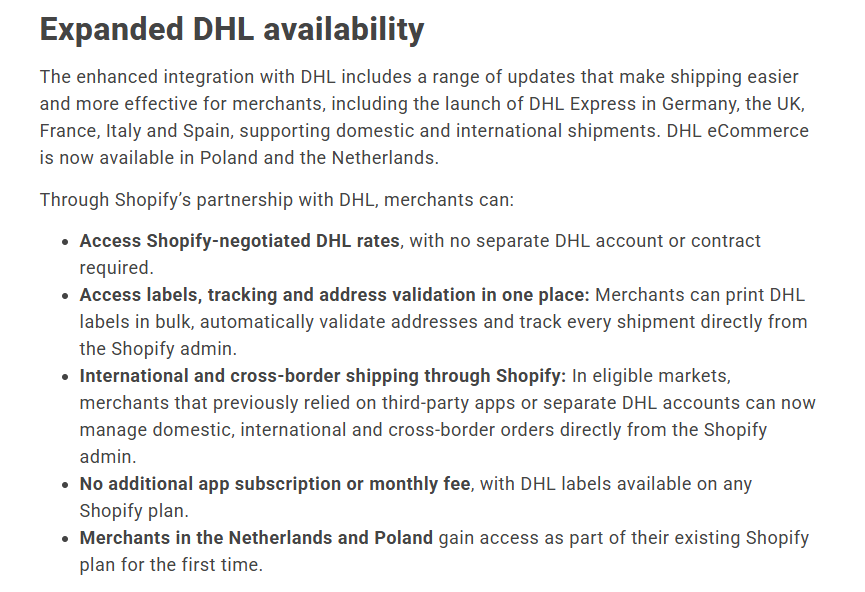
Image source: channelx
One detail worth noting is that merchants can now directly use the logistics rates negotiated between Shopify and DHL, without registering a separate DHL account or signing an additional contract. In other words, even a small merchant just starting out can get platform-level negotiated shipping rates.
Logistics operations are also further centralized in the Shopify admin: merchants can print DHL shipping labels in bulk, automatically validate recipient addresses, and directly view and track the shipping status of each shipment.
For eligible markets, local, international, and cross-border order management that previously required jumping to a third-party app can now be handled in a one-stop manner in the Shopify admin.

Image source: channelx
From the perspective of merchants' actual operations, the value of this 'admin integration' lies in reducing friction. The trouble with logistics often is not how difficult any single action is, but that you need to switch back and forth between multiple systems, repeatedly enter information, and check statuses one by one.
Of course, the service details available to merchants in different markets are not exactly the same. DHL Express mainly covers shipping locations in Germany, the United Kingdom, France, Italy, and Spain, and supports domestic, intra-EU, and international shipping outside the EU.
DHL eCommerce's availability in Poland and the Netherlands has some specific limitations. For example, DHL eCommerce in Poland currently does not support local shipping within Poland; it only supports shipping to other EU countries. Parcels need to be delivered to DHL lockers, and door-to-door pickup is not supported. Before enabling it, merchants should check their own market and shipping location to confirm the specific service scope and requirements.
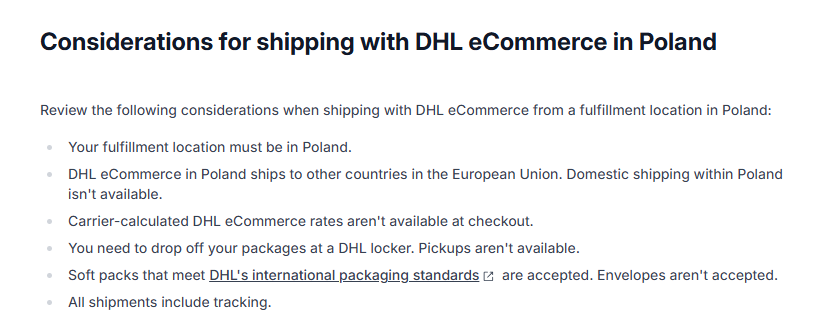
Image source: shopify
Overall, Shopify's move this time can be understood as an 'infrastructure reinforcement.' It did not tell any grand story, but instead focused its efforts on specific and tedious areas such as bulk processing, label printing, picking lists, and automated carrier selection.
For European merchants preparing for the holiday peak season, these tools may not solve all logistics challenges, but at least they can reduce some repetitive work in daily operations and add more certainty.
As for how much efficiency improvement these features can bring in actual use, merchants may need to wait until peak season has truly run its course before giving their own answers.