 71
01
Amazon has taken its business to before the order is placed
Temu quickly became popular in overseas markets with low-priced goods, putting competitive pressure on Amazon.
In November 2024, Amazon launched its low-price shopping channel Amazon Haul, and then in November 2025 launched the standalone shopping app Amazon Bazaar, continuing to expand into the low-price market.
However, Amazon's latest move is no longer aimed only at products and prices.
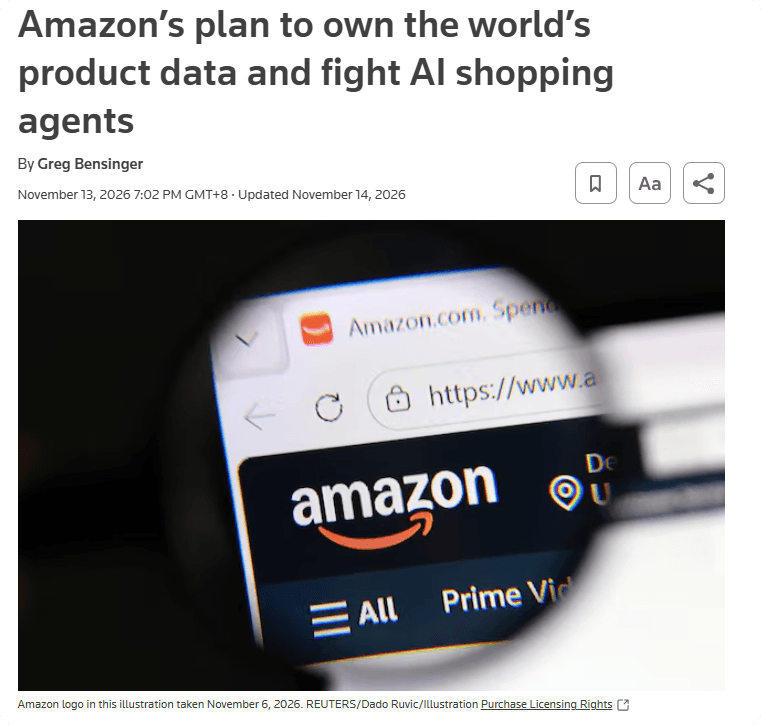
According to Reuters, Amazon is considering launching an initiative called World Product Graph, preparing to build a database of global products. Even products not sold on Amazon may be included.
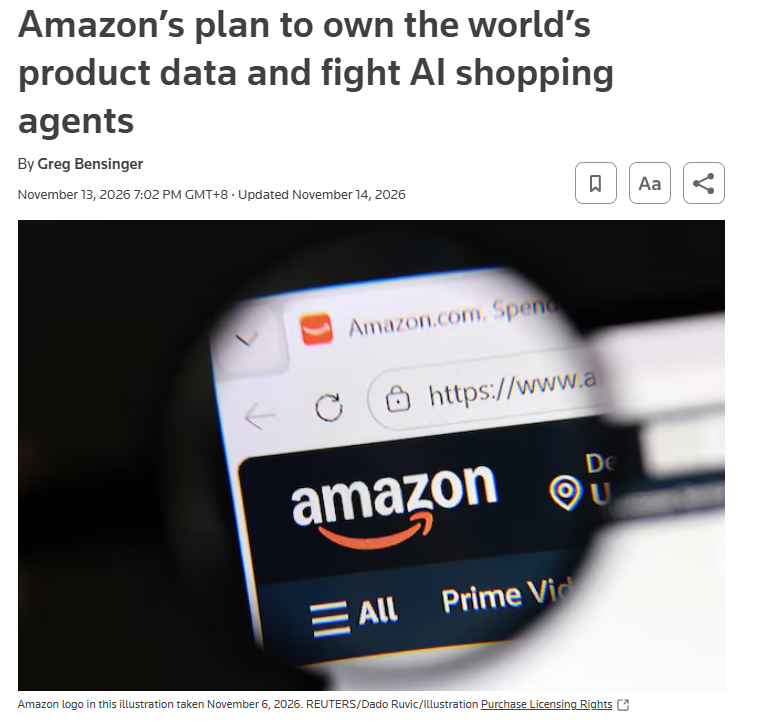
Image source: Reuters
Why should an e-commerce platform care about products it doesn't sell?
It's not hard to understand. Many consumers don't know what they want to buy from the start.
For example, when preparing to buy a coffee machine, they may first search Google for product recommendations, then visit brand websites to learn the specifications and read other consumers' reviews, and only then open Amazon to compare prices and delivery times.
What Amazon wants to do is keep this shopping process on its own platform as well.
A Morgan Stanley survey shows that at the beginning of product research, 57% of surveyed online shoppers prioritize Google, while only 16% choose Amazon. When consumers already know exactly what they want to buy, 41% start searching on Amazon, higher than 23% on Google.
The two sets of data reflect a difference: when consumers are still choosing products, they are more accustomed to getting information through search engines; once they have a clear purchase target, Amazon's advantage gradually emerges.
Therefore, Amazon's hope to include more off-Amazon products is not to move all products into its own store, but to make consumers think of Amazon first when choosing products.
Image source: investing
In fact, Amazon has already made some moves in this area.
This year, the platform further integrated its AI shopping assistant, allowing consumers to directly describe their needs, with AI recommending products, comparing prices, and checking historical prices.
At the same time, Shop Direct is also gradually integrating products from off-site merchants; consumers can jump to merchants' official websites to buy, and some products also support Amazon purchasing on their behalf through Buy for Me.
From AI shopping guides to off-site product integration, Amazon is trying to connect the steps of finding products, choosing products, and purchasing.
Image source: Google
02
It's not just Amazon—everyone is competing for the shopping entry point
Looking at the entire e-commerce industry, you'll find that similar arrangements are not uncommon.
Walmart expanded its AI shopping assistant Sparky in October this year. Consumers can describe their needs through text or images, let AI help find products, and also receive shopping suggestions based on nearby store inventory.
Alibaba in China is also advancing similar attempts.
In May this year, Taobao and Tmall's product catalogs were connected to Qwen. Consumers can find products and compare styles through conversation, then enter Taobao to complete the purchase. AI is responsible for understanding needs, while Taobao ecosystem platforms provide products and transaction services.
Shopify's approach is different. It wants to help merchants bring products into the AI tools consumers commonly use.
Eligible products can appear in channels such as ChatGPT, Google AI Mode, and Gemini, giving consumers a chance to discover these products even if they do not actively open the merchant's website.
Although the specific practices of each platform differ, the direction is actually fairly consistent: wherever consumers raise shopping needs, platforms want to provide products and services there.
Image source: walmart.
03
Sellers need to pay attention to opportunities for products to be discovered
For cross-border sellers, these changes are worth paying attention to.
In the past, sellers focused more on how products could gain platform search rankings, how to enter recommendation traffic, and how to improve order conversion rates. But as AI gradually participates in shopping decisions, whether products can be accurately identified, understood, and recommended may also become a new competitive factor.
This places higher demands on product information. Product titles, specifications, feature characteristics, applicable scenarios, and the differences between different models all need to be as clear as possible. After all, for AI to help consumers choose products, it first needs to accurately understand the products.
Of course, the World Product Graph is still at the planning stage, and AI shopping is still in the process of development. How many additional orders it can bring specifically cannot be concluded for now.
But it can be seen that competition among e-commerce platforms is gradually extending from after consumers decide to buy to before purchase. For sellers, the future may require considering not only how to make products appear in front of consumers, but also how to make products discoverable and understandable through more shopping entry points.