Ce document se concentre sur le marché étranger des solutions intelligentes adaptées au vieillissement, en analysant en profondeur l'état actuel du marché, les orientations des produits innovants et les cas d'entreprises chinoises à l'international, dans le but de fournir aux entreprises concernées des perspectives de marché complètes et des références stratégiques. Le contenu est le suivant :
1. État actuel du marché étranger des solutions intelligentes adaptées au vieillissement
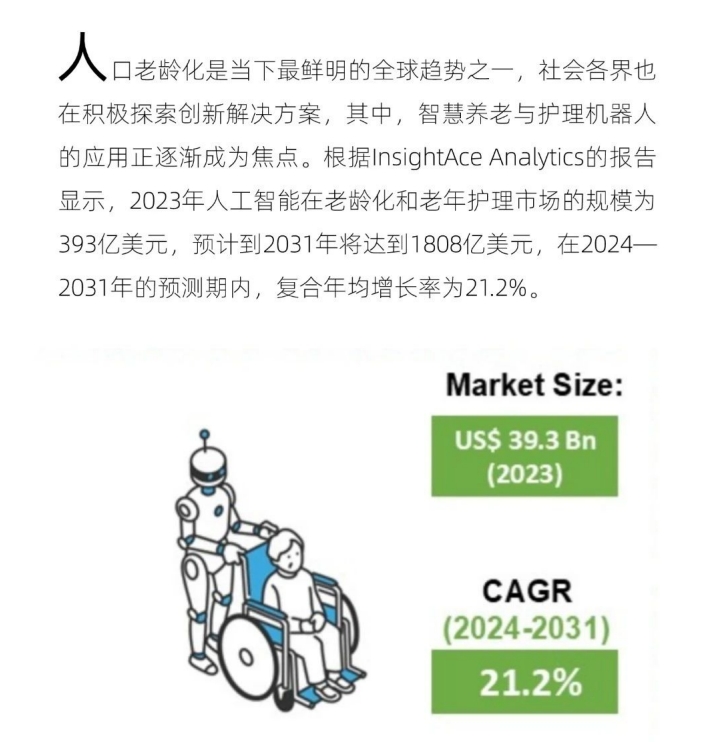
- Taille du marché et tendances de croissance : En 2023, la taille du marché de l'intelligence artificielle dans le vieillissement et les soins aux personnes âgées était de 39,3 milliards de dollars, avec une prévision de 180,8 milliards de dollars d'ici 2031, et un taux de croissance annuel composé de 21,2 % entre 2024 et 2031.
- Opportunités de soins à domicile : Près de 90 % des personnes âgées préfèrent vieillir chez elles, et les technologies de soins intelligents peuvent résoudre les problèmes de sécurité. Les régions développées d'Europe et d'Amérique sont matures dans ce domaine.
- Caractéristiques du marché régional
- Marché nord-américain : Part importante des revenus des soins par IA, utilisation généralisée de la télémédecine et des mégadonnées, fort intérêt pour l'intelligence artificielle et la robotique, les robots de service pouvant fournir divers services à domicile.
- Marché européen : L'Allemagne promeut les technologies de santé numériques et les systèmes de maison intelligente, et lance des projets d'innovation en soins ; la Suède favorise des projets pilotes de numérisation intelligente pour les soins communautaires aux personnes âgées, et élabore une stratégie nationale pour l'IA et un plan de santé électronique.
2. Orientations des produits innovants pour les solutions intelligentes adaptées au vieillissement à l'étranger en 2024
- Sécurité et protection à domicile
- Détection et prévention des chutes : Des capteurs portables ou pendentifs peuvent détecter les chutes et alerter, certains incluent un suivi GPS, les systèmes de sécurité domestique intègrent plusieurs capteurs, et l'éclairage intelligent ainsi que les assistants vocaux renforcent la sécurité.
- Gestion des médicaments : Des distributeurs de pilules électroniques avec alarmes et rappels, pouvant notifier les soignants en cas d'écart, mais ne remplaçant pas les examens professionnels.
- Hygiène et santé
- Dispositifs de surveillance : Des appareils portables intelligents suivent les paramètres de santé, fournissant des données en temps réel pour aider à détecter les problèmes précocement.
- Soins personnels et hygiène : Par exemple, des baignoires intelligentes, des robots de soins, etc., améliorent l'indépendance et la commodité des soins personnels.
- Stimulation cognitive : Des applications d'entraînement cérébral numérique, des dispositifs de musicothérapie, des expériences de réalité virtuelle, etc., peuvent stimuler la cognition et maintenir la vivacité d'esprit.
- Participation sociale et connexion
- Smartphones et tablettes adaptés aux personnes âgées : Avec des fonctions d'assistance, de grands écrans et des interfaces simplifiées, faciles à utiliser pour les seniors.
- Réalité virtuelle et jeux : La VR offre de nouvelles voies de divertissement social pour les personnes âgées à mobilité réduite, et les jeux favorisent les interactions sociales et les défis cognitifs.
3. Cas et stratégies d'entreprises chinoises à l'international
- Zuo Keji : Spécialisée dans les soins intelligents pour les personnes âgées dépendantes, avec des produits incluant des robots de soins intelligents pour l'hygiène, etc. La stratégie d'internationalisation est déterminée par l'itération des produits et les études de marché, adoptant d'abord un modèle B2B puis B2C, s'appuyant sur des distributeurs étrangers pour résoudre les problèmes de service après-vente. En 2023, les revenus à l'international représentaient 40 %.
- Maidesite : Axée sur les dispositifs de réadaptation médicale à domicile, avec les marques Mateside et VOCIC. Les produits à prix élevé misent sur le marketing de marque, tandis que ceux à bas prix misent sur le rapport qualité-prix pour étendre le marché, en accumulant une réputation de marque grâce à des produits et services de qualité. Certains de leurs produits sont populaires à l'étranger.